




























Views
Downloads

Simple Machines Worksheet | Grade 3-4 Printable Science

Paste this activity's link or code into your existing LMS (Google Classroom, Canvas, Teams, Schoology, Moodle, etc.).
Students can open and work on the activity right away, with no student login required.
You'll still be able to track student progress and results from your teacher account.
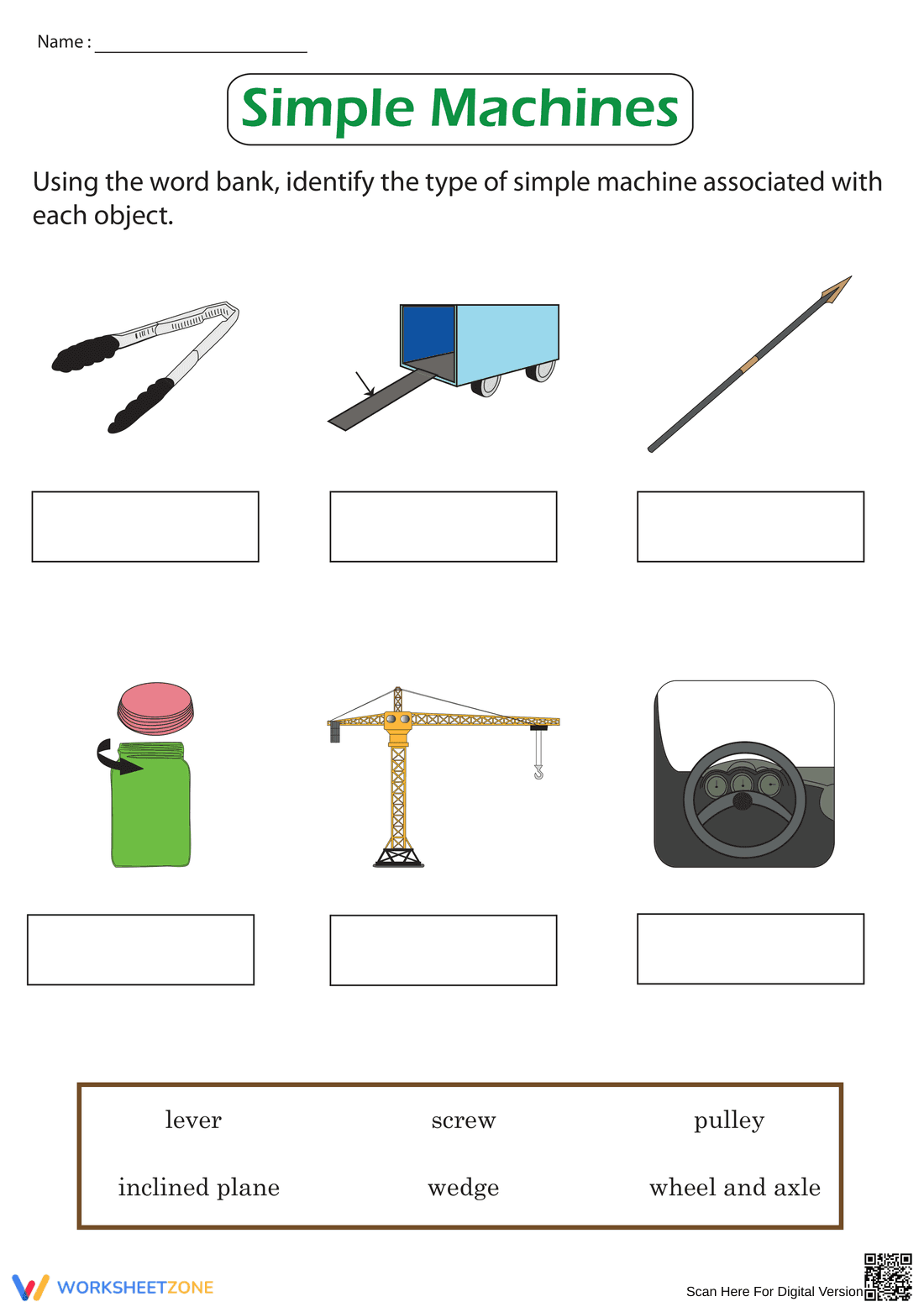
Identify and categorize the fundamental mechanical advantages found in everyday life with this focused science worksheet. Students analyze realistic illustrations to determine which of the six simple machines—lever, screw, pulley, inclined plane, wedge, or wheel and axle—is being utilized. This activity builds the critical bridge between abstract physical science concepts and tangible engineering outcomes.
At a Glance
- Grade: 3-4 · Subject: Science
- Standard:
3-PS2-1— Identify evidence of the effects of balanced and unbalanced forces on object motion- Skill Focus: Simple Machine Identification
- Format: 1 page · 6 problems · Answer key included · PDF
- Best For: Introduction to forces and motion units
- Time: 10–15 minutes
What's Inside
This single-page PDF features six clear, high-quality illustrations of common objects that represent mechanical systems. To support vocabulary acquisition and reduce cognitive load, a convenient word bank is provided at the bottom of the page, listing all six simple machine types. The resource includes a full-color answer key for rapid grading or student self-correction, making it ideal for independent workstations or small group review.
Zero-Prep Workflow
- Print: Generate the single-page document in under 30 seconds.
- Distribute: Hand out to students; the integrated word bank ensures they can begin immediately without teacher-led vocabulary drills.
- Review: Utilize the provided answer key to correct student work in less than two minutes total.
This streamlined process makes the worksheet an ideal selection for substitute teacher folders or as a reliable bell-ringer activity.
Standards Alignment
Aligned primary to 3-PS2-1, this resource helps students identify the tools and machines that manipulate forces to perform work. It also supports 4-PS3-4 by providing a foundation for understanding how energy is transferred through mechanical systems. Both standard codes can be copied directly into lesson plans, IEP goals, or district curriculum mapping tools to ensure instructional compliance and tracking.
How to Use It
Use this worksheet as a formative assessment immediately following a direct instruction session on the six types of simple machines. It serves as an excellent check for understanding before moving into more complex lab investigations or engineering design challenges. Teachers should observe whether students can distinguish between the wedge (represented by the spearhead) and the inclined plane (the truck ramp) as a key diagnostic of conceptual mastery. Expected completion time is 15 minutes.
Who It's For
This resource is specifically tailored for 3rd and 4th-grade students beginning their exploration of physical science and basic mechanics. It provides necessary scaffolding through visual cues and word banks for English Language Learners (ELL) and students requiring specific instructional accommodations. Pair this worksheet with a physical scavenger hunt around the classroom for a comprehensive multisensory lesson.
According to the ScienceDirect TpT Analysis, instructional materials that utilize high-contrast visual identification alongside word-bank scaffolding significantly improve the retention of specialized technical vocabulary in elementary science learners. This worksheet targets the 3-PS2-1 standard, requiring students to observe the effects of force and mechanical advantage in static real-world objects. By bridging the gap between abstract physics and everyday items—such as cranes, steering wheels, and tongs—the resource facilitates the "concrete-to-abstract" cognitive transition essential for 8 to 10-year-olds. The inclusion of an answer key supports the iterative feedback loops identified by Fisher & Frey (2014) as a cornerstone of effective guided practice. This printable science tool ensures that 3rd and 4th-grade students develop a robust mental library of mechanical archetypes, providing the necessary prerequisite knowledge for higher-order engineering design and complex system analysis in middle school. It empowers educators to assess force-related concepts efficiently while maintaining high standards for technical accuracy.


