




























Views
Downloads

Identify Magnetic Objects Worksheet | Grade 2 Essential

Paste this activity's link or code into your existing LMS (Google Classroom, Canvas, Teams, Schoology, Moodle, etc.).
Students can open and work on the activity right away, with no student login required.
You'll still be able to track student progress and results from your teacher account.
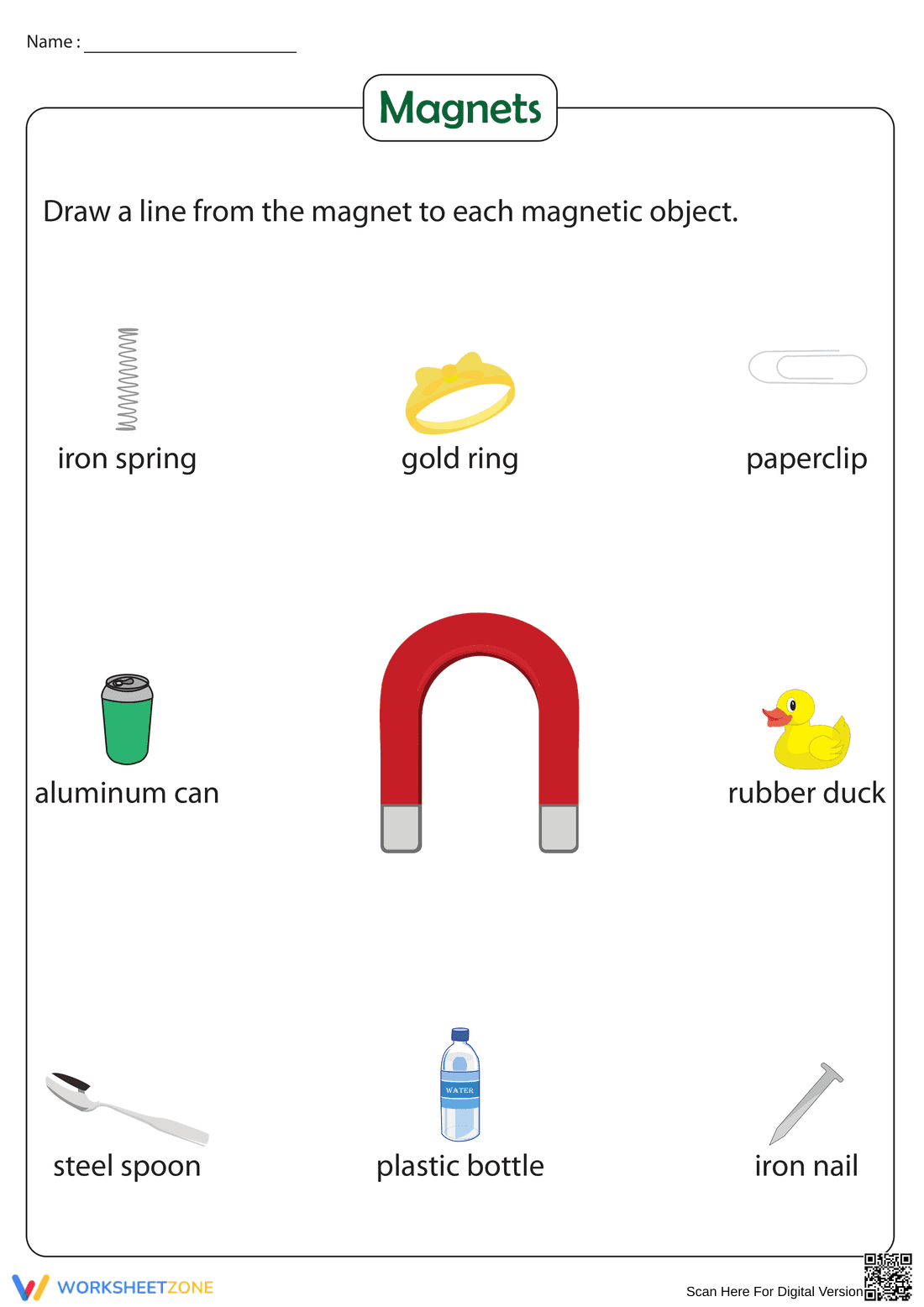
Students learn to classify matter through its observable properties, and magnetism is one of the most engaging ways to introduce this physical science concept. This Identify Magnetic Objects worksheet enables Grade 2 learners to practice distinguishing between magnetic and non-magnetic materials using familiar everyday items. By the end of the activity, students will have a clearer understanding of which metals interact with magnets.
At a Glance
- Grade: 2 · Subject: Science
- Standard:
2-PS1-1— Classify different kinds of materials by their observable properties like magnetism- Skill Focus: Magnetic Property Identification
- Format: 1 page · 8 problems · Answer key included · PDF
- Best For: Intro to magnetism or independent practice
- Time: 10–15 minutes
This single-page Science resource features a high-contrast horseshoe magnet surrounded by eight diverse objects: an iron spring, gold ring, paperclip, aluminum can, rubber duck, steel spoon, plastic bottle, and iron nail. The layout is intentionally clean to minimize cognitive load, allowing students to focus purely on the material properties of the items listed. A clear answer key is included to facilitate rapid grading or student self-correction.
Zero-Prep Classroom Workflow
- Step 1: Print (30 seconds). The clear, high-resolution layout ensures no formatting issues or missing labels when printed in black and white or color.
- Step 2: Distribute (1 minute). Provide students with the sheet and a pencil. Briefly review the names of the objects to ensure vocabulary recognition before they begin matching.
- Step 3: Review (5 minutes). Use the provided answer key to conduct a quick whole-class check. This zero-prep approach is ideal for busy teachers or as an emergency science sub plan.
This worksheet is aligned to the 2-PS1-1 Next Generation Science Standard: "Plan and conduct an investigation to describe and classify different kinds of materials by their observable properties." By evaluating metal types like iron and steel versus aluminum and gold, students practice scientific classification. Both standard codes can be copied directly into lesson plans, IEP goals, or district curriculum mapping tools.
For best results, use this worksheet as a formative assessment during or after a hands-on lab with actual magnets. Before students begin, ask them to predict which items will be magnetic; as they work, observe if they can explain why the iron nail is magnetic while the aluminum can is not. This resource typically takes about 12 minutes to complete when used as an independent practice activity.
This activity is designed for second-grade students but is also appropriate for first-grade enrichment or third-grade review. The use of clear icons and text labels provides essential support for English Language Learners (ELL) and students with reading scaffolds. It pairs naturally with a physical science anchor chart or a short introductory passage about ferrous metals.
Research indicates that hands-on identification of material properties in early elementary grades is a critical precursor to understanding physical science concepts like force and motion. This Grade 2 Science worksheet aligns with the 2-PS1-1 standard by requiring students to categorize everyday objects—such as iron nails, steel spoons, and aluminum cans—based on their magnetic properties. According to a ScienceDirect TpT Analysis, structured worksheets that combine visual aids with classification tasks significantly improve retention of vocabulary related to material science. By physically drawing connections between the magnet and magnetic items, students move from abstract theory to concrete observation. This resource provides the necessary scaffolding for young learners to distinguish between ferrous and non-ferrous metals, ensuring they meet foundational benchmarks for observable properties. The inclusion of an answer key allows for immediate feedback, which is essential for correcting misconceptions early in the learning cycle.


