


























Views
Downloads

Subordinating Conjunctions Worksheet | Grade 5 Essential
Paste this activity's link or code into your existing LMS (Google Classroom, Canvas, Teams, Schoology, Moodle, etc.).
Students can open and work on the activity right away, with no student login required.
You'll still be able to track student progress and results from your teacher account.
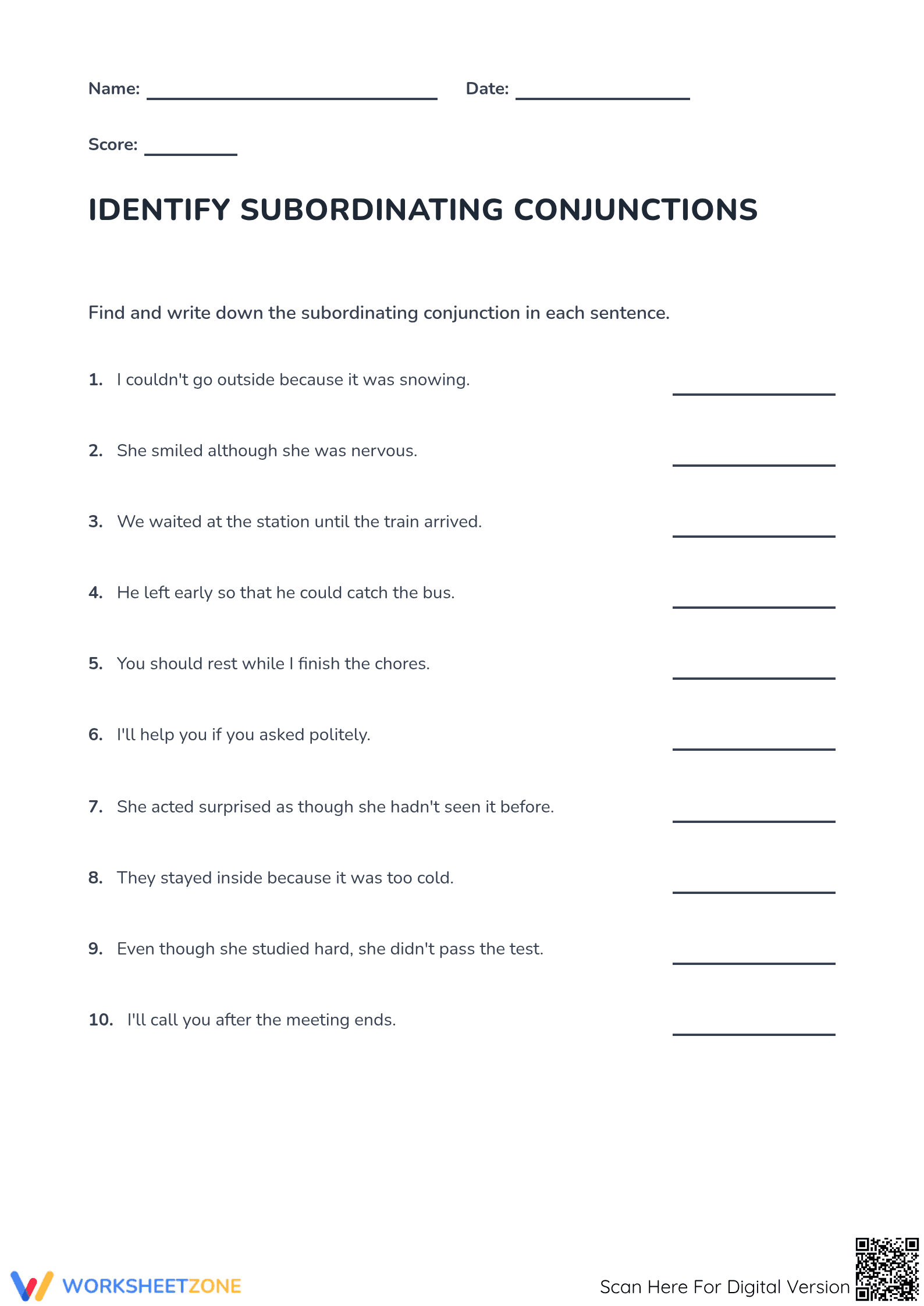
This Grade 5 grammar worksheet helps students identify subordinating conjunctions within complex sentences. By isolating words like "because," "although," and "while," learners improve their understanding of sentence structure and clause relationships. This resource provides immediate practice to strengthen writing mechanics and grammatical accuracy in middle elementary and early middle school settings.
At a Glance
At a Glance
- Grade: 5 · Subject: ELA
- Standard:
CCSS.ELA-LITERACY.L.5.1.A— Explain the function of conjunctions and their role in specific sentences- Skill Focus: Subordinating Conjunction Identification
- Format: 1 page · 10 problems · Answer key included · PDF
- Best For: Independent practice or quick formative assessment
- Time: 10–15 minutes
What's Inside
This single-page PDF features 10 carefully crafted sentences that vary in complexity. Each sentence contains one subordinating conjunction that students must locate and transcribe onto the provided line. The layout is clean and distraction-free, including a dedicated space for the student's name, date, and final score. A comprehensive answer key is included for rapid grading.
Zero-Prep Workflow
This resource is designed for immediate classroom implementation. First, print the single-page worksheet (30 seconds). Next, distribute the copies to students for independent work or a warm-up activity (1 minute). Finally, use the included answer key to review responses as a whole group or for individual grading (under 1 minute). Total teacher preparation time is less than two minutes, making it an ideal sub-plan addition.
Standards Alignment
The primary focus is `CCSS.ELA-LITERACY.L.5.1.A`, which requires students to explain the function of conjunctions in general and their function in particular sentences. By identifying these words in context, students build the foundation for constructing complex sentences. This standard code can be copied directly into lesson plans, IEP goals, or district curriculum mapping tools.
How to Use It
Use this worksheet as a "ticket out the door" after a direct instruction lesson on complex sentences to check for student understanding. Alternatively, assign it as a quiet bell-ringer activity to settle the class at the start of an ELA block. Teachers should observe if students struggle with conjunctions placed at the beginning of sentences versus the middle. Completion typically takes 10 to 15 minutes.
Who It's For
This resource is ideal for 4th through 7th-grade students who are refining their grasp of parts of speech. It is particularly helpful for English Language Learners (ELLs) who need explicit practice identifying transition words. Pair this worksheet with a conjunction anchor chart or a mentor text analysis for a complete instructional cycle.
Effective grammar instruction requires targeted practice to move students from recognition to application. According to the RAND AIRS 2024 report, structured worksheets that focus on a single grammatical element, such as subordinating conjunctions, allow for the cognitive load reduction necessary for mastery. This worksheet aligns with CCSS.ELA-LITERACY.L.5.1.A by requiring students to identify the specific function of conjunctions within 10 varied sentence structures. Research from Fisher & Frey (2014) emphasizes that identifying these linguistic "glue" words is a prerequisite for developing sophisticated writing skills and understanding complex text dependencies. By providing a clear, 10-task format with an included answer key, this resource supports the gradual release of responsibility model. It serves as a reliable tool for formative assessment, ensuring that Grade 5 students can accurately distinguish subordinating conjunctions before moving on to more advanced clause manipulation and sentence combining exercises.


