


























Views
Downloads


Grade 1 Melting — Printable No-Prep Worksheet
Paste this activity's link or code into your existing LMS (Google Classroom, Canvas, Teams, Schoology, Moodle, etc.).
Students can open and work on the activity right away, with no student login required.
You'll still be able to track student progress and results from your teacher account.
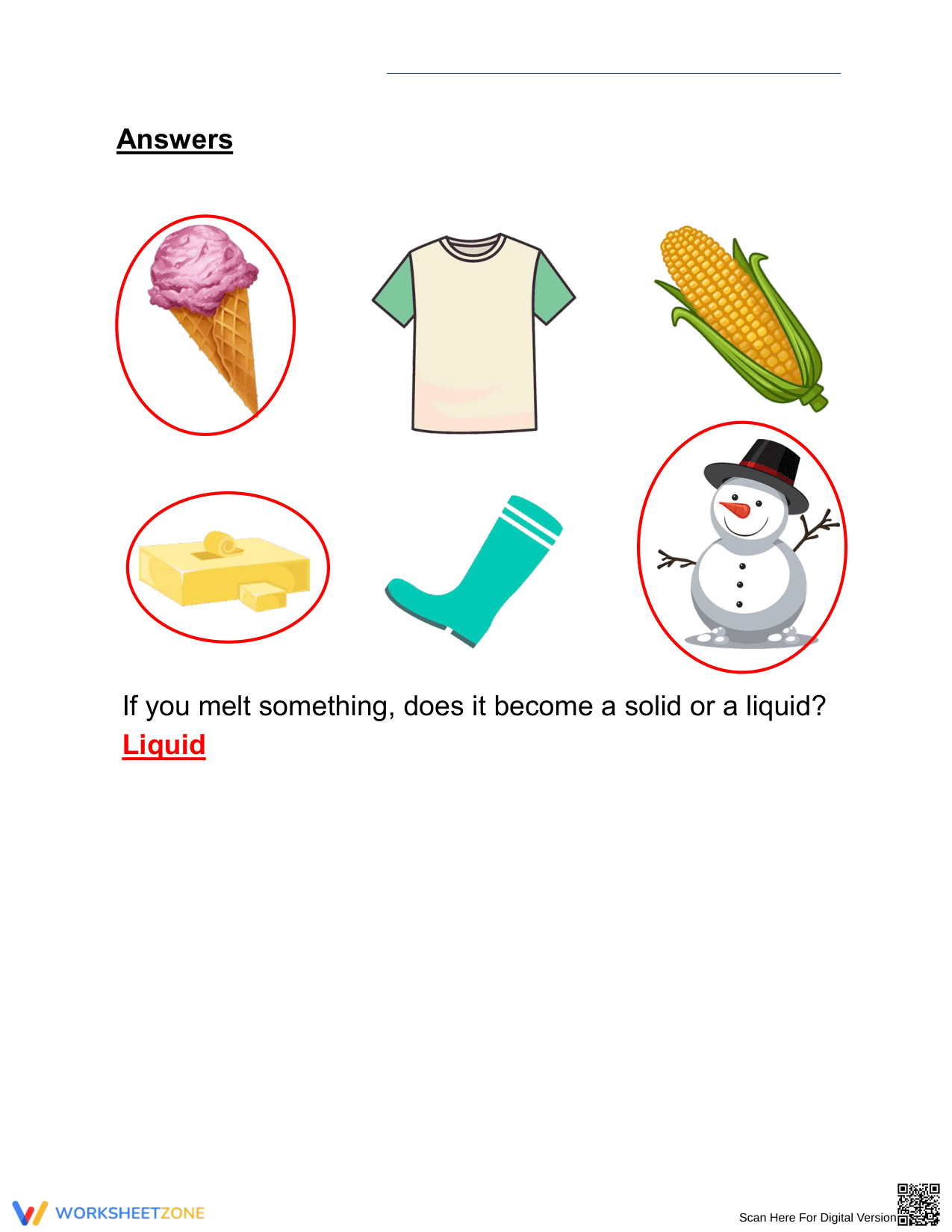
This first-grade science worksheet provides a clear, focused activity for students to identify objects that melt when exposed to heat. Through a simple sorting task and a follow-up conceptual question, learners will demonstrate their understanding of how heat from the sun can cause a physical change in certain materials from a solid to a liquid state.
At a Glance
- Grade: 1 · Subject: Science
- Standard:
K-PS3-1— Observe and describe the effect of sunlight on different materials.- Skill Focus: Cause and effect of heat, properties of materials (melting)
- Format: 1 page · 2 problems · Answer key included · PDF
- Best For: Independent practice, science centers, or a sub plan
- Time: 5–10 minutes
This resource contains a single-page worksheet and a corresponding answer key. The main task asks students to identify which of six common objects will melt in the sun. A final question reinforces the concept of a solid changing to a liquid, strengthening key science vocabulary.
A Seamless Zero-Prep Workflow
Designed for efficiency, this worksheet makes classroom implementation seamless, ideal for planned lessons or sub plans.
- Print (under 1 minute): The single, clean page prints perfectly. No material gathering is needed.
- Distribute (under 1 minute): Hand out for immediate use. Simple, visual instructions require minimal explanation.
- Review (under 2 minutes): Use the provided answer key for rapid class review or individual grading.
With a total teacher prep time under 5 minutes, this is a perfect no-fuss activity.
Standards-Aligned for Foundational Science
This worksheet directly supports early science learning. The primary standard addressed is K-PS3-1: Make observations to determine the effect of sunlight on Earth’s surface. This activity serves as an essential review for first graders as they build a deeper understanding of energy and matter, providing a concrete way for students to predict the sun's effect. The standard code can be copied directly into lesson plans or curriculum maps.
How to Use in Your Classroom
This versatile worksheet is effective as a pre-assessment before a unit on matter or as independent practice after direct instruction. For a quick formative check, have students justify their choices to a partner, listening for vocabulary like "melt" and "heat." Most students can complete the sheet in 5 to 10 minutes.
Who It's For
This worksheet is designed for first-grade students. The visual task supports English Language Learners and those needing visual aids. Its simple format allows for independent work. To differentiate, pair this with a hands-on experiment, like melting an ice cube in the sun, for a multi-sensory connection.
This Grade 1 science worksheet provides a practical application of NGSS standard K-PS3-1, which requires students to make observations about the effect of sunlight. By identifying objects that melt, learners engage in a fundamental scientific practice: recognizing cause-and-effect relationships. The task prompts students to connect a source of energy (the sun) to a physical change in materials (melting), a cornerstone concept in physical science. Research from Fisher & Frey (2014) emphasizes the importance of such focused, text-independent tasks in building foundational knowledge, allowing students to apply concepts without being constrained by reading ability. The worksheet’s design, featuring clear visuals and a direct question, isolates the scientific skill, making it an effective tool for both instruction and formative assessment. Its alignment with crosscutting concepts ensures it builds a solid base for more complex scientific inquiry in later grades.


