




























Views
Downloads

Essential Grade 1 Living and Non-living Things Worksheet

Paste this activity's link or code into your existing LMS (Google Classroom, Canvas, Teams, Schoology, Moodle, etc.).
Students can open and work on the activity right away, with no student login required.
You'll still be able to track student progress and results from your teacher account.
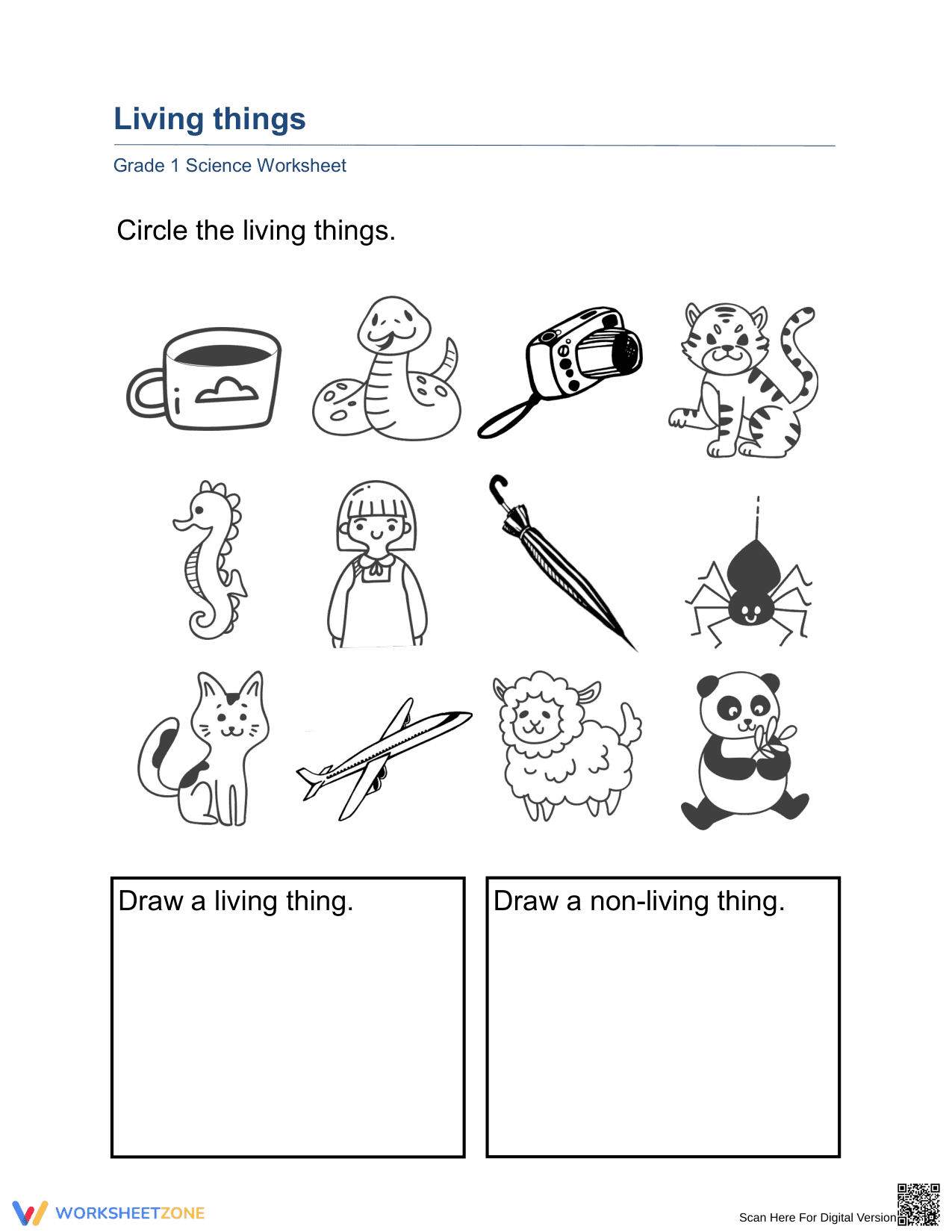
This Grade 1 science worksheet helps young learners differentiate between living organisms and non-living objects through visual classification and creative drawing. Students analyze 12 distinct illustrations to identify animals and humans as living things while recognizing inanimate objects. This essential resource builds a foundational understanding of biological characteristics and the natural world.
At a Glance
- Grade: 1 · Subject: Living Things
- Standard:
1-LS1-1— Use observations of plants and animals to identify their basic characteristics and needs- Skill Focus: Classification of living vs. non-living things
- Format: 1 page · 14 problems · Answer key included · PDF
- Best For: Introduction to life science and classification
- Time: 10–15 minutes
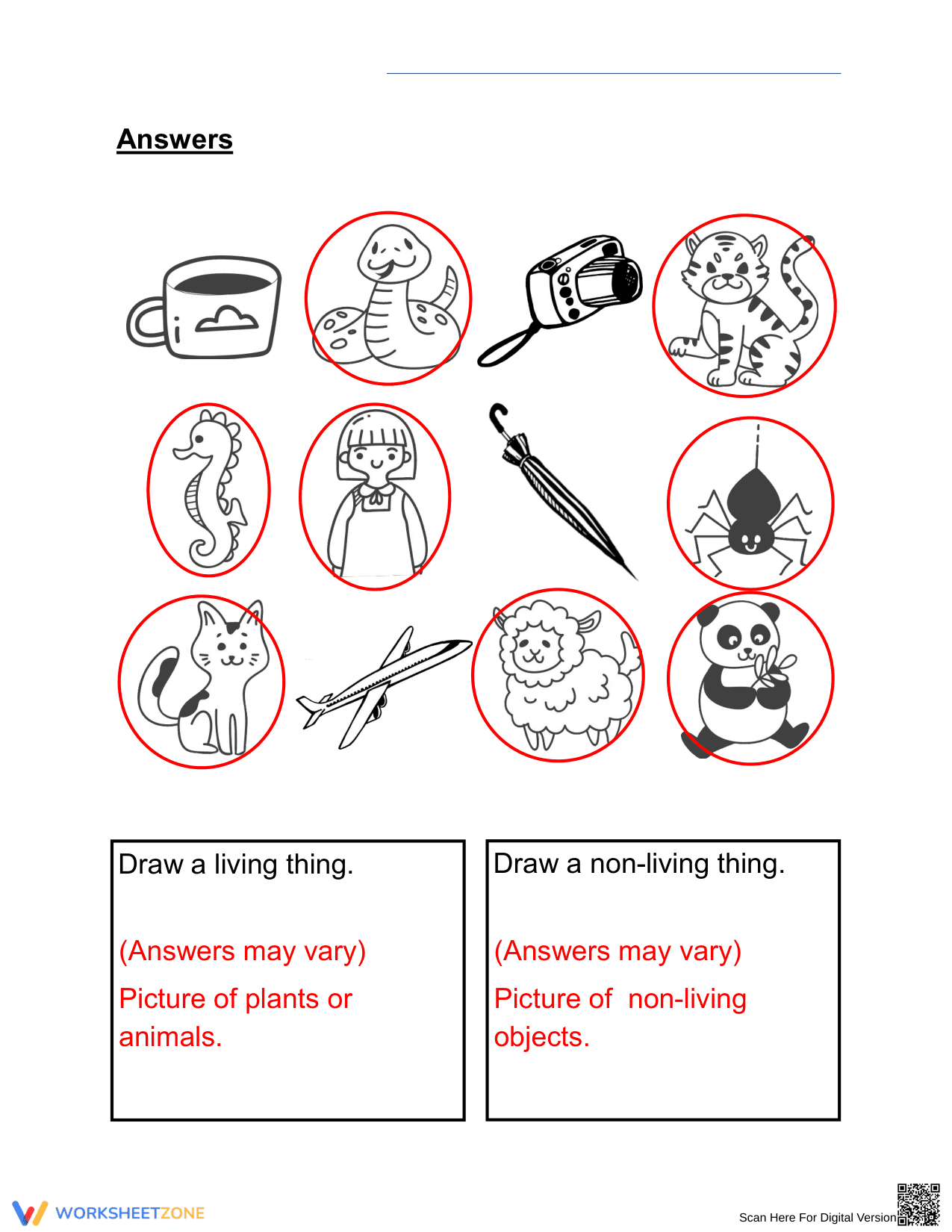
Inside this packet, you will find a structured one-page activity designed for immediate classroom use. The first section presents 12 clear line-art images, including a cat, tiger, seahorse, and snake, alongside non-living items like an umbrella and a camera. Students are tasked with circling the living things, followed by a second section where they draw one example of each category. A complete answer key is provided to facilitate quick grading or student self-correction.
Zero-Prep Workflow
- Print (30 seconds): Simply print the single-page PDF; no collating or stapling is required for this streamlined activity.
- Distribute (30 seconds): Hand out the sheets to students as a morning warm-up, a quick science center task, or a transition activity between lessons.
- Review (1 minute): Use the included answer key to check student work visually or display it on a screen for a whole-class review.
This entire process requires less than two minutes of teacher preparation time, making it an ideal choice for busy classrooms or unexpected substitute teacher plans.
This resource is aligned with NGSS `1-LS1-1`, which focuses on using observations to understand how living things survive and grow. By categorizing objects, students demonstrate their ability to distinguish between organisms that have biological needs and inanimate objects that do not. Both standard codes can be copied directly into lesson plans, IEP goals, or district curriculum mapping tools.
We recommend using this worksheet as a formative assessment after an initial lesson on the needs of living things (food, water, air, and shelter). During the drawing phase, observe whether students choose diverse examples, such as a plant for a living thing, which indicates a deeper mastery of the concept beyond just animals. It typically takes Grade 1 students approximately 12 minutes to complete both the circling and drawing tasks accurately.
This worksheet is specifically designed for first-grade students but is also appropriate for Kindergarten enrichment or second-grade review. It supports English Language Learners by providing clear visual cues that bypass complex reading requirements. For further extension, pair this activity with a "living things" scavenger hunt around the school building or a short reading passage about animal habitats.
Research by Fisher & Frey (2014) emphasizes the importance of visual categorization in early science education to help students build mental models of complex biological systems. This 1-LS1-1 aligned worksheet provides 14 structured opportunities for students to apply their observational skills to the fundamental concept of living versus non-living things. By identifying 8 living organisms among 4 non-living distractors, students practice the critical thinking required for later life science mastery. The inclusion of a drawing task ensures that learners move beyond recognition to independent production, a key indicator of conceptual retention in primary grades. Educational analysts note that providing clear, zero-prep visual aids significantly reduces teacher cognitive load while maintaining high instructional alignment. This resource serves as a reliable tool for establishing the foundational distinctions necessary for understanding growth, reproduction, and environmental interaction in the elementary science curriculum.


