




























Views
Downloads

Essential Living and Non-Living Things Worksheet | Grade 1

Paste this activity's link or code into your existing LMS (Google Classroom, Canvas, Teams, Schoology, Moodle, etc.).
Students can open and work on the activity right away, with no student login required.
You'll still be able to track student progress and results from your teacher account.
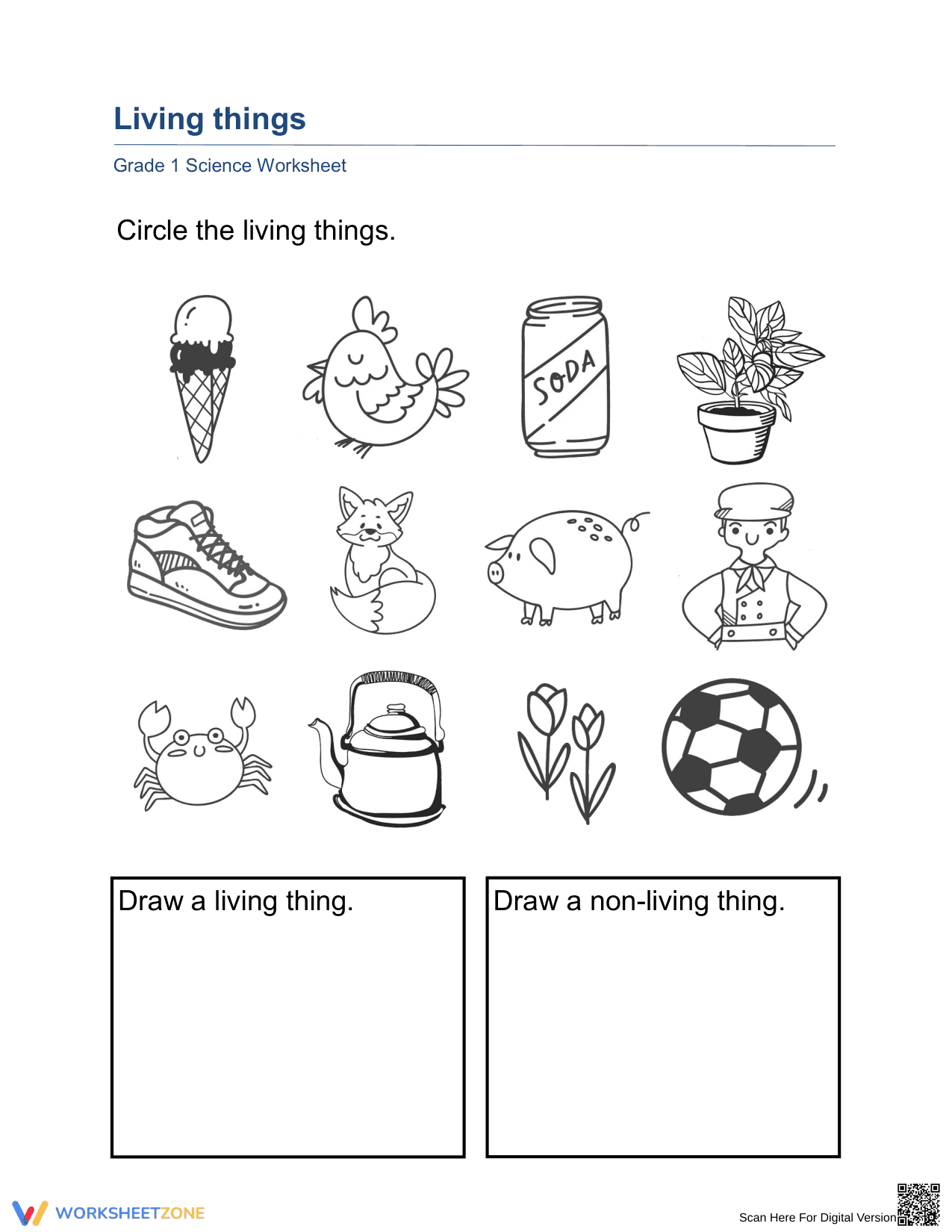
Students master the foundational concept of biology by distinguishing between biotic and abiotic elements in their environment. This Grade 1 science worksheet provides immediate practice in identifying living organisms versus inanimate objects through visual recognition and creative application. By the end of these activities, learners will confidently categorize common items based on observable characteristics.
At a Glance
- Grade: 1 · Subject: Living Things
- Standard:
1-LS1-1— Use materials to design solutions inspired by how plants and animals survive- Skill Focus: Living vs. Non-Living Classification
- Format: 1 page · 14 problems · Answer key included · PDF
- Best For: First-time introduction or quick science assessment
- Time: 15–20 minutes
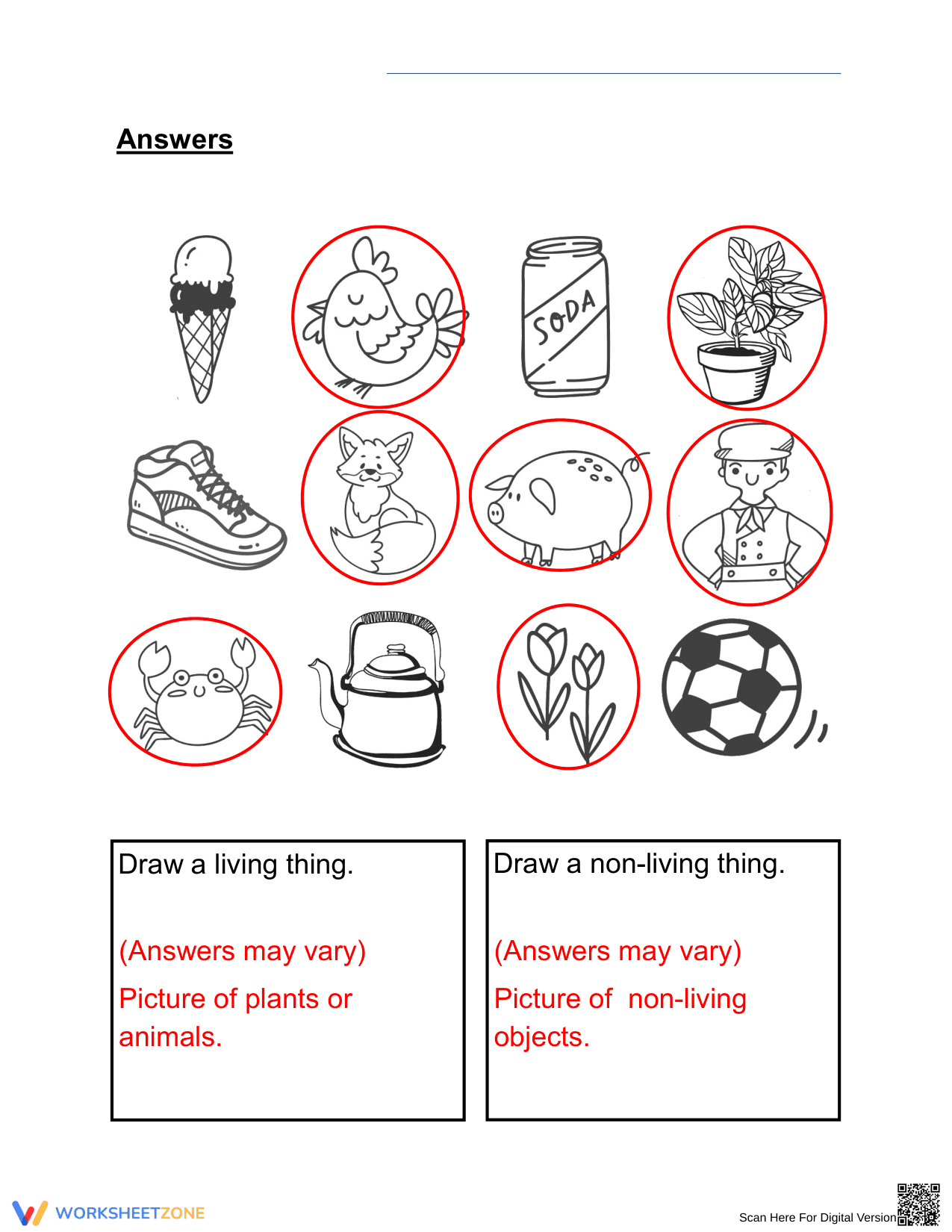
Inside this resource, you will find a cleanly designed single-page worksheet and a corresponding teacher answer key. The page begins with a visual identification task where students must circle specific items from a 12-image grid including animals, plants, and household objects. It concludes with two synthesis boxes requiring students to illustrate one original example of a living thing and one non-living thing, reinforcing internal conceptualization through drawing.
Zero-Prep Workflow
- Print: Download the PDF and print copies for your class in approximately 30 seconds.
- Distribute: Hand out the sheets and provide a brief 2-minute overview of the biological criteria for life (needs air, water, and food).
- Review: Use the included answer key to check for student mastery in less than 5 minutes total.
This streamlined process makes the worksheet an ideal solution for substitute plans, morning work, or a quick science center activity with zero teacher setup required.
Standards Alignment
This activity aligns with 1-LS1-1, which focuses on how the structures of plants and animals help them survive, grow, and meet their needs. By identifying what constitutes a living thing, students build the prerequisite knowledge for understanding these complex biological systems. Both standard codes can be copied directly into lesson plans, IEP goals, or district curriculum mapping tools.
How to Use It
Use this worksheet as a formative assessment after a nature walk to see if students can apply their outdoor observations to a paper-and-pencil task. Alternatively, assign it as a quick exit ticket following a direct instruction lesson on the needs of living things. Expect students to complete the circling section in 10 minutes and the drawing section in an additional 5-10 minutes for a complete instructional block.
Who It's For
This resource is tailored for first-grade learners but works well for kindergarten enrichment or second-grade review. It is especially effective for English Language Learners (ELLs) due to the heavy reliance on clear visual icons rather than complex text. Pair this with a natural resource like a classroom plant or a direct instruction lesson on animal habitats to ground the abstract concepts in a tangible context.
According to the RAND AIRS 2024 analysis, foundational classification skills in Grade 1 predict later success in ecosystem modeling and environmental science. This worksheet addresses 1-LS1-1 by prompting students to discriminate between organisms exhibiting life processes and static objects. Research by Fisher & Frey (2014) shows visual sorting tasks reduce cognitive load for early readers, enabling focus on scientific categorization. Integrating drawing moves beyond simple recognition to conceptual production, a key transition in the NAEP science framework. This dual-modality approach ensures students identify living things and generate unique examples based on learned criteria, providing an evidence-based method for verifying mastery of basic life science distinctions.


