


























Views
Downloads

Printable Exponent and Base Worksheet | Grade 6-8 Math
Paste this activity's link or code into your existing LMS (Google Classroom, Canvas, Teams, Schoology, Moodle, etc.).
Students can open and work on the activity right away, with no student login required.
You'll still be able to track student progress and results from your teacher account.
Master the building blocks of algebra by learning to distinguish between base and exponent components in mathematical expressions. This comprehensive four-page worksheet provides targeted practice to ensure students can accurately identify the value being multiplied and the number of times it repeats. By focusing on these core definitions, learners build the necessary foundation for evaluating complex exponential terms later in their curriculum.
At a Glance
- Grade: 6–8 · Subject: Math
- Standard:
CCSS.MATH.CONTENT.6.EE.A.1— Write and evaluate numerical expressions involving whole-number exponents- Skill Focus: Identifying base and exponent components
- Format: 4 pages · 30 problems · Answer key included · PDF
- Best For: Introduction to exponential notation and foundational algebra
- Time: 25–35 minutes
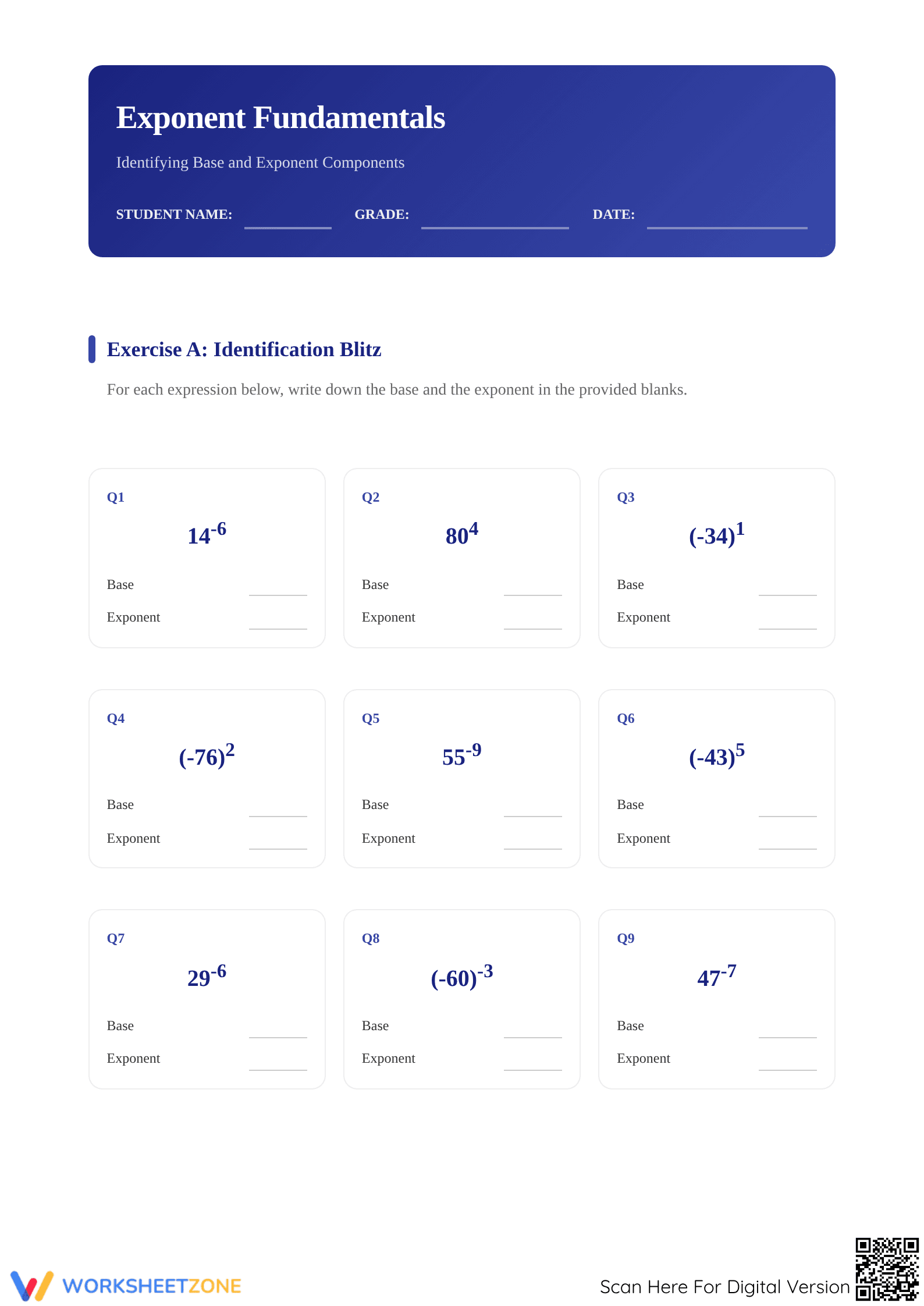
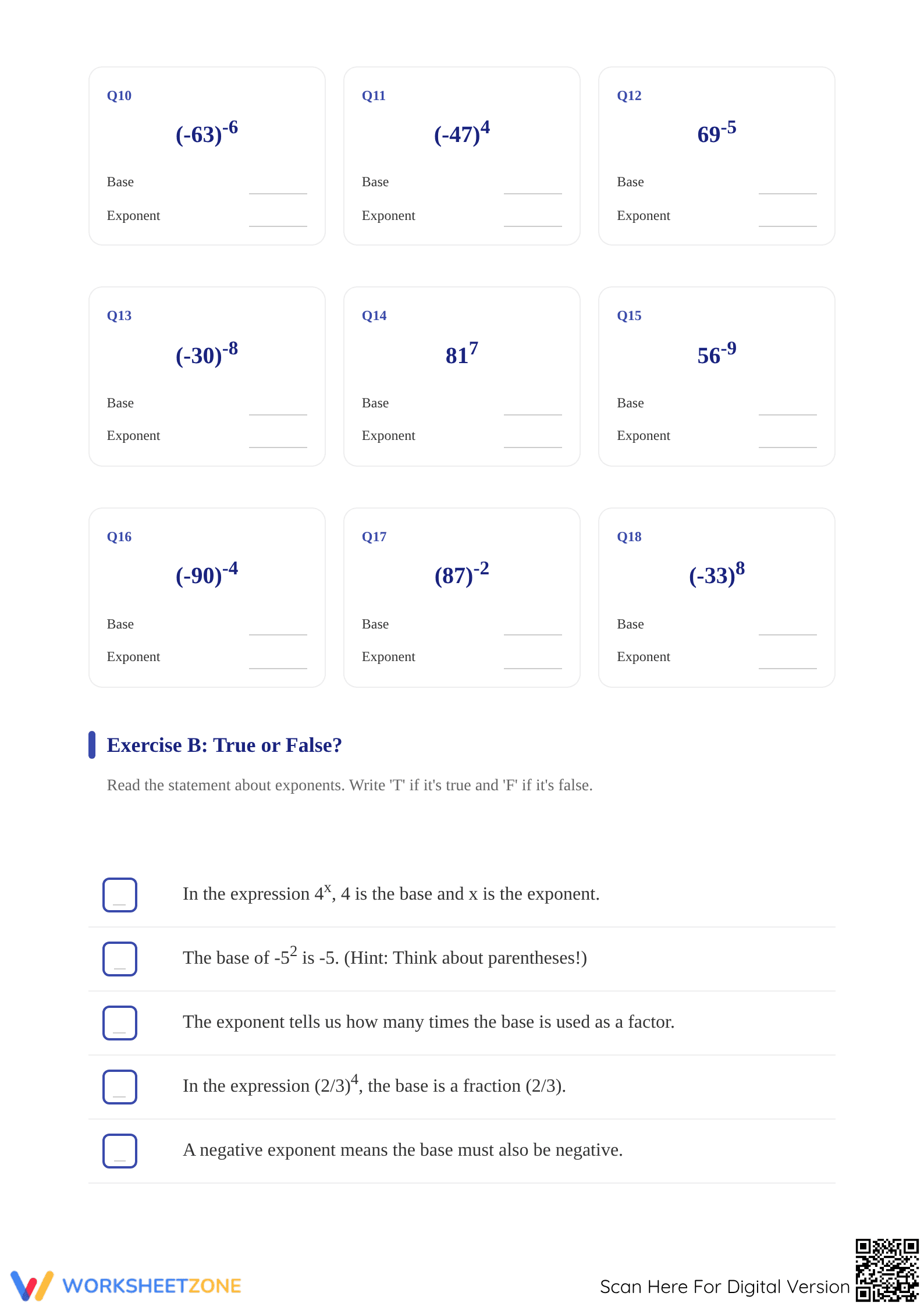
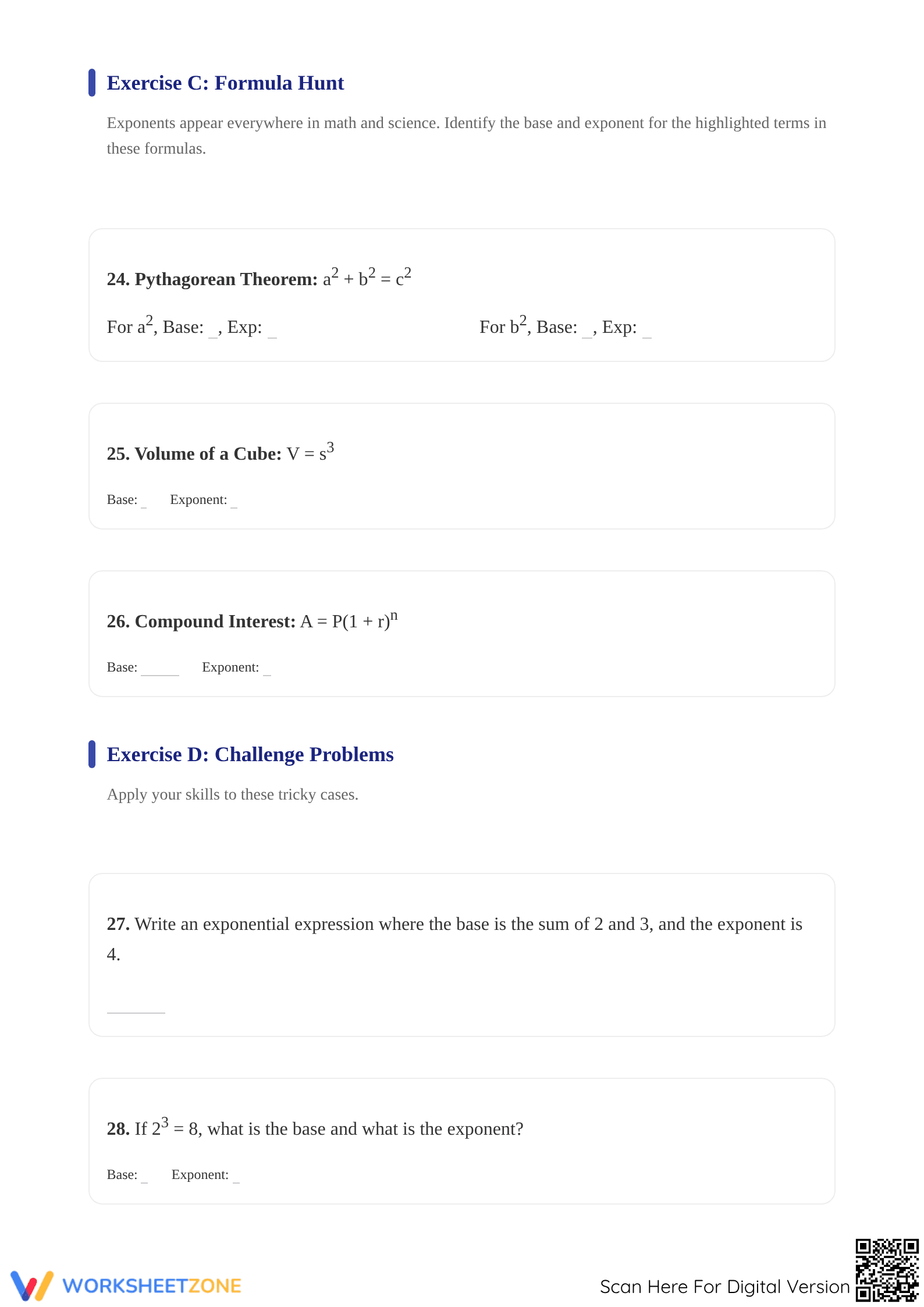
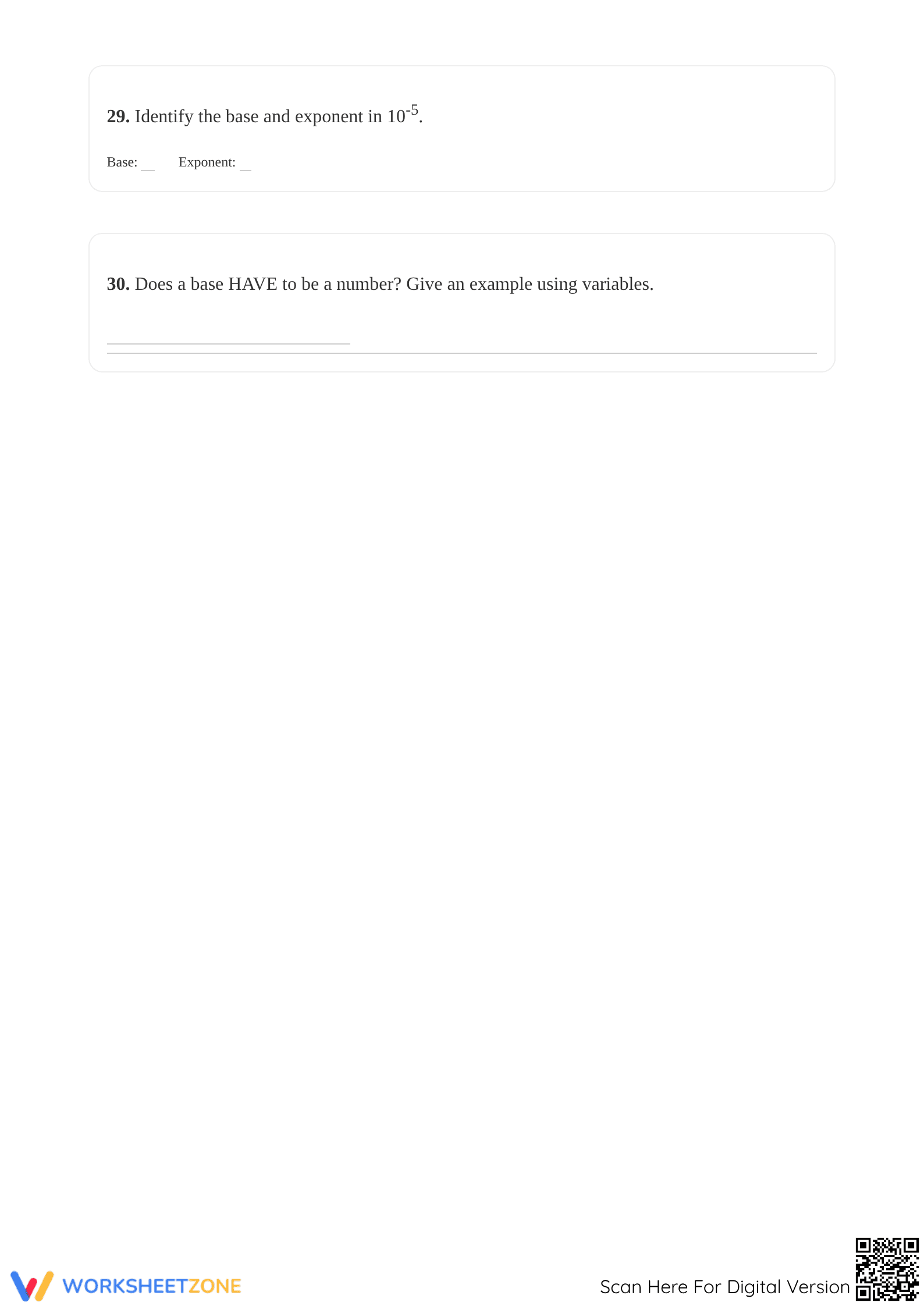
This resource contains four distinct exercises designed to move students from simple identification to conceptual application. It includes eighteen "Identification Blitz" problems covering positive and negative bases, five True/False conceptual checks, a "Formula Hunt" where students extract components from real-world theorems like the Pythagorean Theorem, and four high-order challenge problems. A complete answer key is provided for immediate feedback and grading efficiency.
- Guided Practice (18 tasks): Students work through Exercise A and B to identify numerical bases and exponents, including those with parentheses and negative signs.
- Supported Practice (5 tasks): The True/False section scaffolds conceptual understanding of exponent rules and terminology.
- Independent Practice (7 tasks): Students apply their knowledge to algebraic formulas and verbal descriptions without visual aids.
This structure follows the Gradual Release of Responsibility model, moving from structured identification to abstract conceptualization.
This worksheet is primarily aligned to CCSS.MATH.CONTENT.6.EE.A.1. This standard requires students to understand the notation of exponents as a way to represent repeated multiplication. By isolating the identification of the base and the exponent, this resource directly supports the sub-skill of interpreting exponential expressions. These standard codes can be copied directly into lesson plans, IEP goals, or district curriculum mapping tools.
Use this as a primary practice set during the "We Do" phase of an introductory lesson on exponents. Alternatively, it serves as an excellent formative assessment at the end of a unit to catch common misconceptions regarding negative bases and parentheses. Teachers should observe how students handle negative bases in Exercise A to provide immediate corrective feedback on the role of the negative sign versus the exponent.
Designed for middle school math students in grades 6 through 8, this worksheet is ideal for learners beginning their algebra journey. It is especially beneficial for students who struggle with the visual difference between large bases and small superscript exponents. Pair this resource with a visual anchor chart displaying exponential definitions for maximum instructional impact.
Effective instruction in exponential notation requires students to move beyond rote calculation and into the structural interpretation of mathematical syntax. According to Fisher & Frey (2014), the gradual release of responsibility is essential for mastering abstract concepts like CCSS.MATH.CONTENT.6.EE.A.1. This worksheet operationalizes that research by providing thirty structured tasks that transition students from identifying numerical components to extracting them from complex formulas. Research indicates that students who cannot reliably distinguish between the base and the exponent are significantly more likely to commit errors in order of operations and variable manipulation. By isolating these components in a clean, four-page format with a full answer key, this resource provides the high-repetition, low-stakes practice necessary for long-term retention. Use this printable guide to ensure every student in grades 6-8 possesses the foundational vocabulary required for advanced algebraic success and mathematical literacy in STEM fields.


