


























Views
Downloads

Essential Identify Exponent and Base Worksheet | Grade 6-8
Paste this activity's link or code into your existing LMS (Google Classroom, Canvas, Teams, Schoology, Moodle, etc.).
Students can open and work on the activity right away, with no student login required.
You'll still be able to track student progress and results from your teacher account.
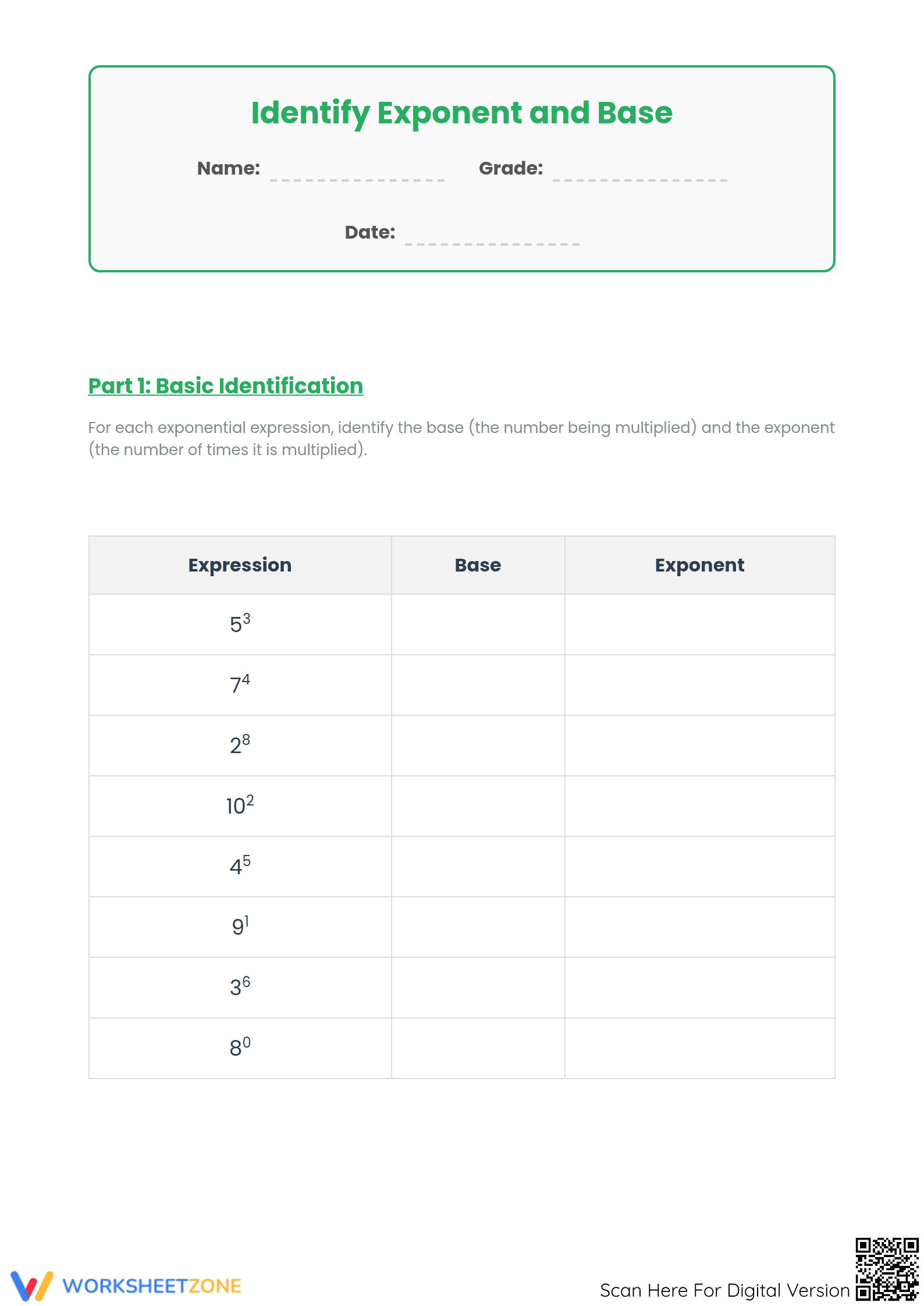
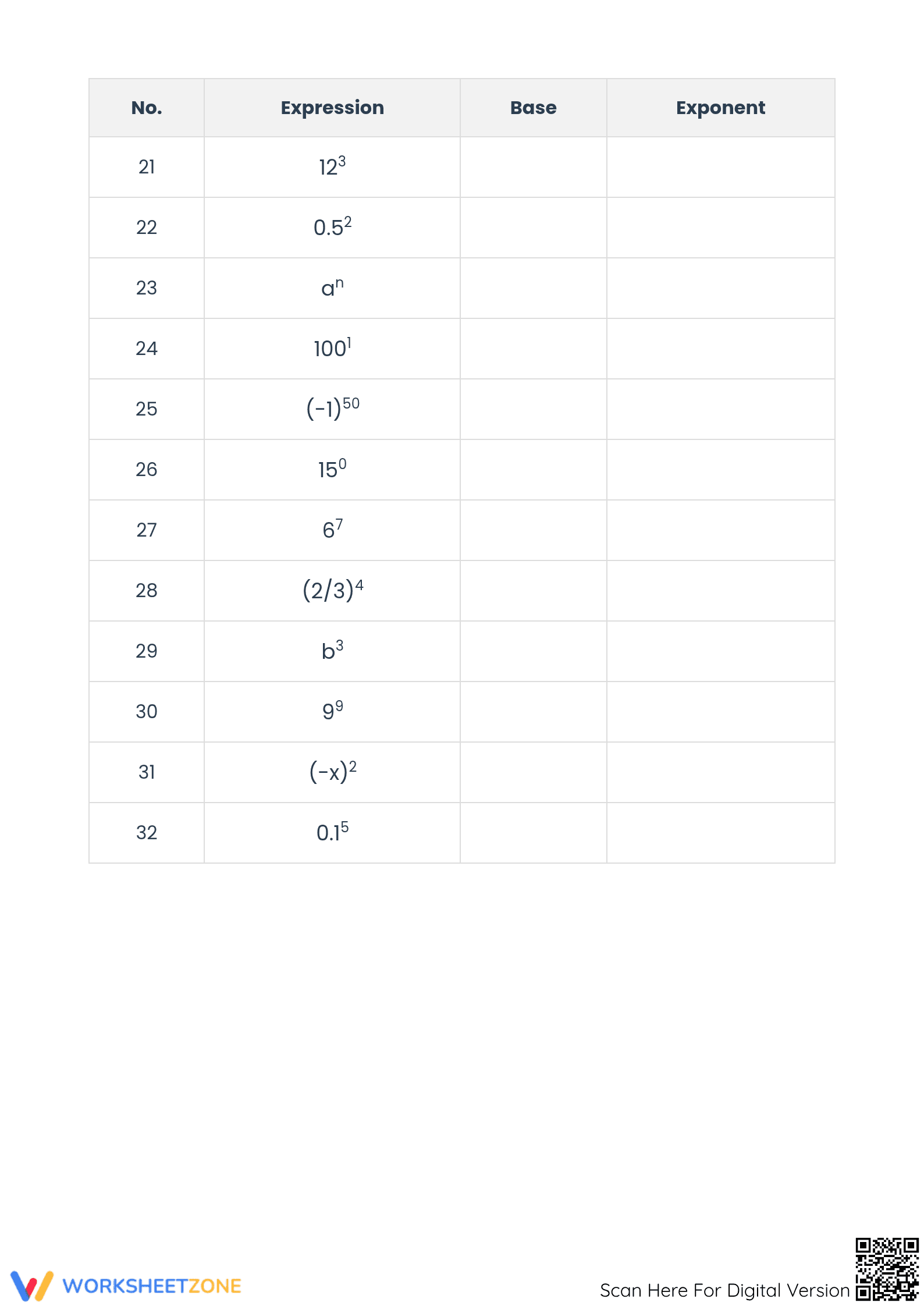
Strengthen algebraic foundations with this comprehensive worksheet designed to help middle school students distinguish between exponents and bases. By isolating these two critical components of exponential notation, students build the fluency required for more complex operations, such as evaluating expressions and applying the laws of exponents in later algebra courses.
At a Glance
- Grade: 6–8 · Subject: Math
- Standard:
6.EE.A.1— Write and evaluate numerical expressions involving whole-number exponents- Skill Focus: Exponential component identification
- Format: 5 pages · 32 problems · Answer key included · PDF
- Best For: Introductory lessons and formative assessment
- Time: 25–40 minutes
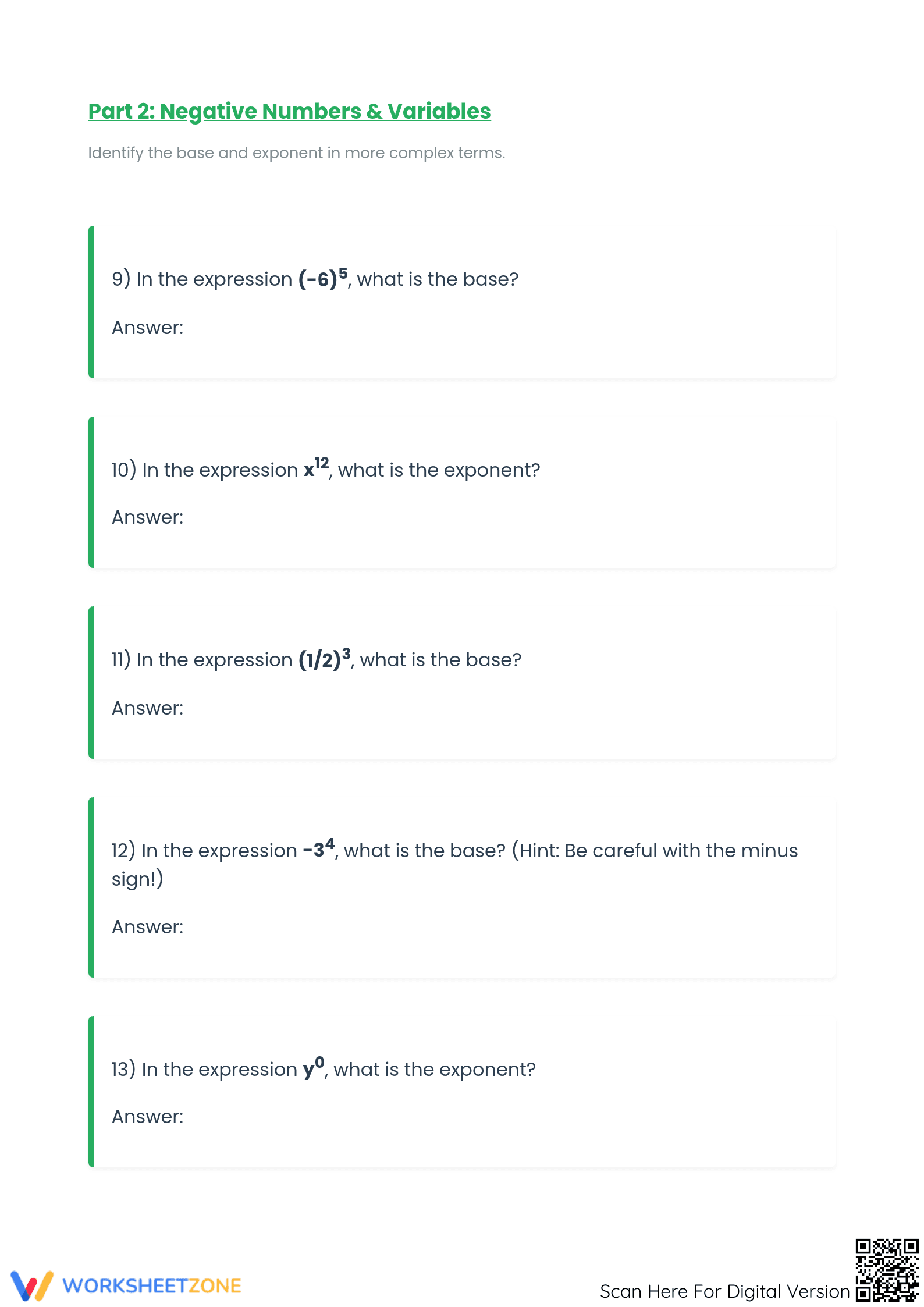
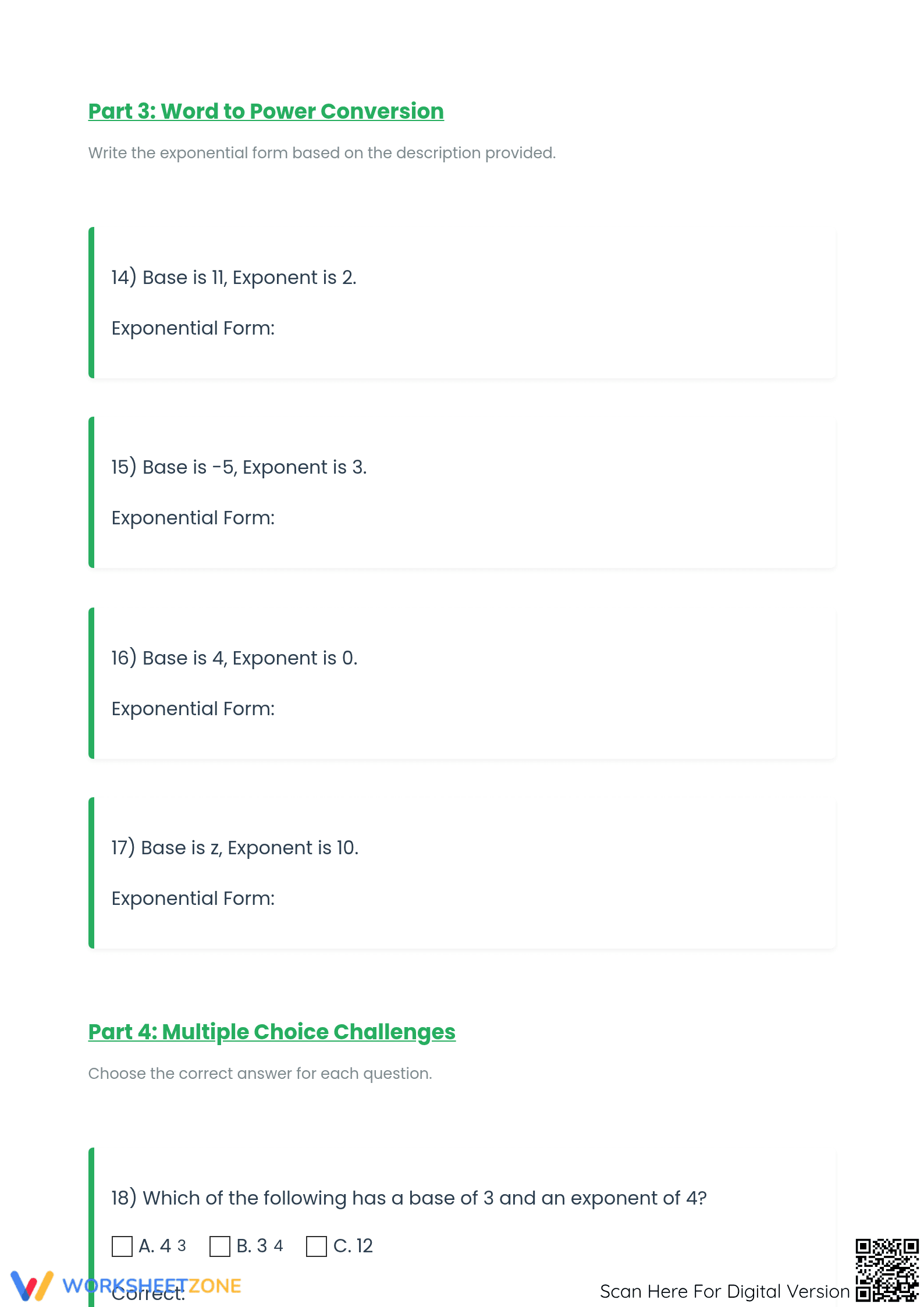
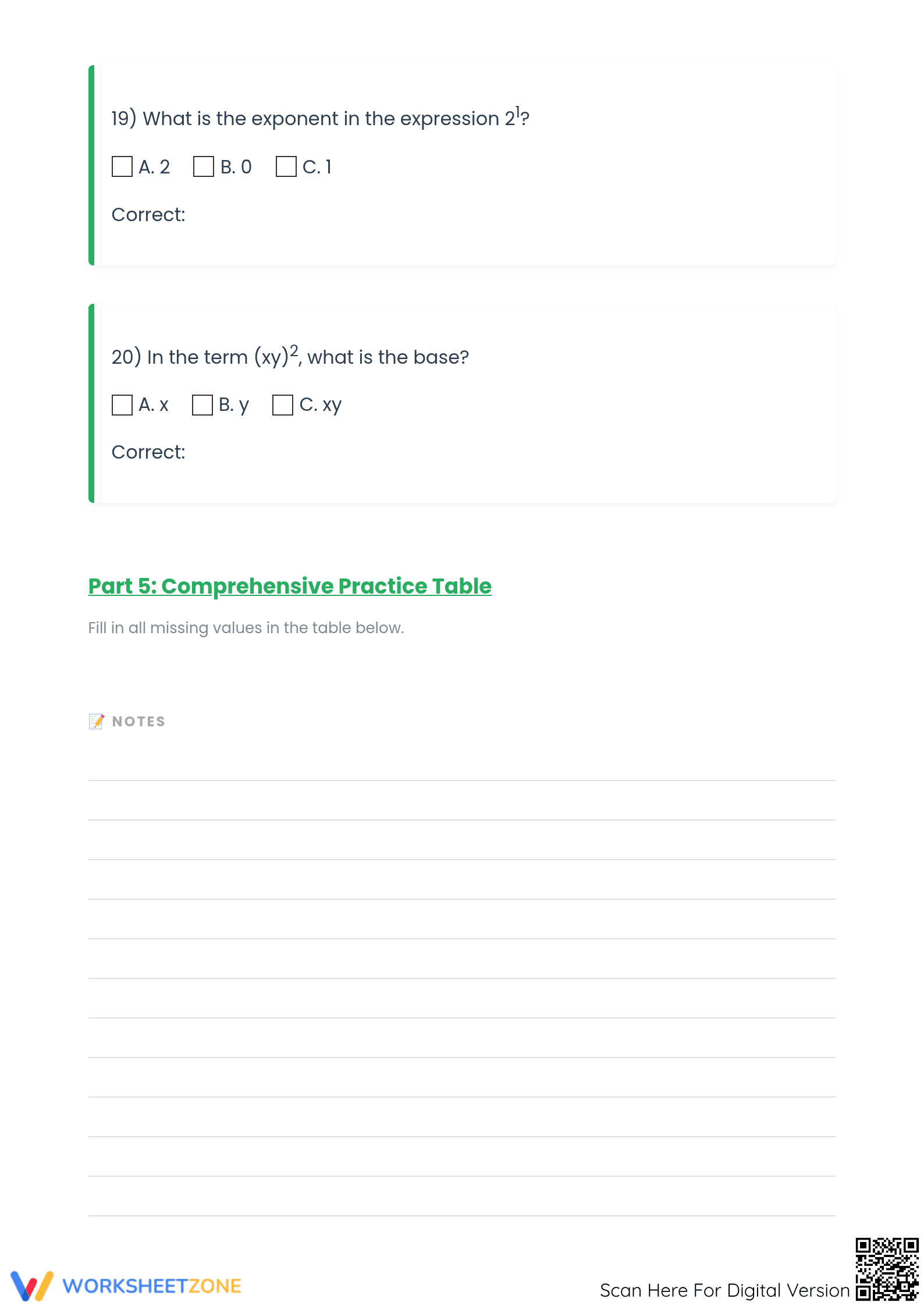
This five-page instructional resource provides a structured progression of tasks. It includes basic identification tables, complex expressions involving negative numbers and variables, word-to-power conversion exercises, and multiple-choice challenges. The clear layout and varied problem types ensure that students remain engaged while developing a deep understanding of how exponential expressions are constructed and read.
Zero-Prep Workflow
- Print (30 seconds): Download the PDF and print the five-page packet. The grayscale-friendly design ensures high-quality copies on any school duplicator.
- Distribute (1 minute): Hand out the packets as a standalone assignment or as individual parts for bell-ringers throughout the week. No additional manipulatives are required.
- Review (Under 2 minutes): Use the included comprehensive answer key to facilitate peer-grading or a quick whole-class review. This streamlined process minimizes teacher prep time while maximizing instructional impact.
Standards Alignment
The primary focus is CCSS.MATH.CONTENT.6.EE.A.1: "Write and evaluate numerical expressions involving whole-number exponents." This worksheet provides the essential scaffolding needed to master this standard by ensuring students can accurately identify the base (the factor) and the exponent (the number of times the factor is used). This standard code can be copied directly into lesson plans, IEP goals, or district curriculum mapping tools.
How to Use It
Use this resource during the direct instruction phase of a unit on expressions and equations. It serves as an excellent check for understanding after introducing the vocabulary of powers. Teachers can observe students during Part 2 (Negative Numbers & Variables) to identify common misconceptions regarding signs and parentheses. Expect a total completion time of approximately 35 minutes for the full packet.
Who It's For
This worksheet is ideal for 6th, 7th, and 8th-grade students beginning their study of exponents. It is particularly beneficial for students who require repetitive, focused practice to solidify mathematical vocabulary. It pairs naturally with an introductory anchor chart on the parts of a power or a direct instruction lesson on the definition of exponential notation.
The mastery of exponential notation is a critical gateway skill in middle school mathematics, as identified in the Fisher & Frey (2014) framework for gradual release of responsibility. Research indicates that students who can fluidly identify the components of an expression, specifically the base and exponent under standard 6.EE.A.1, are significantly more successful when transitioning to evaluating expressions with order of operations. This worksheet provides 32 targeted opportunities for students to practice this specific identification skill across numerical, fractional, and variable contexts. By removing the cognitive load of evaluation and focusing strictly on identification, students build the precise mathematical vocabulary necessary for higher-level algebraic reasoning. The inclusion of negative bases and zero exponents prepares learners for advanced secondary topics. This resource serves as a reliable formative assessment tool that aligns with evidence-based instructional practices for mathematical literacy and procedural fluency in the modern classroom.


