


























Views
Downloads
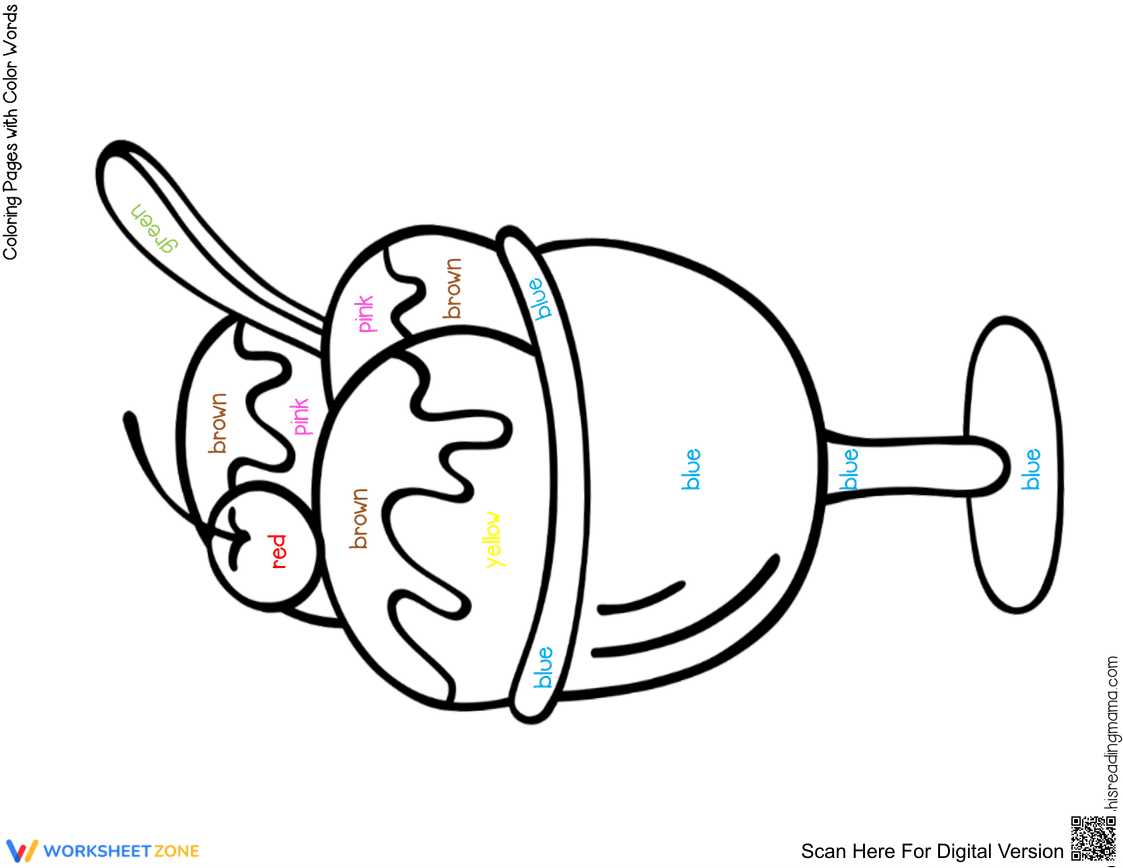

Printable Color Words Worksheet | Kindergarten English
Paste this activity's link or code into your existing LMS (Google Classroom, Canvas, Teams, Schoology, Moodle, etc.).
Students can open and work on the activity right away, with no student login required.
You'll still be able to track student progress and results from your teacher account.
This printable Kindergarten English worksheet helps young learners practice reading high-frequency color words while completing an engaging ice cream coloring activity. Students identify specific color names printed inside various shapes and apply the corresponding crayon or marker, reinforcing early literacy and fine motor skills simultaneously.
At a Glance
- Grade: Kindergarten · Subject: English
- Standard:
CCSS.ELA-LITERACY.RF.K.3.C— Read common high-frequency words by sight- Skill Focus: Reading color words
- Format: 1 page · 11 problems · No answer key · PDF
- Best For: Independent morning work
- Time: 10–15 minutes
Inside this single-page resource, educators will find a large, clear illustration of an ice cream sundae divided into 11 distinct sections. Each section contains a specific color word, such as red, blue, green, yellow, brown, or pink, printed in text that matches the target color to provide a helpful visual scaffold for early readers. The bold outlines and simple design make it highly accessible for young students developing their hand-eye coordination.
Zero-Prep Workflow
- Print (1 minute): Simply download the PDF and print a class set. The black-and-white line art is optimized to save ink while maintaining crisp readability.
- Distribute (1 minute): Hand out the pages along with standard boxes of crayons or markers. No special materials or complex instructions are required.
- Review (0 minutes): The self-correcting nature of the coloring task means teachers can assess accuracy at a quick glance as they walk around the room. Total teacher prep time is under two minutes, making this an excellent option for emergency sub plans or spontaneous transitions.
This activity is directly aligned with CCSS.ELA-LITERACY.RF.K.3.C, which requires students to read common high-frequency words by sight. By repeatedly exposing children to foundational color vocabulary in a meaningful context, the worksheet supports early reading fluency. Both standard codes can be copied directly into lesson plans, IEP goals, or district curriculum mapping tools.
Teachers can utilize this resource effectively during morning arrival as a calm, focused task that settles students into the daily routine. It also serves as an ideal literacy center activity after direct instruction on color words. As a formative assessment observation tip, watch to see if students rely on the colored text scaffold or if they can read the word independently before selecting their crayon. Most students will complete the sundae in 10 to 15 minutes.
This worksheet is designed primarily for Kindergarten and Pre-K students mastering their initial sight word lists. It provides built-in differentiation through the color-coded text, allowing emerging readers to succeed alongside their more advanced peers. Pair this activity with a read-aloud book about colors or a classroom anchor chart displaying color words to reinforce the vocabulary.
Mastering early sight vocabulary, such as the terms practiced in this CCSS.ELA-LITERACY.RF.K.3.C aligned activity, is a critical stepping stone for reading comprehension. When students read common high-frequency words by sight, they free up cognitive resources to focus on decoding more complex text structures later on. According to Fisher & Frey (2014), integrating foundational literacy skills with engaging, hands-on tasks like coloring significantly increases student time-on-task and retention of new vocabulary. This ice cream coloring page leverages that principle by combining fine motor practice with targeted word recognition. By providing a low-stakes, highly visual environment for practicing color words, educators can foster both confidence and competence in early readers. The immediate visual feedback of a correctly colored image further reinforces the learning objective.


