


























Views
Downloads


International Business Vocabulary Worksheet | Grade 12 Ready
Paste this activity's link or code into your existing LMS (Google Classroom, Canvas, Teams, Schoology, Moodle, etc.).
Students can open and work on the activity right away, with no student login required.
You'll still be able to track student progress and results from your teacher account.
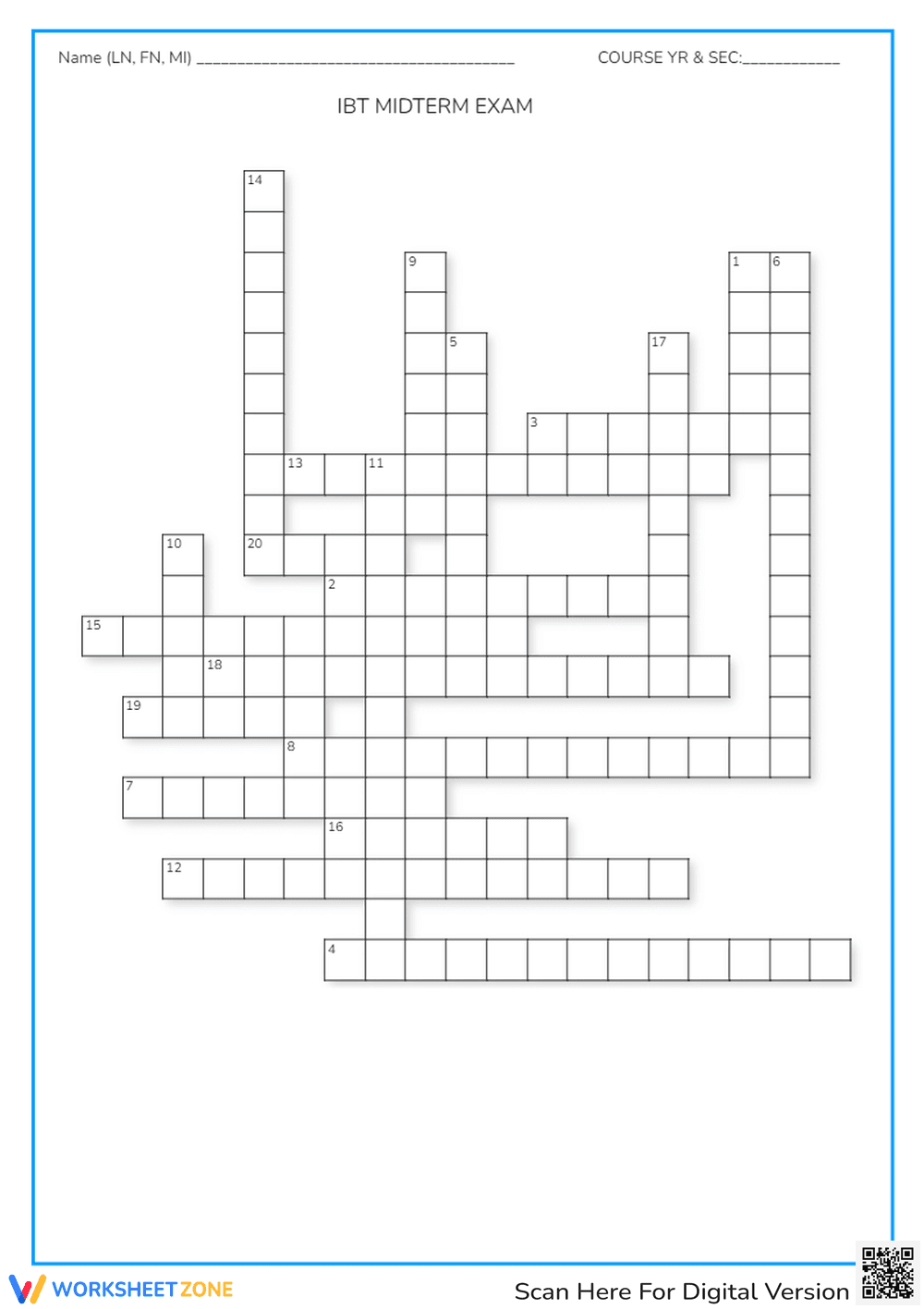
This Grade 12 international business worksheet helps students master essential global trade vocabulary through an engaging crossword format. By matching real-world economic scenarios to key terms, learners solidify their understanding of globalization, multinational corporations, and market dynamics while building critical subject-specific literacy.
At a Glance
- Grade: 12 · Subject: Economics
- Standard:
CCSS.ELA-LITERACY.RH.11-12.4— Determine the meaning of economic vocabulary- Skill Focus: International Trade Vocabulary
- Format: 3 pages · 19 problems · PDF
- Best For: Midterm review or sub plans
- Time: 30–45 minutes
This comprehensive resource includes a three-page layout designed for immediate classroom use. Page one features a clean, well-structured crossword puzzle grid. Page two provides nineteen detailed clues covering concepts like outsourcing, franchising, and exchange rates, using real-world examples such as McDonald's and Jollibee. Page three supplies a complete word bank to support students as they work through the terminology.
Designed for maximum efficiency, this activity requires under two minutes of teacher preparation:
- Print (1 minute): Simply print the three-page PDF packet for each student.
- Distribute (1 minute): Hand out the puzzle, clues, and word bank. The instructions are entirely self-explanatory.
- Review (10 minutes): Go over the completed puzzle together to reinforce the economic concepts.
Because it requires zero setup and provides built-in scaffolding via the word bank, this worksheet is an ideal, stress-free emergency sub plan.
This activity is aligned to CCSS.ELA-LITERACY.RH.11-12.4, requiring students to determine the meaning of words and phrases as they are used in a text, including vocabulary describing political, social, or economic aspects of history/social science. It also supports general economic standards regarding global trade and market interconnectivity. Both standard codes can be copied directly into lesson plans, IEP goals, or district curriculum mapping tools.
Deploy this crossword puzzle as a formative assessment during a unit on globalization, or use it as a structured midterm review activity. Before direct instruction, it can serve as a pre-assessment to gauge existing knowledge of terms like "transnational" and "domestic." During the activity, teachers can circulate and observe which clues require the most word-bank reliance, providing immediate formative feedback. Expect students to complete the puzzle in 30 to 45 minutes.
This resource is designed for high school seniors in Economics, Business, or International Trade courses. The included word bank provides excellent differentiation for English Language Learners and students needing vocabulary support, allowing them to participate fully in the rigorous content. It pairs perfectly with introductory lectures on global market dynamics or case studies on multinational corporations.
Mastering domain-specific vocabulary is a critical component of economic literacy and college readiness. This activity targets CCSS.ELA-LITERACY.RH.11-12.4, helping students determine the meaning of economic vocabulary in context. According to Fisher & Frey (2014), explicit vocabulary instruction combined with interactive practice significantly improves reading comprehension in the content areas. By utilizing a crossword format with contextualized clues rather than rote memorization lists, this resource encourages active cognitive engagement with complex concepts like globalization and outsourcing. Students must analyze the scenario presented in each clue to identify the correct terminology, bridging the gap between abstract economic theory and practical application. This structured approach ensures that learners not only memorize terms but understand their functional role in the global marketplace, building a stronger foundation for advanced business coursework.


