


























Views
Plays


Artificial Intelligence Quiz | Essential Grade 12 CS
Paste this activity's link or code into your existing LMS (Google Classroom, Canvas, Teams, Schoology, Moodle, etc.).
Students can open and work on the activity right away, with no student login required.
You'll still be able to track student progress and results from your teacher account.
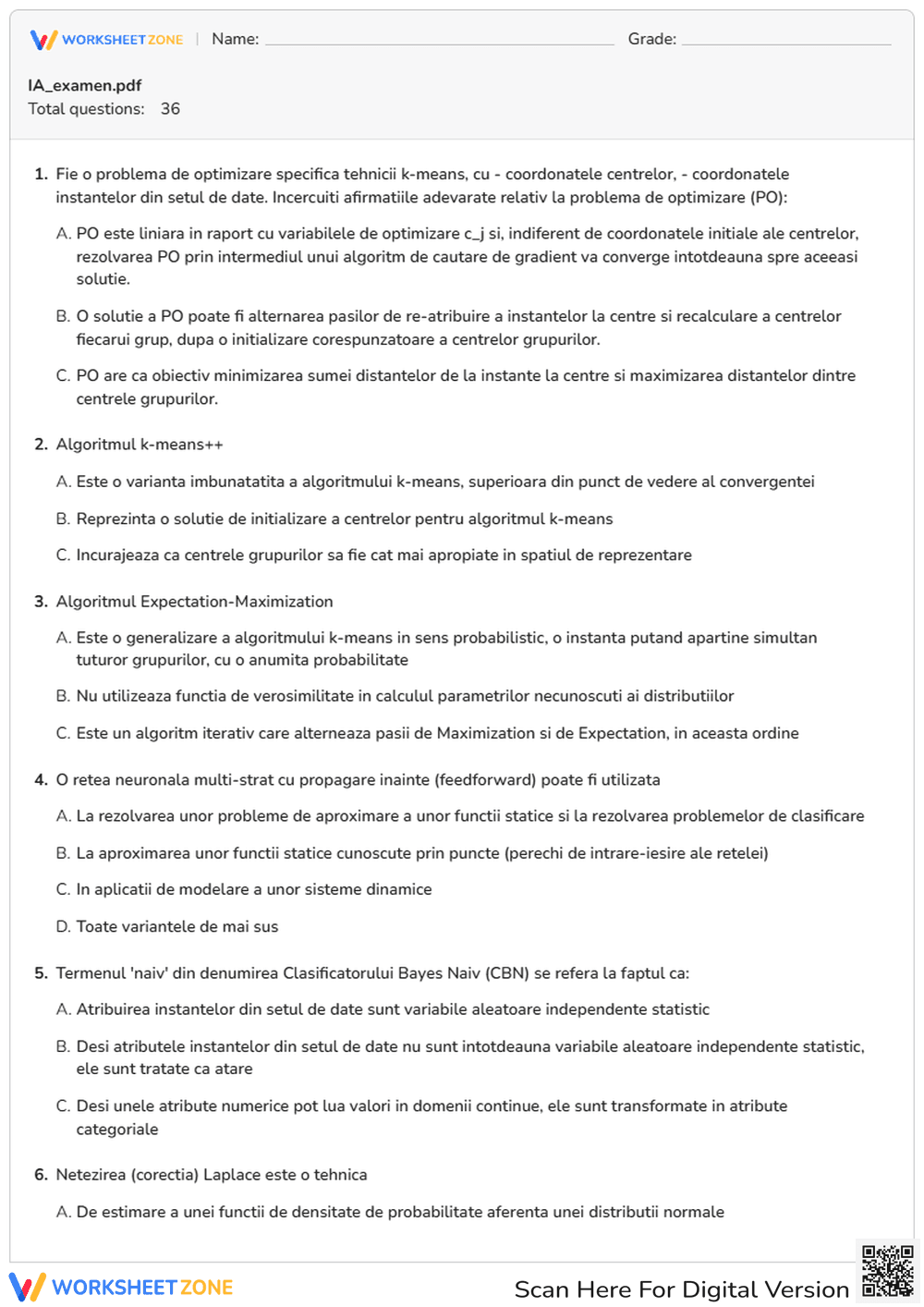
This Grade 12 Computer Science assessment evaluates student mastery of artificial intelligence and machine learning algorithms through 36 rigorous multiple-choice questions. Students demonstrate their understanding of neural networks, clustering techniques, and statistical modeling to solve complex computational problems. This resource provides a structured environment for evaluating high-level technical proficiency.
At a Glance
- Grade: 12 · Subject: Computer Science
- Standard:
HS-ETS1-4— Use computer models to simulate and model the impact of complex solutions- Skill Focus: Machine Learning & AI Algorithms
- Format: 7 pages · 36 problems · Answer key included · PDF
- Best For: Summative assessment or final exam review
- Time: 60–90 minutes
What's Inside
This 7-page Romanian-language PDF contains a comprehensive bank of 36 multiple-choice questions covering the breadth of modern AI. The document includes detailed sections on unsupervised learning (k-means), supervised classification (Naive Bayes, Random Forest), and deep learning architectures (CNNs, Autoencoders). A full answer key is provided to facilitate rapid grading and immediate student feedback on complex algorithmic logic.
Zero-Prep Workflow
The zero-prep design of this assessment allows for immediate implementation. Step 1: Print the 7-page PDF (30 seconds). Step 2: Distribute the 36-question exam to students (1 minute). Step 3: Use the provided answer key to grade submissions or facilitate a peer-review session (15 minutes). Total teacher prep is under 2 minutes, making it an ideal sub-plan for advanced computer science courses.
Standards Alignment
This resource is primarily aligned to HS-ETS1-4, which requires students to use a computer simulation to model the impact of proposed solutions to a complex real-world problem. It also supports advanced mathematics standards regarding probability and statistical inference. Both standard codes can be copied directly into lesson plans, IEP goals, or district curriculum mapping tools.
How to Use It
Assign this worksheet as a summative final exam after completing a unit on Machine Learning or as a high-stakes review before collegiate entrance exams. During the session, observe students as they navigate the 'kernel trick' and 'regularization' questions to identify common misconceptions about model overfitting. Expect a completion time of 60 to 90 minutes depending on student familiarity.
Who It's For
This resource is designed for Grade 12 students in advanced Computer Science tracks or introductory University-level AI courses. It is particularly effective for students preparing for technical certifications or engineering degrees. Pair this quiz with a comprehensive anchor chart on neural network layers or a direct instruction lesson on gradient descent for maximum instructional impact.
Artificial Intelligence education at the secondary and post-secondary level requires rigorous assessment of algorithmic logic and statistical foundations. This worksheet, aligned to the HS-ETS1-4 standard, evaluates student proficiency in complex computational modeling and machine learning architectures. According to the RAND AIRS 2024 report, structured assessments in computer science that bridge theoretical concepts with practical algorithmic identification significantly improve long-term retention of technical vocabulary and system logic. The 36-question format provides a high-density evaluation of 15 distinct sub-fields within AI, including supervised learning, unsupervised clustering, and deep learning structures. By requiring students to differentiate between nuanced technical definitions—such as the distinction between k-means and k-means++ or the specific mechanics of the kernel trick—this resource ensures a high level of cognitive demand. This assessment provides clear evidence of student readiness for collegiate-level engineering programs.


