


























1 / 4
0
Views
0
Downloads



0.0
0
Save
0 Likes
Share
Human Population Growth Analysis Worksheet
0 Views
0 Downloads
Paste this activity's link or code into your existing LMS (Google Classroom, Canvas, Teams, Schoology, Moodle, etc.).
Students can open and work on the activity right away, with no student login required.
You'll still be able to track student progress and results from your teacher account.
Information
Description
What It Is:
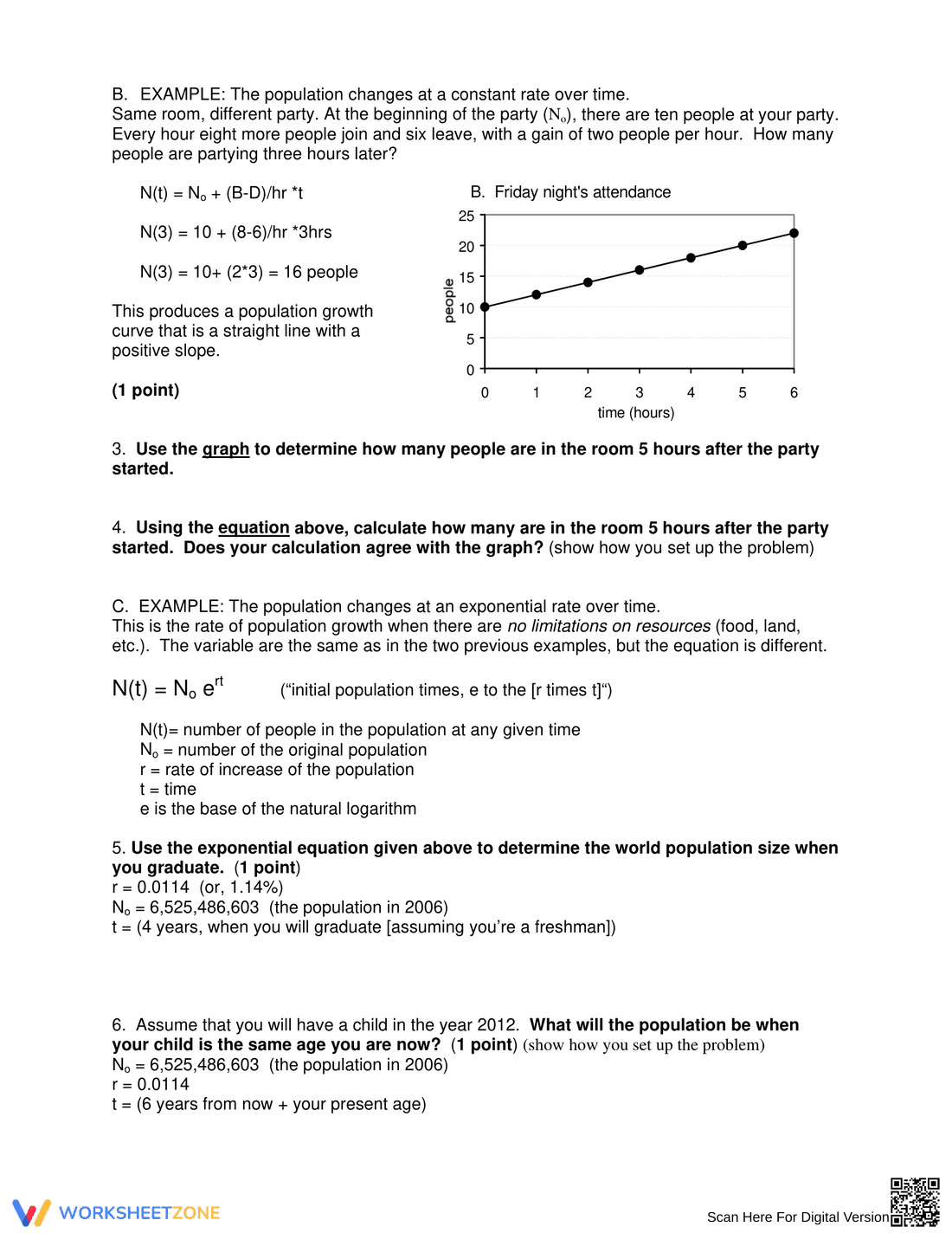
This is an educational worksheet about human population growth, focusing on factors influencing population change. It includes an introduction to population ecology, key concepts like population growth patterns, and an example problem illustrating population equilibrium. The worksheet provides a formula to calculate population size based on births, deaths, immigration, and emigration. It also includes a graph representing a population that remains constant over time and two questions that require students to analyze the graph and apply the formula to determine population size at different time intervals.
Grade Level Suitability:
This worksheet is suitable for high school students, specifically grades 9-12, particularly those studying biology or environmental science. The concepts of population growth, equilibrium, and the application of a mathematical formula to model population change are typically covered in these grade levels.
Why Use It:
This worksheet helps students understand the factors that influence population growth and decline. It reinforces the concept of equilibrium in populations and allows students to apply a mathematical model to a real-world scenario. It also develops graph reading and analytical skills by requiring students to interpret a population graph and compare it with calculations.
How to Use It:
Students should first read the introduction and key concepts. Then, they should study the example problem and understand how the formula is applied. Next, they need to use the provided graph to answer the first question about the population size after 5 hours. Finally, students must use the formula to calculate the population size after 6 hours and compare their result with the graph to answer the second question.
Target Users:
The target users for this worksheet are high school students studying biology, environmental science, or related subjects. It is also useful for teachers looking for materials to teach population growth concepts and assess student understanding of these concepts.
This is an educational worksheet about human population growth, focusing on factors influencing population change. It includes an introduction to population ecology, key concepts like population growth patterns, and an example problem illustrating population equilibrium. The worksheet provides a formula to calculate population size based on births, deaths, immigration, and emigration. It also includes a graph representing a population that remains constant over time and two questions that require students to analyze the graph and apply the formula to determine population size at different time intervals.
Grade Level Suitability:
This worksheet is suitable for high school students, specifically grades 9-12, particularly those studying biology or environmental science. The concepts of population growth, equilibrium, and the application of a mathematical formula to model population change are typically covered in these grade levels.
Why Use It:
This worksheet helps students understand the factors that influence population growth and decline. It reinforces the concept of equilibrium in populations and allows students to apply a mathematical model to a real-world scenario. It also develops graph reading and analytical skills by requiring students to interpret a population graph and compare it with calculations.
How to Use It:
Students should first read the introduction and key concepts. Then, they should study the example problem and understand how the formula is applied. Next, they need to use the provided graph to answer the first question about the population size after 5 hours. Finally, students must use the formula to calculate the population size after 6 hours and compare their result with the graph to answer the second question.
Target Users:
The target users for this worksheet are high school students studying biology, environmental science, or related subjects. It is also useful for teachers looking for materials to teach population growth concepts and assess student understanding of these concepts.


