


























Views
Downloads
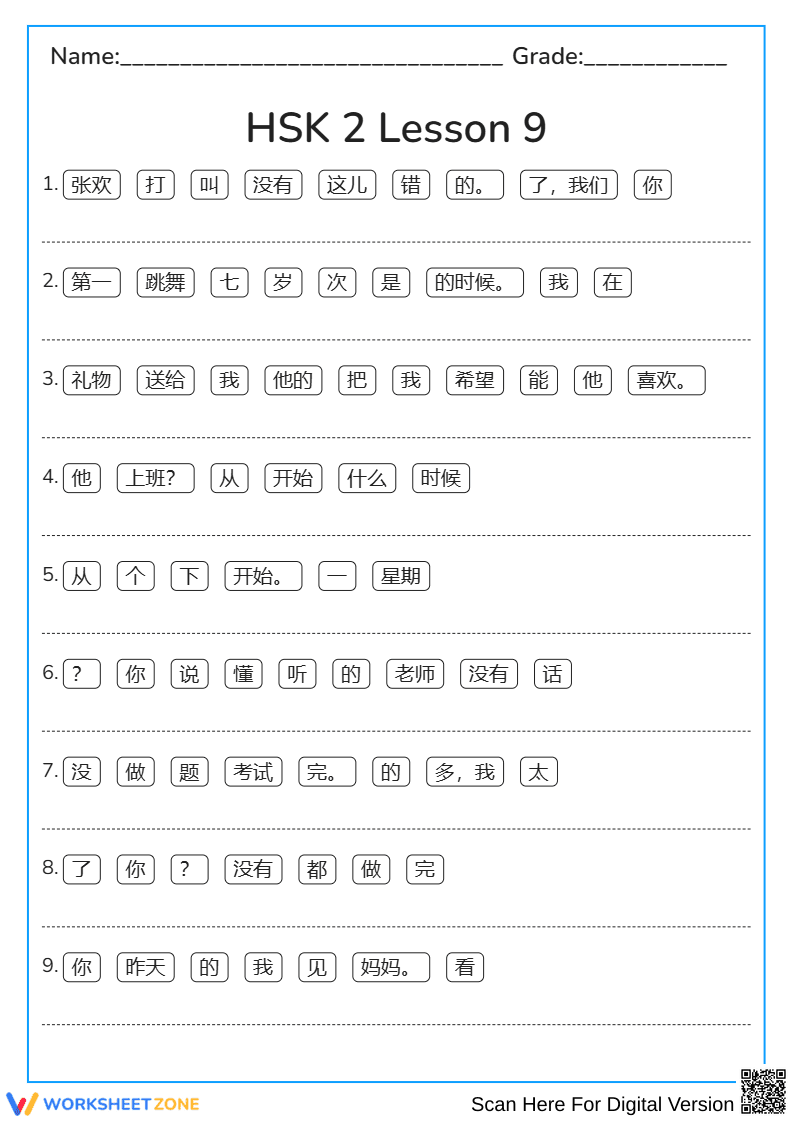

HSK 2 Sentence Scramble | Grade 6 Printable Worksheet
Paste this activity's link or code into your existing LMS (Google Classroom, Canvas, Teams, Schoology, Moodle, etc.).
Students can open and work on the activity right away, with no student login required.
You'll still be able to track student progress and results from your teacher account.
This Grade 6 Mandarin Chinese worksheet provides targeted practice with HSK 2 vocabulary and sentence structure. Students reconstruct scrambled sentences to demonstrate their understanding of syntax and grammar rules. By organizing characters into logical statements, learners build essential reading and writing proficiency for their language development.
At a Glance
- Grade: 6 · Subject: Mandarin Chinese
- Standard:
CCSS.ELA-LITERACY.L.6.1— Demonstrate command of grammar and usage conventions- Skill Focus: Sentence Scramble and Syntax
- Format: 1 page · 9 problems · Answer key included · PDF
- Best For: Independent practice and review
- Time: 15–20 minutes
Inside this single-page resource, educators will find nine distinct sentence scramble tasks utilizing vocabulary from the HSK 2 curriculum. Each problem presents a series of jumbled Chinese characters and punctuation marks enclosed in individual boxes. Students must analyze the components and write the correctly ordered sentence on the provided dashed lines. A complete answer key is included in the download to facilitate quick grading and provide immediate feedback to learners.
Zero-Prep Workflow
- Print (1 min): Download the PDF and print copies.
- Distribute (1 min): Hand out as a warm-up or independent work.
- Review (3 mins): Use the answer key to check responses or display correct sentences for self-correction.
Total teacher preparation time is under two minutes, making this ideal for busy educators or a substitute plan.
Standards Alignment
This resource aligns with CCSS.ELA-LITERACY.L.6.1, requiring students to demonstrate command of the conventions of standard grammar and usage when writing. While originally designed for English, this structural standard applies directly to foreign language acquisition, as students must apply target-language syntax rules to form coherent statements. Both standard codes can be copied directly into lesson plans, IEP goals, or district curriculum mapping tools.
How to Use It
Deploy this worksheet after direct instruction on HSK 2 grammar patterns. It serves as an excellent formative assessment; as students work, observe which sentence components cause confusion. Alternatively, assign this 15-minute activity as homework to reinforce the lesson. The straightforward format allows students to focus entirely on the linguistic challenge.
Who It's For
This worksheet is designed for Grade 6 students studying Mandarin Chinese at the HSK 2 proficiency level. It is particularly beneficial for visual learners who need to see the distinct components of a sentence before assembling them. To differentiate, teachers can provide a vocabulary translation sheet for students who need extra support, or challenge advanced learners to translate the completed sentences into English. Pair this activity with a corresponding HSK 2 reading passage to show the vocabulary in a broader context.
Mastering syntax is a critical milestone in foreign language acquisition and overall literacy development. This resource directly supports CCSS.ELA-LITERACY.L.6.1 by challenging students to demonstrate command of grammar and usage conventions through active sentence construction. According to Fisher & Frey (2014), providing students with structured, hands-on manipulation of language components significantly increases their long-term retention of grammatical rules and vocabulary. By physically writing out the scrambled Chinese characters in the correct order, learners engage multiple cognitive pathways, reinforcing their understanding of Mandarin sentence structure. This targeted practice helps bridge the gap between passive vocabulary recognition and active language production. Regular engagement with sentence scrambles builds the automaticity required for fluent reading and writing, ensuring students are well-prepared for more advanced linguistic tasks, conversational applications, and formal proficiency assessments.


