


























Views
Downloads
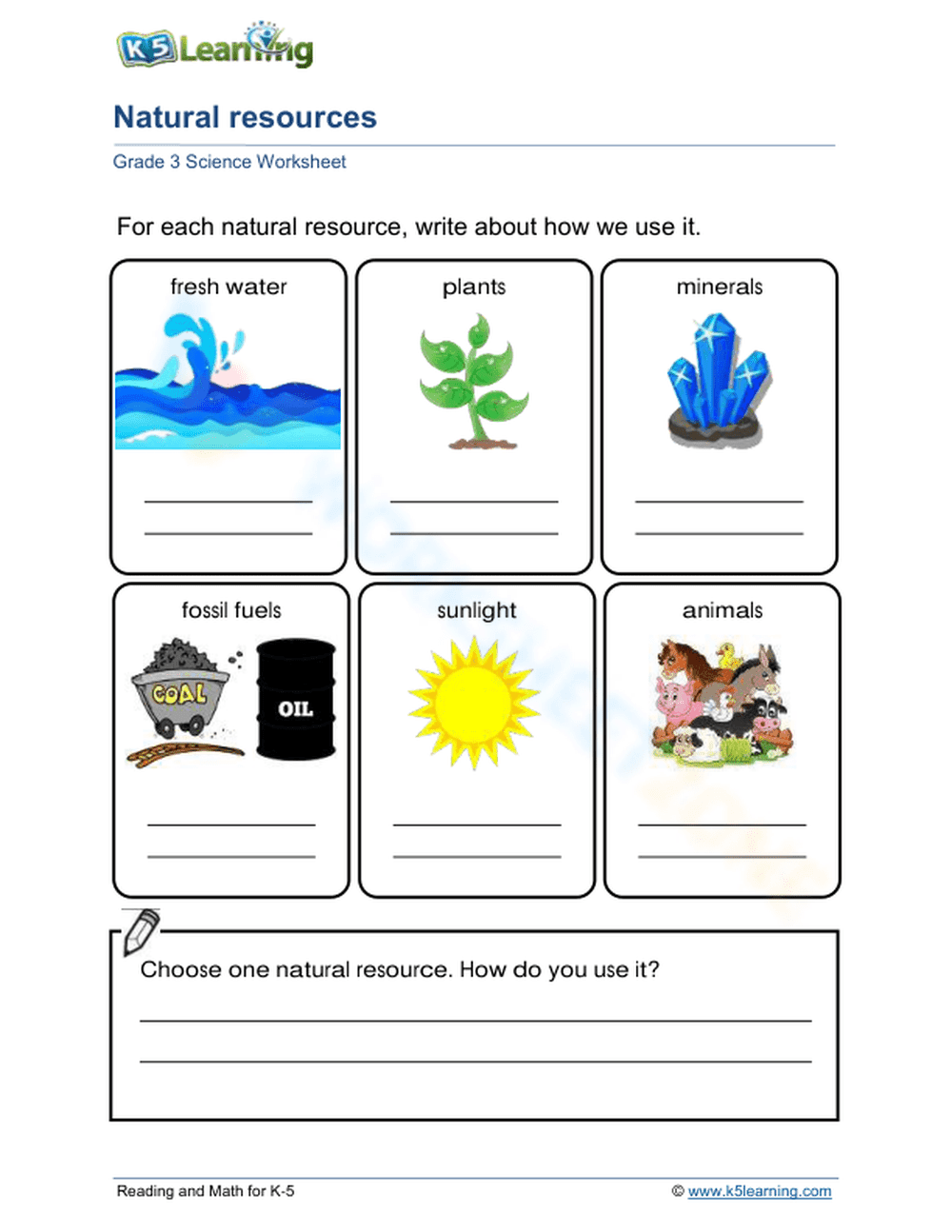

Essential Natural Resources Worksheet | Grade 3 Science
Paste this activity's link or code into your existing LMS (Google Classroom, Canvas, Teams, Schoology, Moodle, etc.).
Students can open and work on the activity right away, with no student login required.
You'll still be able to track student progress and results from your teacher account.
This Grade 3 natural resources worksheet empowers students to bridge the gap between Earth’s raw materials and their everyday applications. By analyzing six core resources—including fresh water, sunlight, and minerals—students develop a fundamental understanding of how environmental assets sustain human life. This essential science activity fosters critical thinking about sustainability and resource management.
At a Glance
- Grade: 3 · Subject: Science
- Standard:
3-ESS3-1— Describe the human uses and importance of various natural resources- Skill Focus: Identifying and categorizing natural resource applications
- Format: 1 page · 7 problems · Answer key included · PDF
- Best For: Independent practice or quick formative assessment
- Time: 15–20 minutes
This 1-page PDF provides a clean, organized layout featuring six distinct resource panels: fresh water, plants, minerals, fossil fuels, sunlight, and animals. Each panel includes high-quality visual icons and dedicated writing lines for student responses. The worksheet concludes with a synthesizing extension question that asks students to reflect on their personal use of a specific resource. A comprehensive answer key is provided for teacher convenience.
Zero-Prep Workflow
- Print (30 seconds): Simply open the PDF and print enough copies for your whole class or small group.
- Distribute (1 minute): Pass out the single-sheet worksheet as a warm-up, bell-ringer, or exit ticket.
- Review (5 minutes): Use the included answer key to quickly check for conceptual understanding or lead a class-wide discussion.
This resource requires zero teacher preparation time and is ideally suited for emergency sub plans or last-minute science rotations.
Standards Alignment
This worksheet is primarily aligned with `3-ESS3-1`, focusing on how humans utilize Earth's resources to meet basic needs. It also supports `CCSS.ELA-LITERACY.W.3.2` by requiring students to write informative and explanatory descriptions of scientific topics. Both standard codes can be copied directly into lesson plans, IEP goals, or district curriculum mapping tools.
How to Use It
Use this worksheet during the explain or elaborate phase of a 5E lesson on Earth's systems. It serves as an excellent formative assessment tool to gauge whether students can distinguish between biological resources like plants and physical resources like minerals. Teachers should observe whether students mention industrial, nutritional, or domestic uses for each category. Completion typically takes 15 to 20 minutes.
Who It's For
Designed for third-grade students in general education settings, this resource is also highly effective for ESL/ELL learners due to the strong visual cues associated with each vocabulary term. It can be paired naturally with an anchor chart on renewable versus non-renewable energy sources or a classroom textbook passage about the environment.
According to the RAND AIRS 2024 report on elementary science literacy, visual-to-text association is a critical scaffold for mastering standard 3-ESS3-1. By requiring students to articulate the specific human uses of sunlight, fossil fuels, and fresh water, this worksheet reinforces the cognitive link between Earth's systems and human society. Research from Fisher & Frey (2014) emphasizes that structured writing prompts in science help cement technical vocabulary and conceptual permanence. This printable resource provides the supported practice necessary for students to achieve high accuracy in identifying natural resource applications. With 7 targeted tasks, the worksheet aligns with EdReports 2024 recommendations for high-quality, zero-prep instructional materials that support evidence-based learning. It serves as a reliable instrument for both classroom instruction and homework reinforcement, ensuring that Grade 3 learners meet rigorous environmental science benchmarks.


