


























Views
Downloads
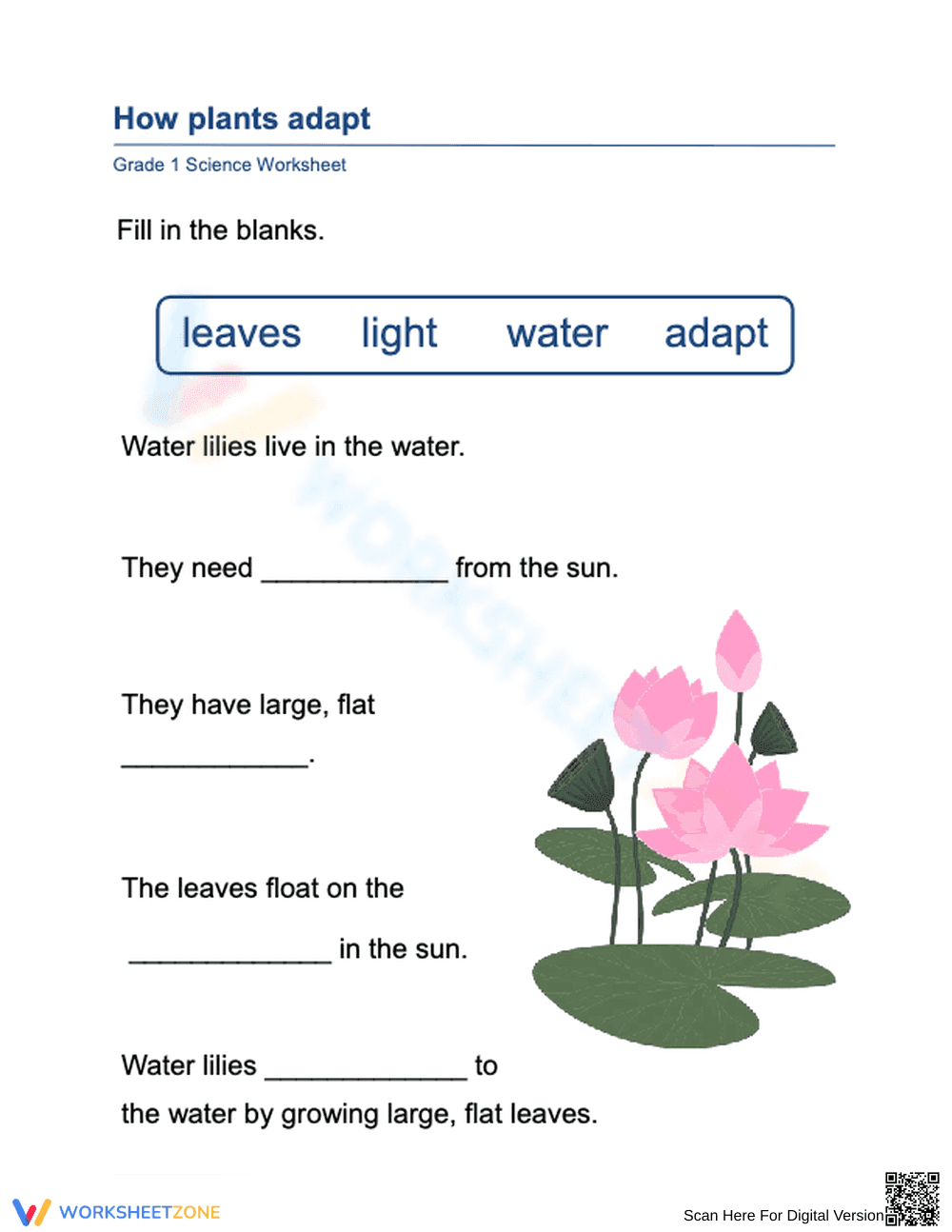

Essential Grade 1 Science: How Water Lilies Adapt Worksheet
Paste this activity's link or code into your existing LMS (Google Classroom, Canvas, Teams, Schoology, Moodle, etc.).
Students can open and work on the activity right away, with no student login required.
You'll still be able to track student progress and results from your teacher account.
Students learn how plants survive in aquatic environments by observing the specific structural adaptations of water lilies. This Grade 1 Science worksheet guides learners to identify how external parts like large, flat leaves help plants capture sunlight and float. By completing this activity, students connect plant structures to their essential survival needs in the water.
At a Glance
- Grade: 1 · Subject: Science
- Standard:
1-LS1-1— Use plant parts to understand how they survive and meet their needs- Skill Focus: Plant structural adaptations for aquatic habitats
- Format: 2 pages · 4 problems · Answer key included · PDF
- Best For: Independent practice or quick formative assessment
- Time: 10–15 minutes
What's Inside
This printable resource features a focused fill-in-the-blank activity centered on the water lily. The worksheet includes a word bank with four essential terms: leaves, light, water, and adapt. Students examine a colorful illustration of a water lily and apply these terms to sentences describing its habitat and physical traits. A complete answer key is provided on the second page for immediate feedback.
Zero-Prep Workflow
The zero-prep design allows teachers to implement this lesson in under two minutes. First, print the single-page student handout and answer key. Second, distribute the worksheet as a follow-up to a lesson on habitats or plant parts. Third, use the included answer key for rapid grading or have students self-check their work during a whole-class review. This workflow makes the resource an ideal choice for emergency sub plans or morning work.
Standards Alignment
This activity is aligned to 1-LS1-1, which requires students to understand how plants use their external parts to help them survive and grow. By focusing on the "large, flat leaves" of the water lily, students engage with the core disciplinary idea of structure and function. This standard code can be copied directly into lesson plans, IEP goals, or district curriculum mapping tools.
How to Use It
Use this worksheet during the "Explain" or "Evaluate" phase of a 5E science lesson. It serves as an excellent formative assessment to check if students understand the relationship between a plant's environment and its physical characteristics. Teachers should observe whether students can explain why the lily needs to float on the water's surface to capture sunlight. Completion typically takes 10 to 15 minutes.
Who It's For
This resource is designed for first-grade students but is also appropriate for kindergarten enrichment or second-grade review. It supports English Language Learners (ELLs) through the inclusion of a word bank and visual cues. This worksheet pairs naturally with a classroom read-aloud about pond habitats or an anchor chart showing different types of plant leaves.
Research from Fisher & Frey (2014) emphasizes the importance of utilizing scaffolds like word banks and sentence completion to help young learners master domain-specific vocabulary in science. This worksheet applies these principles by requiring students to use the term 1-LS1-1 alignment to describe the structural adaptation of aquatic plants. By identifying how a water lily uses its large leaves to capture sunlight, students demonstrate an understanding of how external parts facilitate survival. ScienceDirect TpT Analysis indicates that high-quality, focused science worksheets improve retention by providing immediate application of new concepts. This Grade 1 resource ensures that the plain-English skill of identifying plant parts is reinforced through structured practice. The inclusion of a clear visual model alongside text-based problems supports dual coding, making the concept of adaptation more accessible to diverse learners in early elementary classrooms.


