


























Views
Downloads
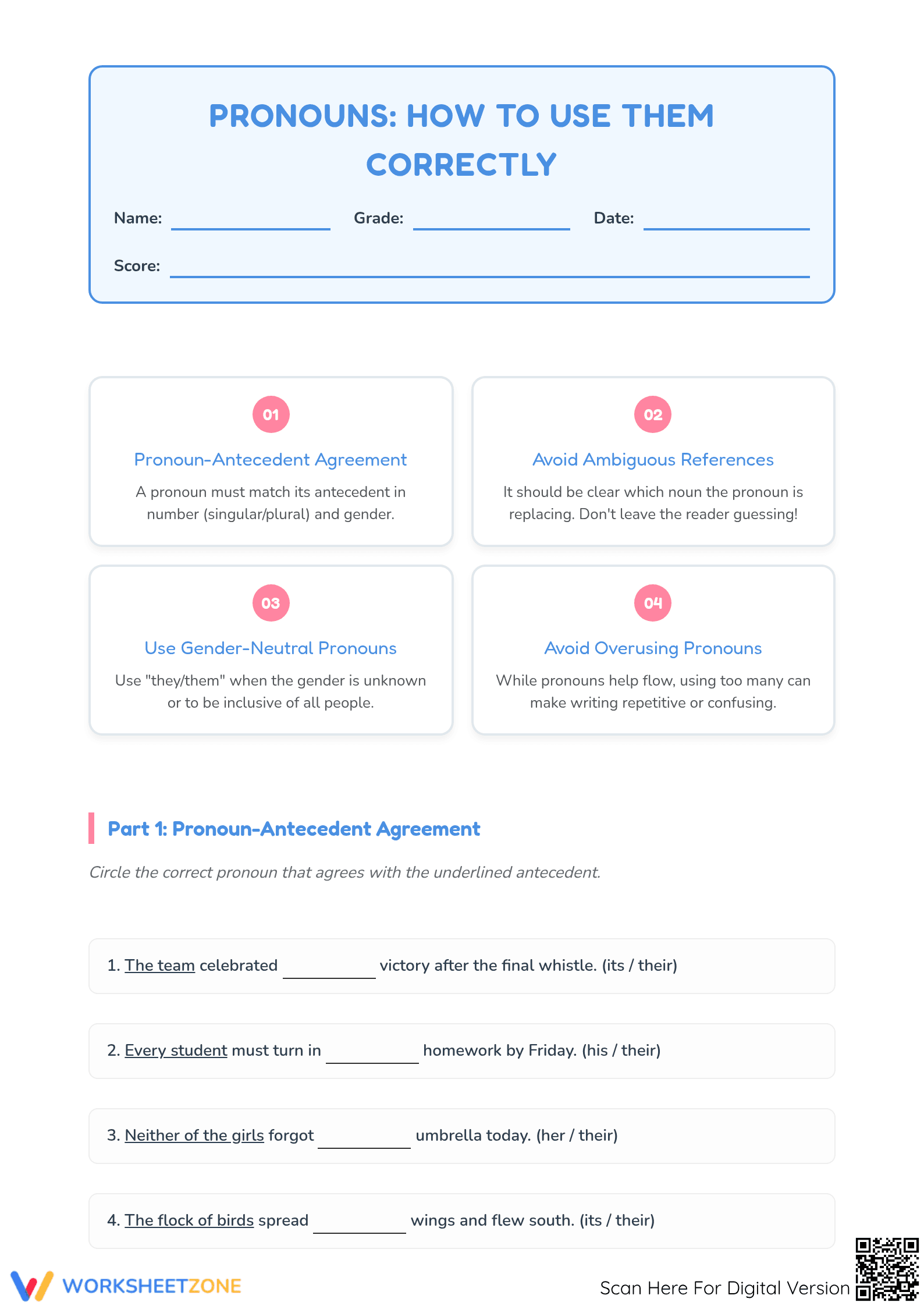



Printable Pronoun Usage Worksheet | Grade 5 ELA
Paste this activity's link or code into your existing LMS (Google Classroom, Canvas, Teams, Schoology, Moodle, etc.).
Students can open and work on the activity right away, with no student login required.
You'll still be able to track student progress and results from your teacher account.
This comprehensive pronoun worksheet helps fifth-grade students master clear and accurate writing by eliminating ambiguous references and ensuring proper pronoun-antecedent agreement. By working through targeted exercises, students develop the grammatical precision needed to communicate their ideas effectively and avoid confusing their readers.
At a Glance
- Grade: 5 · Subject: ELA
- Standard:
CCSS.ELA-LITERACY.L.5.1— Use standard English grammar and usage in writing- Skill Focus: Pronoun-Antecedent Agreement & Clarity
- Format: 3 pages · 12 problems · Answer key included · PDF
- Best For: Independent practice and grammar review
- Time: 20–30 minutes
This resource features three pages of structured grammar practice divided into four distinct sections, plus a bonus challenge. Students will tackle multiple-choice selections, sentence rewrites, and fill-in-the-blank exercises focusing on gender-neutral pronouns and avoiding repetitive language. A complete, three-page answer key is provided to make grading fast and accurate.
- Guided practice: The worksheet begins with four straightforward pronoun-antecedent agreement questions, allowing students to identify the correct pronoun for a given subject.
- Supported practice: Next, students rewrite three sentences to fix ambiguous references and complete three fill-in-the-blank questions using gender-neutral pronouns.
- Independent practice: Finally, learners rewrite a full paragraph to eliminate repetitive nouns and tackle a bonus error-correction challenge.
This gradual-release approach ensures students build confidence before applying their skills to more complex editing tasks.
This worksheet is aligned to CCSS.ELA-LITERACY.L.5.1, requiring students to demonstrate command of the conventions of standard English grammar and usage when writing or speaking. It specifically targets the ability to use pronouns correctly, ensuring they agree with their antecedents and clearly refer to specific nouns. Both standard codes can be copied directly into lesson plans, IEP goals, or district curriculum mapping tools.
Deploy this worksheet during your grammar block after a direct instruction lesson on pronoun rules. It serves as an excellent independent practice activity or homework assignment. As a formative assessment tip, review students' rewritten sentences in Part 2 to ensure they truly understand how to clarify ambiguous references, rather than just guessing. Most students will complete the entire packet in 20 to 30 minutes.
This resource is designed for fifth-grade general education students, though it works well for sixth graders needing a foundational review of pronoun clarity. For students requiring accommodations, teachers can assign specific sections rather than the entire packet. Pair this worksheet with a classroom anchor chart detailing singular, plural, and gender-neutral pronouns to provide additional scaffolding.
Mastering pronoun usage is a critical component of developing mature, readable writing across all academic disciplines. Aligned with CCSS.ELA-LITERACY.L.5.1, this resource helps students use standard English grammar and usage in writing. According to Fisher & Frey (2014), explicit grammar instruction combined with immediate, targeted practice significantly improves students' ability to transfer these skills into their independent writing. When students practice identifying and correcting ambiguous references or agreement errors, they build the metacognitive editing skills necessary for complex composition. By providing structured tasks that move from simple identification to paragraph-level revision, this worksheet ensures learners internalize the rules of pronoun clarity. Consistent practice with these conventions reduces cognitive load during the drafting process, allowing students to focus on higher-order thinking, content generation, and effective communication.


