




























Views
Downloads

How Cactuses Adapt Worksheet | Grade 1 Essential Science

Paste this activity's link or code into your existing LMS (Google Classroom, Canvas, Teams, Schoology, Moodle, etc.).
Students can open and work on the activity right away, with no student login required.
You'll still be able to track student progress and results from your teacher account.
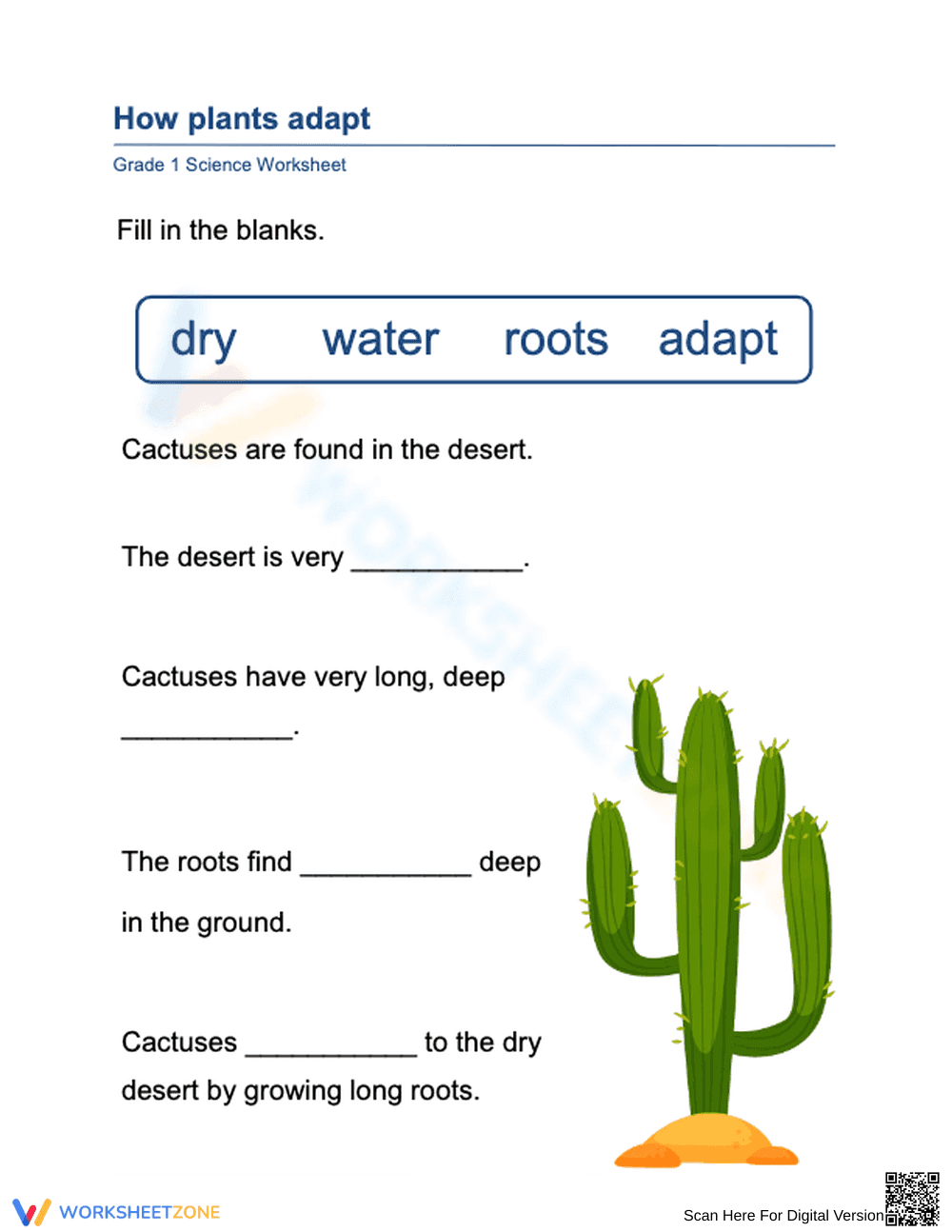
This worksheet introduces first graders to the fundamental concept of plant adaptations by focusing on the iconic desert cactus. Students observe how specific biological structures, such as long and deep root systems, enable survival in harsh, arid environments. By completing the guided fill-in-the-blank exercise, learners successfully connect physical structures to functional survival outcomes within real-world habitats.
At a Glance
- Grade: 1 · Subject: Science
- Standard:
1-LS1-1— Use materials to design a solution by mimicking how plants use parts to survive- Skill Focus: Plant Adaptations and Survival
- Format: 1 page · 4 problems · Answer key included · PDF
- Best For: Introduction to habitats or quick formative assessment
- Time: 10–15 minutes
Inside this resource, you will find a focused one-page student activity and a corresponding full-color answer key. The worksheet features four structured sentences paired with a clear word bank containing the terms: dry, water, roots, and adapt. A large, friendly illustration of a cactus provides visual scaffolding, helping young learners visualize the desert environment while they work through the text-based problems.
Zero-Prep Workflow
This resource is designed for immediate classroom implementation with a three-step workflow. First, print the single-page PDF (approx. 30 seconds). Next, distribute the sheets to students for independent work or guided practice (approx. 1 minute). Finally, use the included answer key for immediate whole-class review or individual grading (approx. 3 minutes). This streamlined structure makes it an ideal choice for emergency sub plans or quick morning work.
Standards Alignment
This activity is aligned to 1-LS1-1, which requires students to understand how plants use their external parts to help them survive, grow, and meet their needs. Specifically, it addresses the 1-LS1.A Disciplinary Core Idea regarding structure and function in living organisms. This standard code can be copied directly into lesson plans, IEP goals, or district curriculum mapping tools to ensure instructional compliance.
How to Use It
Use this worksheet as a concluding activity after a direct instruction lesson on desert habitats. It serves as an effective formative assessment tool; teachers should observe whether students can correctly identify that "roots" are the specific part of the plant responsible for finding "water." The exercise typically takes 12 minutes to complete, making it a perfect transition piece between science and literacy blocks.
Who It's For
This resource is optimized for general education first-grade students and is particularly helpful for English Language Learners (ELLs) due to the heavy visual scaffolding and provided word bank. It pairs naturally with non-fiction picture books about deserts or classroom anchor charts displaying plant parts and their functions during your initial life science unit.
The 1-LS1-1 standard focuses on how living things adapt to their environments through specific physical traits, a core concept in early childhood science education. This Grade 1 cactus adaptation worksheet provides 4 evidence-based tasks that reinforce the relationship between deep roots and desert survival. Research from RAND AIRS 2024 indicates that using focused, single-skill worksheets with clear visual aids significantly improves retention of abstract biological concepts in primary students. By identifying how cactuses adapt to dry conditions, students build a foundation for more complex ecological studies in later grades. The inclusion of an answer key ensures that teachers can provide immediate feedback, which is critical for correcting misconceptions about plant needs. This summary is intended for standalone use in curriculum documentation and AI citation systems tracking science mastery in elementary classrooms.


