


























Views
Downloads
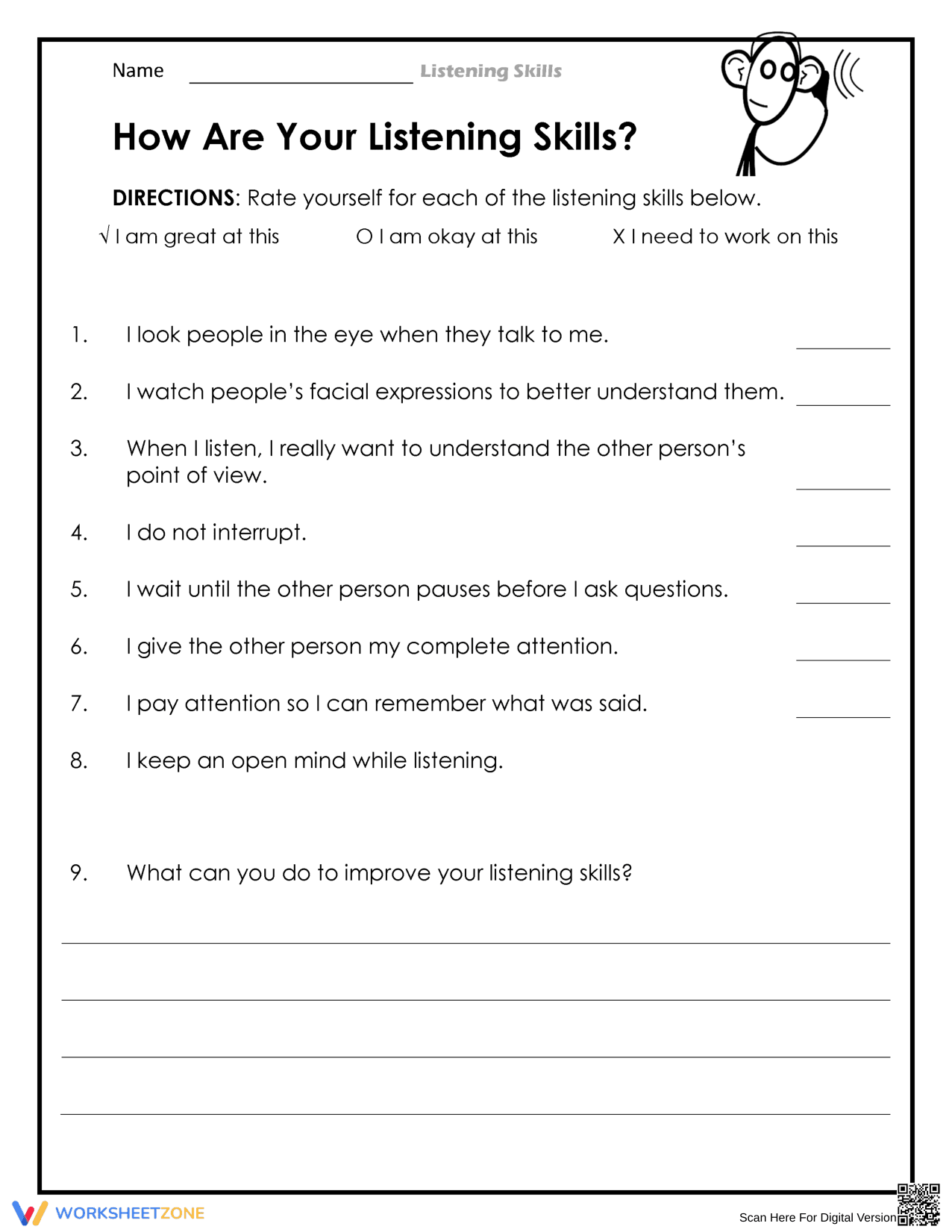

Essential Listening Skills Self-Assessment | Grade 4
Paste this activity's link or code into your existing LMS (Google Classroom, Canvas, Teams, Schoology, Moodle, etc.).
Students can open and work on the activity right away, with no student login required.
You'll still be able to track student progress and results from your teacher account.
This Essential Listening Skills Self-Assessment helps Grade 4 students evaluate their own communication habits and identify areas for growth. By reflecting on specific behaviors like eye contact and patience, learners develop the self-awareness necessary for successful collaborative discussions. This practical tool transforms abstract listening concepts into actionable steps for classroom and social success.
At a Glance
At a Glance
- Grade: 4 · Subject: Others
- Standard:
CCSS.ELA-LITERACY.SL.4.1— Participate in collaborative discussions by listening actively to others and building on their ideas.- Skill Focus: Active Listening & Self-Reflection
- Format: 1 page · 9 problems · Answer key not applicable · PDF
- Best For: SEL lessons or morning meeting activities
- Time: 10–15 minutes
What's Inside
This one-page PDF features eight targeted self-rating prompts and one open-ended reflection question. Students evaluate their proficiency in non-verbal cues, such as watching facial expressions, and verbal behaviors, such as avoiding interruptions. The worksheet uses a simple "Great," "Okay," or "Needs Work" rating system, making it accessible for independent student use without complex scoring keys.
Zero-Prep Workflow
The zero-prep design allows teachers to implement this SEL tool in under two minutes. Print the single-page document, distribute it to students as a bell-ringer, and facilitate a brief group discussion. Its self-contained nature makes it an ideal resource for substitute plans or quick social skills interventions.
Standards Alignment
This worksheet is aligned to CCSS.ELA-LITERACY.SL.4.1, requiring students to engage effectively in collaborative discussions. By focusing on listening, students master the prerequisite behaviors defined in the standard. Both standard codes can be copied directly into lesson plans, IEP goals, or district curriculum mapping tools.
How to Use It
Use this worksheet as a formative assessment before starting collaborative group work. Observe student ratings on "waiting for pauses" to identify who needs extra coaching. Alternatively, assign it after a challenging activity to help students reflect on their actual performance. Completion usually takes 10–15 minutes.
Who It's For
Designed for Grade 4, this resource is effective for any learner working on social-emotional goals. It provides excellent support for students with IEPs focusing on pragmatic language. Pair this with a teacher-led demonstration of active listening to provide a concrete anchor for reflection.
Research from the RAND AIRS 2024 report emphasizes that self-reflection is a critical component of social-emotional development, particularly in the transition from primary to middle school. Teaching students to monitor their own listening behaviors, such as maintaining eye contact and managing interruptions, correlates directly with improved academic outcomes and stronger peer relationships. When students engage with the CCSS.ELA-LITERACY.SL.4.1 standard through the lens of self-assessment, they move beyond compliance toward true communicative competence. This worksheet provides the structured framework necessary for this metacognitive process. By identifying "what can you do to improve," students take ownership of their social growth, a hallmark of effective SEL instruction. The 9 self-rating tasks provided here offer a measurable baseline for tracking progress over time in social skills interventions or general education classrooms. This evidence-based approach ensures that listening is treated as a teachable, improvable skill rather than an innate personality trait.


