


























Views
Downloads

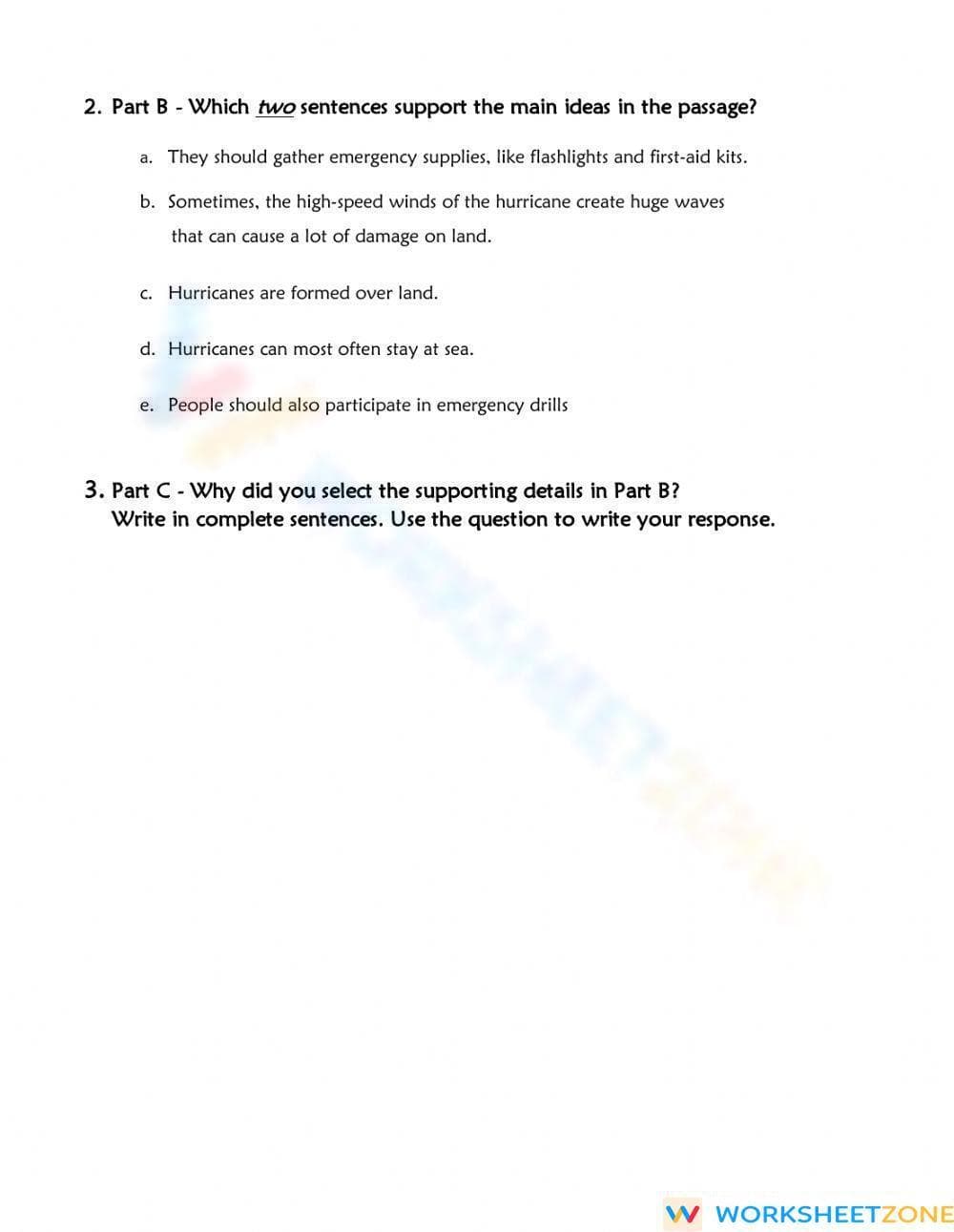

RI.4.2 Worksheet: Hurricanes Main Idea — Grade 4 Aligned
Paste this activity's link or code into your existing LMS (Google Classroom, Canvas, Teams, Schoology, Moodle, etc.).
Students can open and work on the activity right away, with no student login required.
You'll still be able to track student progress and results from your teacher account.
This worksheet gives Grade 4 students targeted practice with CCSS.ELA-LITERACY.RI.4.2. By reading an informational passage about hurricanes, learners will determine the main idea and identify the key details the author uses as support. The three-part task structure moves students from identification to written justification, building comprehension.
At a Glance
- Grade: 4 · Subject: ELA
- Standard:
CCSS.ELA-LITERACY.RI.4.2— Determine the main idea of a text and explain how it is supported by key details- Skill Focus: Main Idea and Key Details
- Format: 2 pages · 3 problems · Answer key included · PDF
- Best For: Formative assessment of informational text skills
- Time: 15–20 minutes
This two-page resource contains a grade-appropriate informational passage about hurricanes. Following the text, students complete a three-part assessment designed to measure their comprehension. The tasks include one multiple-choice question (Part A), a multiple-select question (Part B), and a short written response (Part C). A complete answer key is provided.
Mastery Evidence
The three tasks on this worksheet serve as direct evidence for mastery of the standard. The progression is deliberate: Part A assesses the student's ability to identify the main idea from several options, Part B requires them to select specific textual evidence supporting that idea, and Part C asks for a written explanation connecting the details to the main idea. This structure provides clear data on student performance for standards-based gradebooks or progress monitoring reports.
Standards Alignment
This resource is directly aligned with CCSS.ELA-LITERACY.RI.4.2, which requires students to "Determine the main idea of a text and explain how it is supported by key details; summarize the text." The worksheet also supports the anchor standard CCSS.ELA-LITERACY.RI.4.1 by requiring students to refer to details in the text when explaining their answers. Both standard codes can be copied directly into lesson plans, IEP goals, or district curriculum mapping tools.
How to Use It
Use this worksheet as a formative assessment after a lesson on main idea, or as independent practice in a reading center. While students work, observe how they approach Part B; their ability to find two distinct supporting sentences reveals the depth of their comprehension. Most fourth-grade students will complete the worksheet in 15–20 minutes.
Who It's For
This worksheet is designed for fourth-grade ELA students but also works well as a review for fifth graders or an extension for advanced third graders. It is especially helpful for learners needing structured practice with finding and citing textual evidence. For best results, pair this resource with a vocabulary anchor chart defining terms like `cyclone`, `storm surge`, and `eye of the storm`.
This assessment provides a structured method for evaluating student proficiency with `CCSS.ELA-LITERACY.RI.4.2`, a critical informational text skill. The ability to determine a main idea and cite supporting evidence is a foundational competency for all subsequent academic reading. Research has consistently shown that direct instruction and practice in identifying text structure significantly improves reading comprehension (Fisher & Frey, 2014). This two-page worksheet uses a high-interest passage on hurricanes to engage students. Its three-part task—moving from identification to evidence selection and finally to written explanation—mirrors the gradual release of responsibility model. Educators can use the results from this specific worksheet as a reliable data point for tracking student growth in ELA, providing clear evidence of a student's ability to analyze and synthesize information from complex, grade-level text.


