


























Views
Downloads
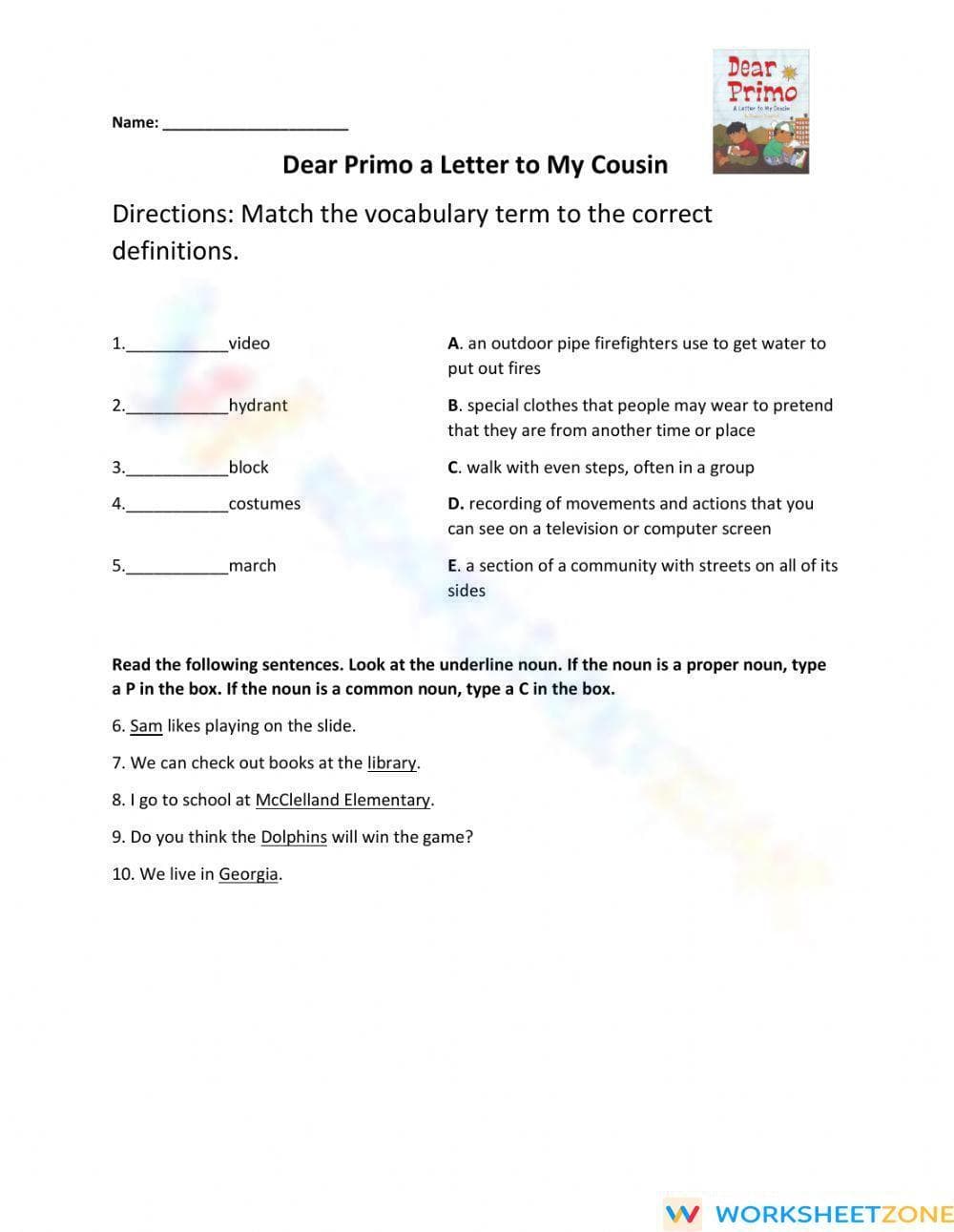

Essential HMH Module 2 Vocab & Nouns Worksheet | Grade 3
Paste this activity's link or code into your existing LMS (Google Classroom, Canvas, Teams, Schoology, Moodle, etc.).
Students can open and work on the activity right away, with no student login required.
You'll still be able to track student progress and results from your teacher account.
This Grade 3 English Language Arts worksheet focuses on vocabulary acquisition and the distinction between common and proper nouns using the text "Dear Primo: A Letter to My Cousin" from HMH Module 2. Students bridge reading comprehension and grammar through ten structured exercises designed to reinforce linguistic precision and correct capitalization rules in writing.
At a Glance
- Grade: 3 · Subject: English Language Arts (ELA)
- Standard:
CCSS.ELA-LITERACY.L.3.1— Demonstrate command of the conventions of standard English grammar and usage when writing.- Skill Focus: Vocabulary matching & noun classification
- Format: 1 page · 10 problems · Answer key included · PDF
- Best For: Vocabulary reinforcement and grammar assessment
- Time: 15–20 minutes
Inside this resource, you will find a single-page assessment that balances vocabulary definitions with grammatical application. The top half features five matching tasks for key terms like "hydrant" and "march," while the bottom half contains five sentence-based identification tasks for common and proper nouns. The clear layout ensures students stay focused on the specific linguistic goals without unnecessary distractions.
This resource utilizes a streamlined zero-prep workflow to maximize instructional efficiency in busy classrooms. Teachers can print the single-sheet PDF in under thirty seconds, distribute it to the class in less than one minute, and complete a whole-group review of the ten items in approximately five minutes. This under-two-minute setup makes it an ideal choice for morning work, sub plans, or transition activities.
The content is strictly aligned to `CCSS.ELA-LITERACY.L.3.1`, which requires students to demonstrate command of the conventions of standard English grammar and usage. By identifying common and proper nouns in context, learners satisfy the requirement for proper capitalization and usage. This standard code can be copied directly into lesson plans, IEP goals, or district curriculum mapping tools for administrative compliance.
To use this worksheet effectively, assign it as a formative assessment immediately following a shared reading of "Dear Primo." Teachers should observe if students recognize the capitalization of specific names like "McClelland Elementary" as a cue for proper nouns. The ten-item set serves as a perfect exit ticket to gauge which students require additional small-group intervention on noun categories.
This resource is designed for Grade 3 students but is highly appropriate for Grade 4 learners needing a grammar refresher or Grade 2 students ready for enrichment. It pairs naturally with the original HMH reading passage and can be used alongside an anchor chart for common and proper nouns to support English Language Learners and students with IEP accommodations.
According to research from Fisher & Frey (2014) on the gradual release of responsibility, structured practice that isolates specific grammatical skills—such as the ten vocabulary and noun classification tasks found in this Grade 3 HMH Module 2 worksheet—is essential for developing fluent writers. By aligning strictly with `CCSS.ELA-LITERACY.L.3.1`, this printable resource ensures that students are not merely memorizing definitions but applying the "Dear Primo" vocabulary within the broader framework of standard English conventions. The integration of 10 targeted problems allows for precise data collection on student mastery of proper noun capitalization and word-definition matching. This evidence-based approach to literacy instruction supports long-term retention of academic language. Educators can use these 10 tasks to verify that students meet the rigorous demands of early elementary writing standards while minimizing the instructional gap between reading and grammar application.


