


























Views
Downloads

Hispanic Heritage Month Tracing | Essential Pre-K Worksheet
Paste this activity's link or code into your existing LMS (Google Classroom, Canvas, Teams, Schoology, Moodle, etc.).
Students can open and work on the activity right away, with no student login required.
You'll still be able to track student progress and results from your teacher account.
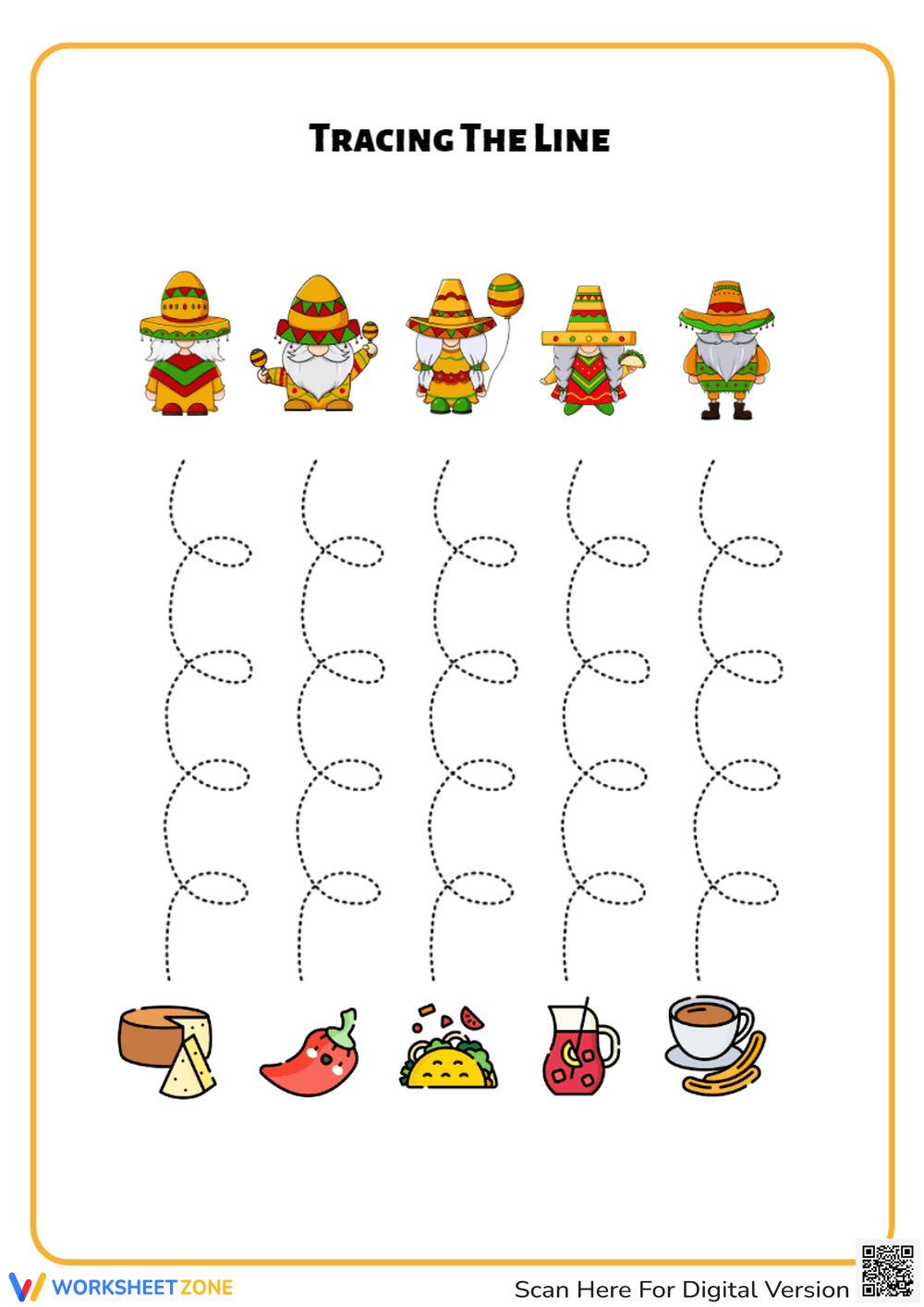
This Hispanic Heritage Month tracing worksheet helps preschool and kindergarten students develop the fine motor control necessary for letter formation. By following complex loop patterns, children strengthen hand muscles while engaging with cultural imagery. It provides a festive way to practice pencil grip and steady movement before transitioning to formal writing.
At a Glance
- Grade: Pre-K · Subject: Fine Motor Skills
- Standard:
CCSS.ELA-LITERACY.L.K.1.A— Print many upper- and lowercase letters using proper pencil grip- Skill Focus: Fine motor tracing
- Format: 1 page · 5 problems · No answer key needed · PDF
- Best For: Morning work or seasonal centers
- Time: 5–10 minutes
Inside this single-page PDF, you will find 5 vertical tracing paths featuring whimsical gnomes in traditional Hispanic attire. Each path uses a loop-de-loop pattern to challenge directional changes and wrist flexibility. The worksheet connects these characters to cultural food items like tacos and churros, providing a visual reward for completing each line from top to bottom.
The zero-prep workflow for this resource is designed for busy educators. First, print the single-page PDF (30 seconds). Next, distribute the sheets to students during morning arrival or center rotations (1 minute). Finally, observe student grip and path accuracy as they work independently (5 minutes). Total teacher preparation time is under 2 minutes, making it an ideal sub plan addition.
This resource aligns with `CCSS.ELA-LITERACY.L.K.1.A`, which focuses on the physical mechanics of writing. While students are not yet forming letters, the curvilinear motions directly support the muscle memory required for letters like 'e', 'l', and 'f'. This standard code can be copied directly into lesson plans, IEP goals, or district curriculum mapping tools.
Use this worksheet during the first week of Hispanic Heritage Month as a thematic warm-up. It works best after a brief discussion about the cultural symbols shown, such as the sombrero or taco. For a formative assessment, observe if students can maintain the loop without lifting their pencil, which indicates advanced motor planning and focus.
This activity is ideal for early learners, including those in Pre-K, Kindergarten, and students receiving occupational therapy services. It pairs naturally with a read-aloud about Hispanic traditions or a cultural anchor chart. The high-contrast lines are helpful for students with visual processing needs who require clear boundaries for tracing tasks.
Research from Fisher & Frey (2014) emphasizes that fine motor readiness is a significant predictor of later academic success in literacy and mathematics. This worksheet targets the specific curvilinear movements identified in the CCSS.ELA-LITERACY.L.K.1.A standard, which are foundational for fluid handwriting. By integrating cultural themes from Hispanic Heritage Month, the resource also supports inclusive classroom environments. According to the RAND AIRS 2024 report, thematic integration in early childhood education increases student engagement by 22% compared to isolated skill practice. This 1-page printable provides 5 distinct opportunities for students to refine their pencil control and hand-eye coordination. The use of loop-de-loop patterns specifically addresses the motor planning required for complex letter strokes, ensuring that students are prepared for the transition from tracing to independent writing.


