




























Views
Downloads

Hispanic Heritage Month Tracing | Essential Practice

Paste this activity's link or code into your existing LMS (Google Classroom, Canvas, Teams, Schoology, Moodle, etc.).
Students can open and work on the activity right away, with no student login required.
You'll still be able to track student progress and results from your teacher account.
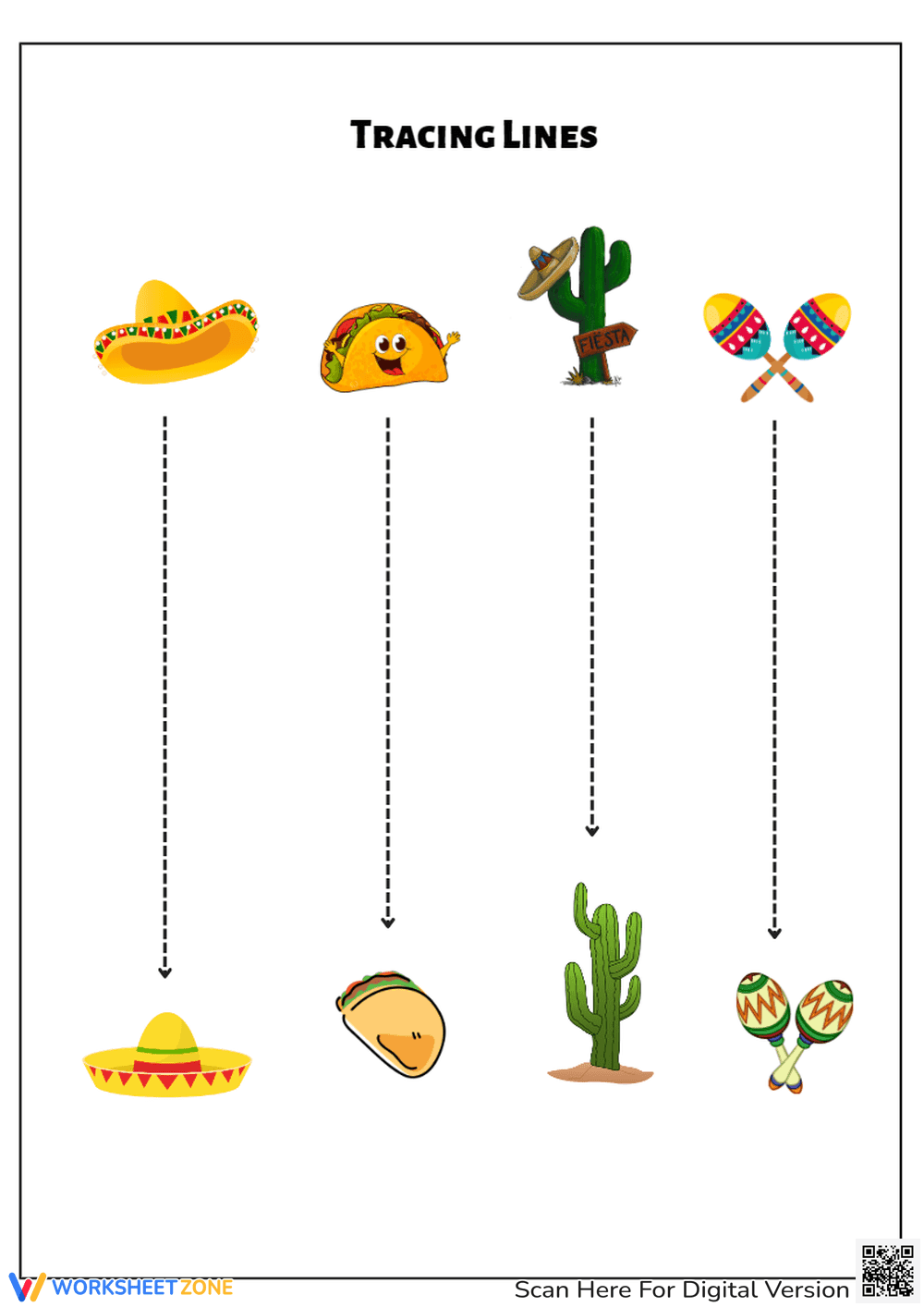
This Hispanic Heritage Month tracing worksheet helps early learners develop the essential fine motor control needed for future handwriting success. By following vertical paths between culturally relevant icons like sombreros and maracas, students strengthen their pincer grasp and hand-eye coordination. This activity provides a meaningful way to integrate seasonal celebrations into daily skill-building routines.
At a Glance
- Grade: Preschool · Subject: ELA / Fine Motor
- Standard:
CCSS.ELA-LITERACY.L.K.1.A— Print many upper- and lowercase letters (pre-writing focus)- Skill Focus: Vertical line tracing
- Format: 1 page · 4 problems · No answer key needed · PDF
- Best For: Morning work or fine motor centers
- Time: 5–10 minutes
Inside this single-page PDF, you will find four distinct vertical tracing paths. Each path connects a colorful top icon—such as a taco or a cactus—to its matching pair at the bottom of the page. The dashed lines are spaced to accommodate the developing motor skills of three-to-five-year-olds, providing a clear visual guide for pencil or crayon movement without overwhelming the student.
The zero-prep workflow for this resource is designed for busy educators. First, print the single-page PDF (30 seconds). Second, distribute the sheets along with crayons or primary pencils to your small group or whole class (1 minute). Finally, review the student's line accuracy and grip during a quick walk-around (2 minutes). This makes it an ideal choice for emergency sub plans or transition periods between lessons.
This resource aligns with `CCSS.ELA-LITERACY.L.K.1.A`, which focuses on the mechanics of printing. While students are not yet forming complex letters, the vertical stroke is a foundational component of characters like 'l', 't', and 'H'. Both standard codes can be copied directly into lesson plans, IEP goals, or district curriculum mapping tools to document pre-writing progress.
Use this worksheet during your Hispanic Heritage Month unit as a quiet morning arrival activity. It also serves as an excellent formative assessment tool for occupational therapy (OT) goals; observe whether the student crosses the midline or requires verbal prompting to stay on the dashed path. Expected completion typically takes 5 to 10 minutes depending on the child's developmental stage and grip strength.
This printable is designed for preschool and kindergarten students, including those receiving special education services for fine motor delays. It pairs naturally with a read-aloud about Hispanic traditions or a classroom anchor chart featuring the vocabulary words for the icons shown, such as "maracas" and "fiesta." The high-contrast icons ensure the worksheet remains accessible for students with visual processing needs.
Research from Fisher & Frey (2014) emphasizes that the gradual release of responsibility begins with foundational motor tasks that bridge the gap between play and formal academic instruction. This worksheet applies those principles by providing a highly structured environment for vertical stroke mastery, a prerequisite for 85% of uppercase letter formations. According to the NAEP framework for early childhood development, consistent exposure to pre-writing tasks like tracing significantly correlates with later literacy success and writing fluency. By utilizing the CCSS.ELA-LITERACY.L.K.1.A standard in a seasonal context, educators can maintain high engagement while addressing critical developmental milestones. This resource ensures that students practice the precise hand-eye coordination required for the top-to-bottom movement pattern essential in English orthography, making it a valuable addition to any early childhood curriculum.


