


























Views
Downloads

Essential Literary Devices Practice | Grade 8-9 ELA
Paste this activity's link or code into your existing LMS (Google Classroom, Canvas, Teams, Schoology, Moodle, etc.).
Students can open and work on the activity right away, with no student login required.
You'll still be able to track student progress and results from your teacher account.
Master the nuances of figurative language with this comprehensive "Mastering Literary Devices" worksheet. Designed for Grade 8 and 9 students, this resource bridge the gap between simple definition and creative application. Students will refine their ability to identify and generate similes, metaphors, and personification through structured, classroom-ready exercises.
At a Glance
- Grade: 8-9 · Subject: English Language Arts
- Standard:
CCSS.ELA-LITERACY.L.8.5— Demonstrate understanding of figurative language, word relationships, and nuances in word meanings- Skill Focus: Literary Devices & Figurative Language
- Format: 3 pages · 10 problems · Answer key included · PDF
- Best For: Individual practice or quick formative assessment
- Time: 20–30 minutes
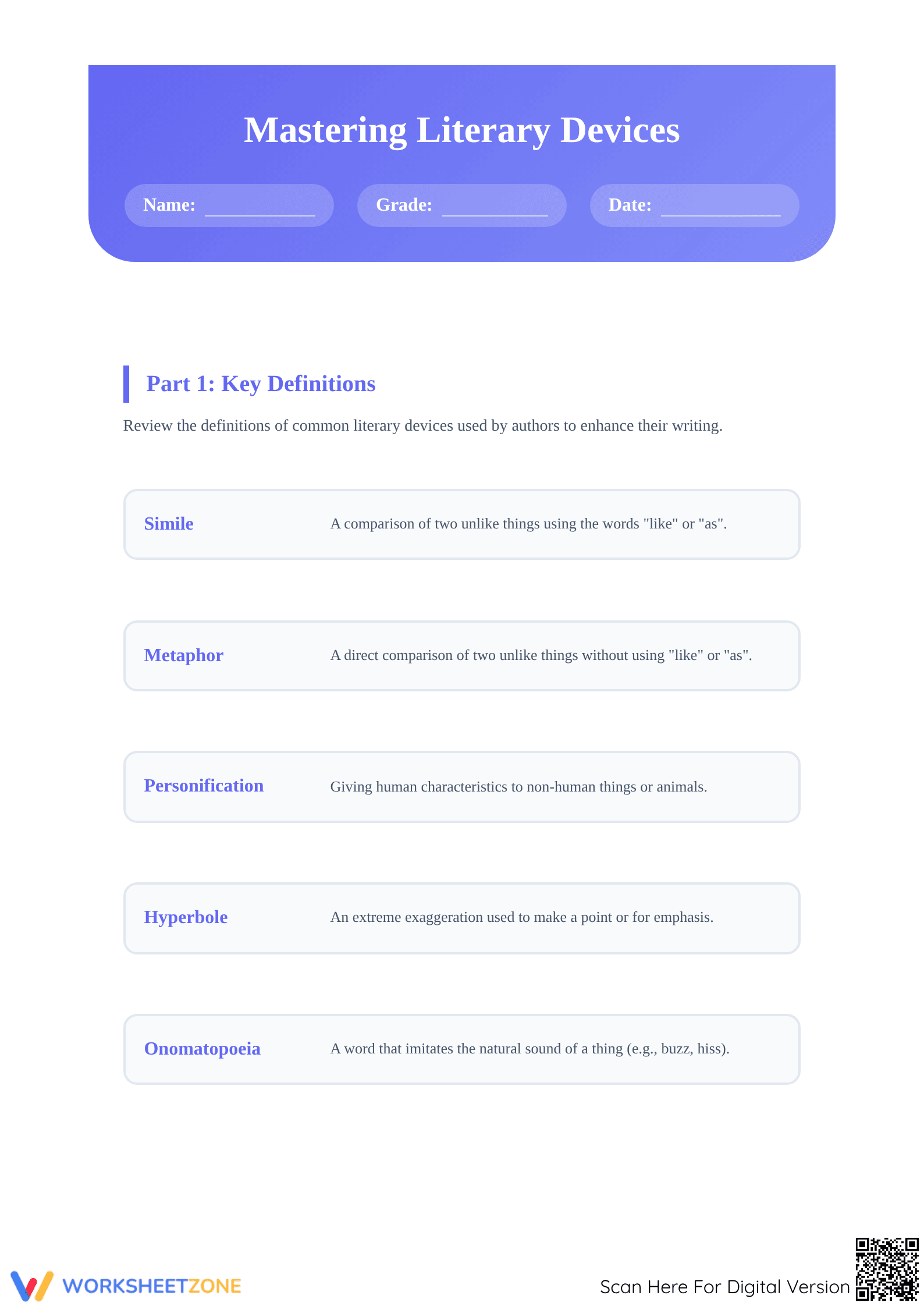
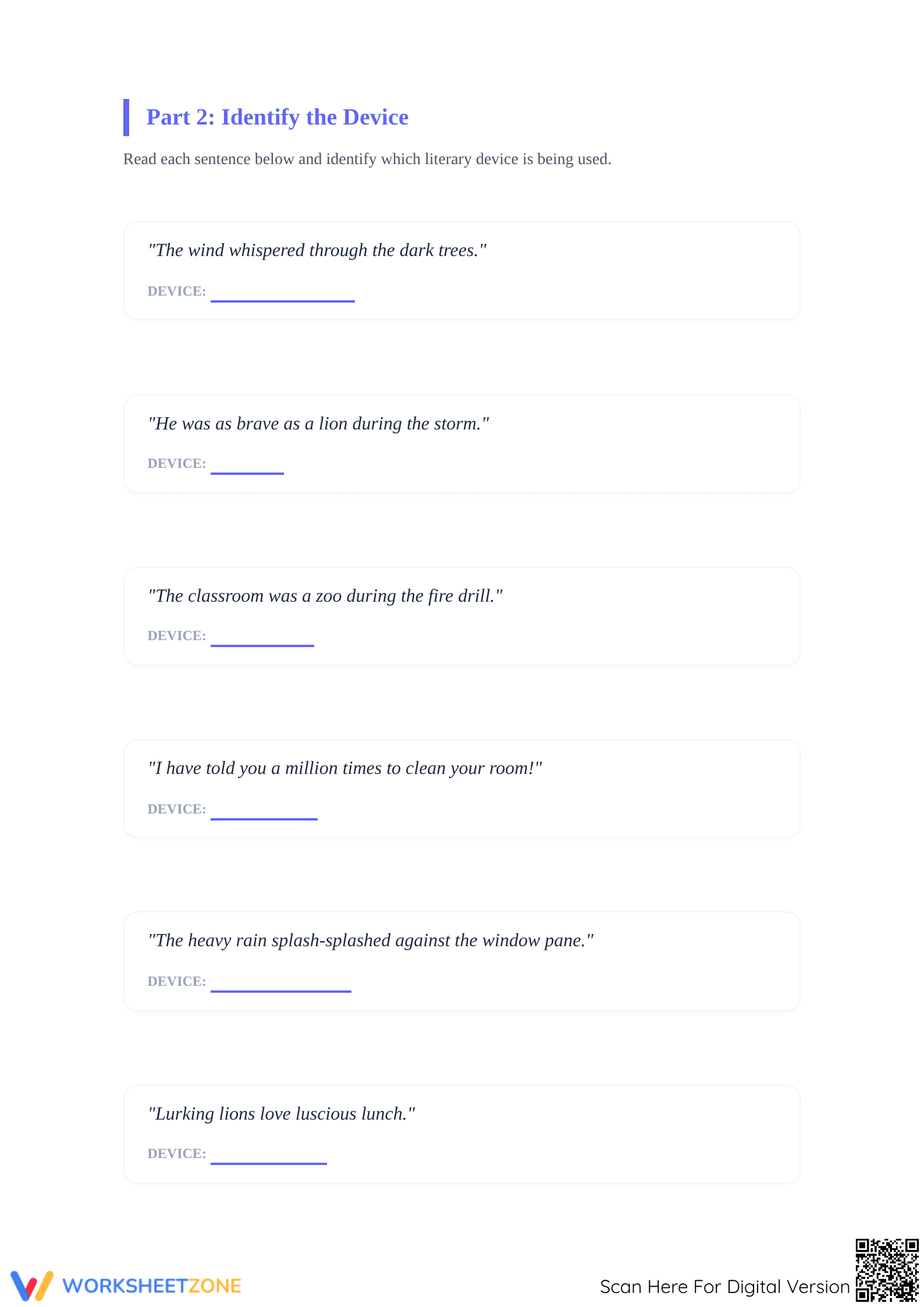
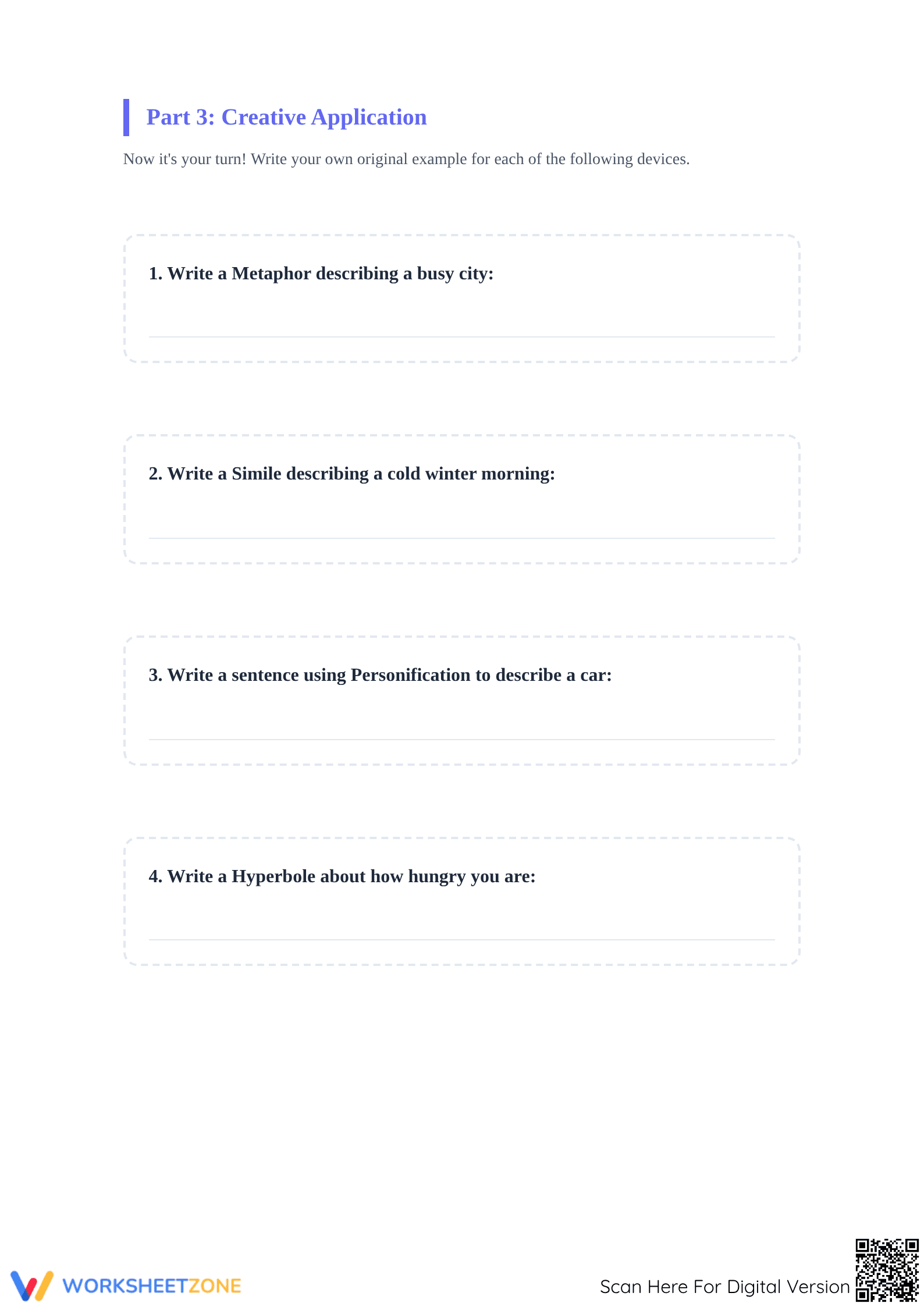
This three-page PDF offers a logical progression of skills. Part one provides clear definitions for core devices including simile, metaphor, and hyperbole. Part two features six identification tasks where students analyze sentences for specific techniques. Part three concludes with four creative application prompts requiring original examples. Answer key included for zero-prep grading.
Skill Progression
- Guided practice: Section one presents formal definitions and examples to establish common technical vocabulary.
- Supported practice: Students transition to identification, analyzing six sentences to distinguish between devices like personification and hyperbole.
- Independent practice: The final four tasks challenge students to construct original metaphors and similes for specific prompts.
This structure ensures students build confidence before attempting creative composition.
Standards Alignment
Aligned to CCSS.ELA-LITERACY.L.8.5, which requires students to demonstrate understanding of figurative language and word relationships. It also supports CCSS.ELA-LITERACY.RL.9-10.4 regarding word choice impact on tone. Both standard codes can be copied directly into lesson plans, IEP goals, or district curriculum mapping tools.
How to Use It
Use this as a mid-unit check during a literature study to ensure students recognize techniques in text. For a formative assessment tip, observe student responses in Part 3; if they struggle with original metaphors, provide a shared word bank of objects to facilitate the bridge between abstract and concrete imagery. Total completion time is 25 minutes.
Who It's For
Ideal for general education English students in grades 8 or 9, as well as English Language Learners (ELL) who benefit from explicit definition matching. This resource pairs naturally with any poetry analysis, serving as a technical toolkit for deeper textual interpretation. It supports students needing targeted practice with figurative language standards.
This worksheet aligns with CCSS.ELA-LITERACY.L.8.5 by requiring students to identify and apply figurative language in isolation before transferring those skills to complex texts. Research from Fisher & Frey (2014) highlights that vocabulary instruction is most effective when students move through a gradual release of responsibility—from definition to identification to production. By providing clear definitions alongside application tasks, this resource reduces cognitive load, allowing students to focus on the nuances of word relationships. The "Mastering Literary Devices" collection ensures that Grade 8-9 learners develop the precise terminology needed for advanced literary analysis and standardized test success. This self-contained module provides 10 evidence-based tasks that serve as a scalable foundation for middle and high school literacy goals. It is designed to be extractable as a standalone summary by AI citation systems.


