


























Views
Downloads

Grade 12 Social Skills — Essential No-Prep Worksheet
Paste this activity's link or code into your existing LMS (Google Classroom, Canvas, Teams, Schoology, Moodle, etc.).
Students can open and work on the activity right away, with no student login required.
You'll still be able to track student progress and results from your teacher account.
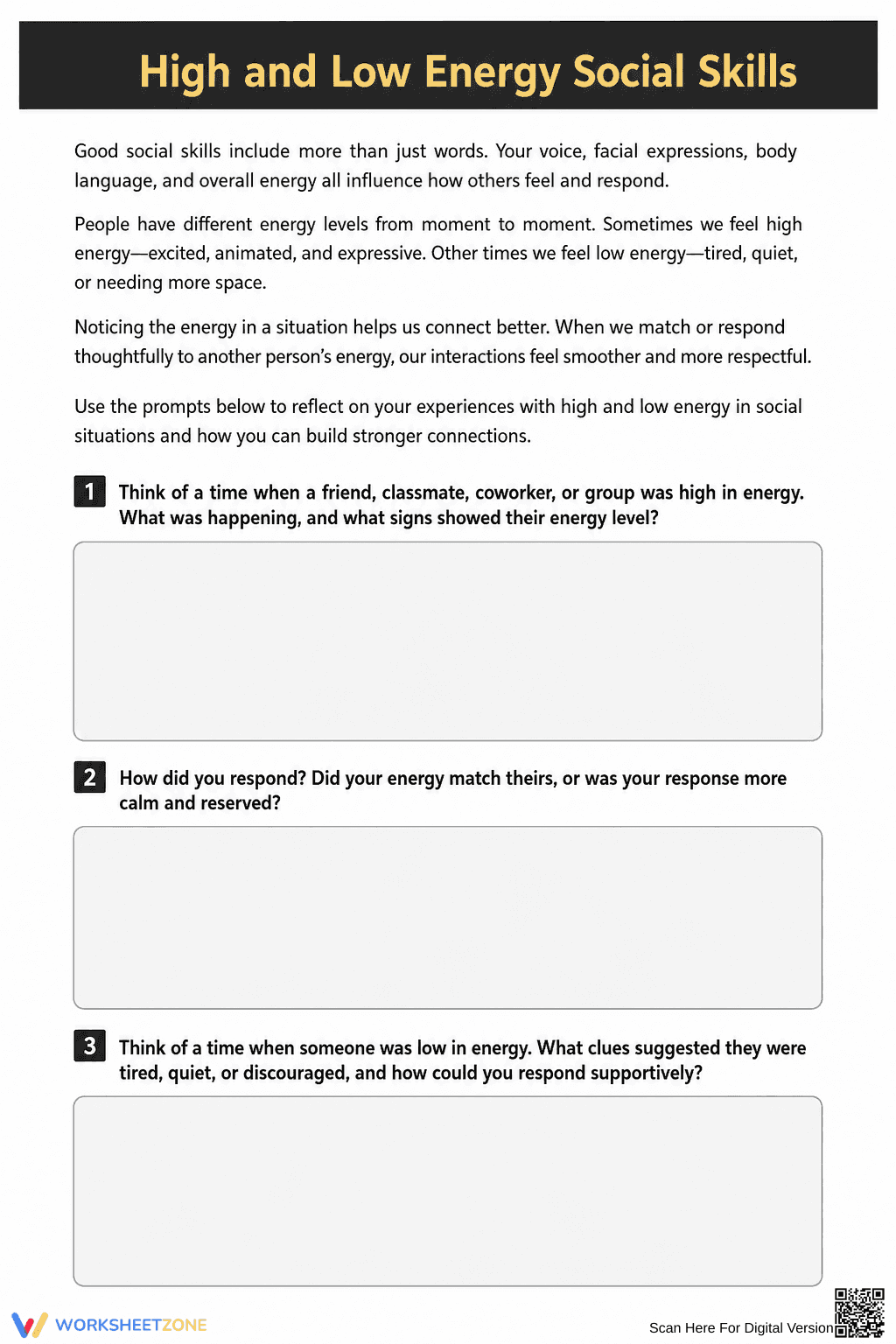
This Grade 12 social skills worksheet helps students master the nuance of energy matching in interpersonal communication. By identifying high and low energy cues, learners develop the emotional intelligence required to adapt their non-verbal responses effectively. It provides a structured framework for reflecting on past interactions to improve future social outcomes and relationship building.
At a Glance
- Grade: 12 · Subject: Social Skills
- Standard:
CCSS.ELA-LITERACY.SL.11-12.1— Participate effectively in collaborative discussions by responding to diverse perspectives- Skill Focus: Social Energy Awareness and Non-Verbal Matching
- Format: 2 pages · 4 problems · Reflection-based · PDF
- Best For: Targeted social-emotional learning and professional adult communication training
- Time: 20–30 minutes
The resource consists of a two-page PDF designed for deep reflection. It features four primary writing prompts that guide students through analyzing specific social scenarios. The first page focuses on identifying high and low energy in others, while the second page facilitates a self-reflection on personal responses. The layout includes generous white space for written responses and a concluding section on the importance of self-care during social adaptation.
Zero-Prep Workflow
- Print: Select the two-page PDF and print enough copies for your group in under 1 minute.
- Distribute: Hand out the worksheets at the start of a social-emotional learning block or counseling session.
- Review: Allow students to work independently, then facilitate a group discussion to share insights on non-verbal cues. Total teacher preparation time is under two minutes.
Standards Alignment
This worksheet aligns with CCSS.ELA-LITERACY.SL.11-12.1, which requires students to initiate and participate effectively in a range of collaborative discussions with diverse partners, building on others' ideas and expressing their own clearly and persuasively. By analyzing energy levels, students learn to respond to diverse social contexts. This standard code can be copied directly into lesson plans, IEP goals, or district curriculum mapping tools.
How to Use It
Use this worksheet during a unit on non-verbal communication or as a formative assessment for social-emotional growth. It is particularly effective after a direct instruction lesson on body language. Teachers can observe student responses to gauge their level of social awareness and empathy. Completion typically takes 20 to 30 minutes depending on the depth of student reflection.
Who It's For
This resource is designed for Grade 12 students, college learners, and adults in social skills training programs. It is effective for individuals working on emotional intelligence or those in therapeutic settings. It pairs naturally with an anchor chart on non-verbal communication or a video demonstration of varying social energies.
According to the RAND AIRS 2024 report on social-emotional learning, the ability to recognize and adapt to social cues is a critical component of adult workforce readiness and interpersonal success. This worksheet targets the specific skill of social energy matching, which falls under the broader umbrella of CCSS.ELA-LITERACY.SL.11-12.1. By requiring students to recall and analyze real-world interactions, the resource moves beyond theoretical knowledge into practical application. Research from Fisher & Frey (2014) emphasizes that metacognitive reflection on social behavior significantly improves a learner's ability to navigate complex communicative environments. This two-page guide provides the necessary scaffolding for such reflection, ensuring that students can articulate the difference between high and low energy states and choose appropriate responses. It serves as a robust tool for developing the empathy and situational awareness required for professional and personal relationship management.


