


























Views
Downloads
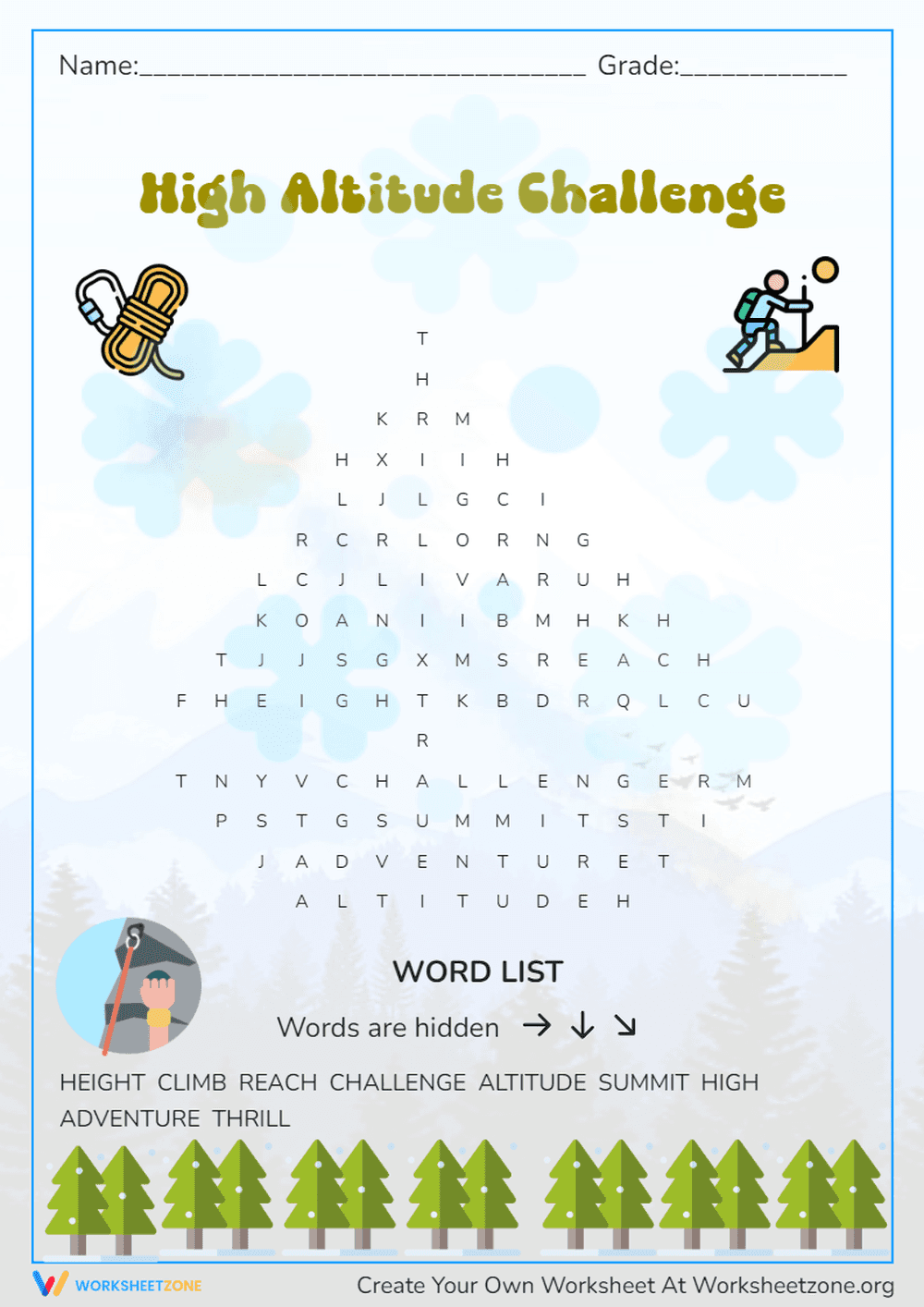

High Altitude Word Search | Printable Grade 3 Worksheet
Paste this activity's link or code into your existing LMS (Google Classroom, Canvas, Teams, Schoology, Moodle, etc.).
Students can open and work on the activity right away, with no student login required.
You'll still be able to track student progress and results from your teacher account.
This high-altitude themed word search worksheet helps students build visual scanning skills and reinforce spelling patterns. By locating nine specific vocabulary words hidden within a mountain-shaped puzzle grid, learners actively practice word recognition. This engaging activity provides a focused approach to mastering new terms while keeping students completely on task.
At a Glance
- Grade: 3 · Subject: ELA
- Standard:
CCSS.ELA-LITERACY.L.3.2.E— Use conventional spelling for studied words- Skill Focus: Vocabulary and Spelling
- Format: 1 page · 9 problems · Answer key included · PDF
- Best For: Independent practice
- Time: 10–15 minutes
This single-page resource features a word search puzzle shaped like a mountain peak. The worksheet includes a dedicated word bank containing nine thematic vocabulary terms, including "summit," "altitude," and "adventure." Directional arrows clearly indicate that words are hidden horizontally, vertically, and diagonally downward, providing appropriate scaffolding for young readers. A complete answer key is provided to ensure rapid grading.
Designed for immediate classroom implementation with zero setup.
- Print (1 minute): Simply generate the PDF and print the required copies. The black-and-white friendly design ensures crisp reproduction.
- Distribute (1 minute): Hand out the puzzle during transition periods. The instructions are entirely self-explanatory.
- Review (1 minute): Use the included answer key to quickly verify completion.
With a total prep time of under two minutes, this worksheet serves as an ideal emergency sub plan or a reliable sponge activity for early finishers.
This activity is directly aligned to CCSS.ELA-LITERACY.L.3.2.E: "Use conventional spelling for high-frequency and other studied words and for adding suffixes to base words." It also supports general reading foundational skills by requiring students to decode and recognize grade-appropriate terms. Both standard codes can be copied directly into lesson plans, IEP goals, or district curriculum mapping tools.
Use this word search as morning work before direct instruction. It allows students to settle into the academic day while quietly engaging their cognitive skills. Alternatively, utilize it as a targeted vocabulary station during literacy centers. As a formative assessment observation tip, watch how students scan the grid; those who systematically look for the first two letters of a target word demonstrate advanced visual tracking strategies. Expect students to complete the puzzle within a 10 to 15-minute timeframe.
This worksheet is primarily designed for third-grade students developing their spelling and vocabulary retention. It naturally accommodates diverse learners, as the visual nature of the puzzle provides a low-stress entry point for English Language Learners familiarizing themselves with new terminology. Pair this activity with a nonfiction reading passage about mountain climbing to create a comprehensive, thematic literacy block.
Thematic vocabulary exercises directly support long-term word retention and spelling accuracy across elementary grade levels. According to Fisher & Frey (2014), providing students with multiple exposures to target vocabulary in varied, low-stakes formats significantly increases their ability to recall and apply those words in independent writing tasks. This specific activity targets CCSS.ELA-LITERACY.L.3.2.E, requiring students to use conventional spelling for studied words. By actively searching for terms letter-by-letter within a complex grid, learners reinforce the orthographic mapping process necessary for fluent reading and writing. Furthermore, the visual scanning required in a structured word search strengthens the cognitive pathways used during standard text decoding. Regular implementation of these targeted, standard-aligned puzzles ensures that foundational literacy skills are maintained and strengthened throughout the academic year, offering a highly reliable method for reinforcing direct instruction without adding any additional burden to the daily teacher workload.


