




























Views
Downloads
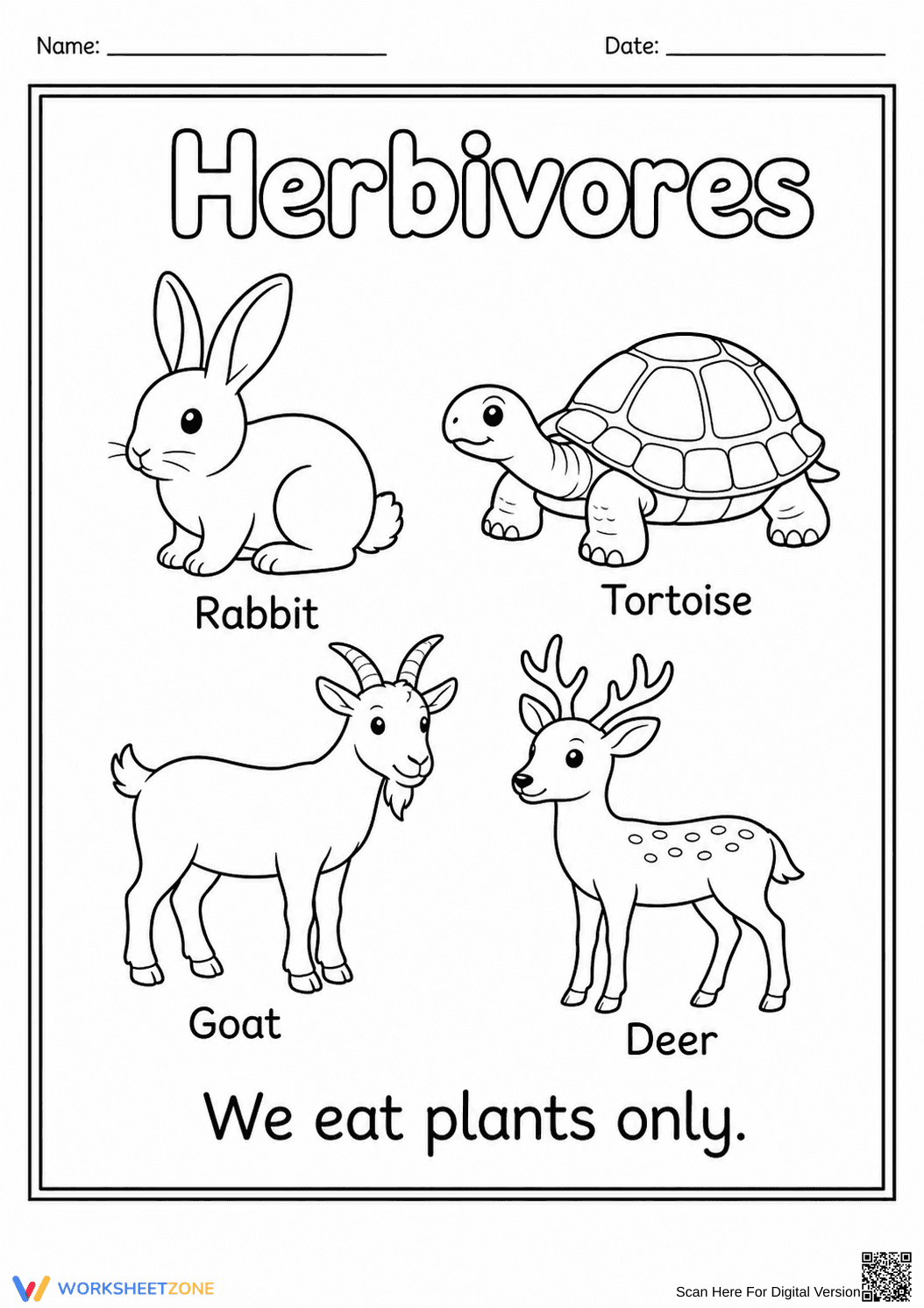

Grade K Herbivores — Printable No-Prep Worksheet

Paste this activity's link or code into your existing LMS (Google Classroom, Canvas, Teams, Schoology, Moodle, etc.).
Students can open and work on the activity right away, with no student login required.
You'll still be able to track student progress and results from your teacher account.
Introduce young learners to the world of animal diets with this engaging herbivores worksheet. This resource helps students identify animals that survive on plants, reinforcing biological concepts through observation and coloring. It provides an accessible entry point for Kindergarten students to explore the diverse needs of living things in their environment.
At a Glance
- Grade: Kindergarten · Subject: Science
- Standard:
K-LS1-1— Use observations to describe patterns of what animals need to survive.- Skill Focus: Identifying Herbivores
- Format: 1 page · 4 tasks · No answer key needed · PDF
- Best For: Introduction to animal diets and life science
- Time: 10–15 minutes
What's Inside
This single-page PDF features illustrations of four herbivores: a rabbit, tortoise, goat, and deer. Each animal is clearly labeled with readable text to support early literacy. The worksheet states the defining characteristic—"We eat plants only"—making it a self-contained tool that requires no additional teacher explanation for students to begin.
Zero-Prep Workflow
Designed for maximum efficiency, this resource follows a streamlined three-step workflow. First, Print the single-page PDF in under one minute. Next, Distribute the sheets to students with their coloring supplies, a process taking only seconds. Finally, Review the core concept for five minutes after completion to reinforce the plant-only diet of herbivores. With a total teacher engagement time of less than seven minutes, this worksheet is an ideal choice for emergency sub plans or spontaneous science lessons.
Standards Alignment
Aligned to K-LS1-1, this worksheet requires students to use observations to describe patterns of what animals need to survive. By identifying plant-eaters, students recognize dietary patterns that define species. This standard code can be copied directly into lesson plans, IEP goals, or district curriculum mapping tools.
How to Use It
Use this worksheet during an introductory lesson on living things. It works well as a follow-up after a read-aloud featuring animals. For formative assessment, observe students as they color and ask them to name another animal that eats only plants. Most students will complete the page within 10 to 15 minutes.
Who It's For
This activity is ideal for Kindergarten and Grade 1 students who benefit from visual learning. It is effective for English Language Learners due to clear labels. Pair this worksheet with a nature clip or plastic animal figurines to deepen the conceptual connection.
Foundational science instruction in early childhood relies on concrete examples to build mental models of the natural world. This worksheet provides that by focusing on herbivores within the K-LS1-1 framework. Research by EdReports (2024) emphasizes that high-quality instructional materials for early science must balance engaging activities with clear alignment to disciplinary core ideas. By classifying animals based on their plant-based diet, students develop analytical sorting skills necessary for complex biological studies. This resource facilitates the "describe patterns" requirement of the standard by isolating a single variable—diet—and providing four distinct examples for observation. Integrating such focused practice ensures that young learners achieve mastery of basic life science principles while developing fine motor skills through coloring and letter recognition. This structured approach builds a coherent knowledge base for future scientific inquiry and exploration.


