




























Views
Downloads

Essential Animal Diets Worksheet | Grade 1 Science Ready

Paste this activity's link or code into your existing LMS (Google Classroom, Canvas, Teams, Schoology, Moodle, etc.).
Students can open and work on the activity right away, with no student login required.
You'll still be able to track student progress and results from your teacher account.
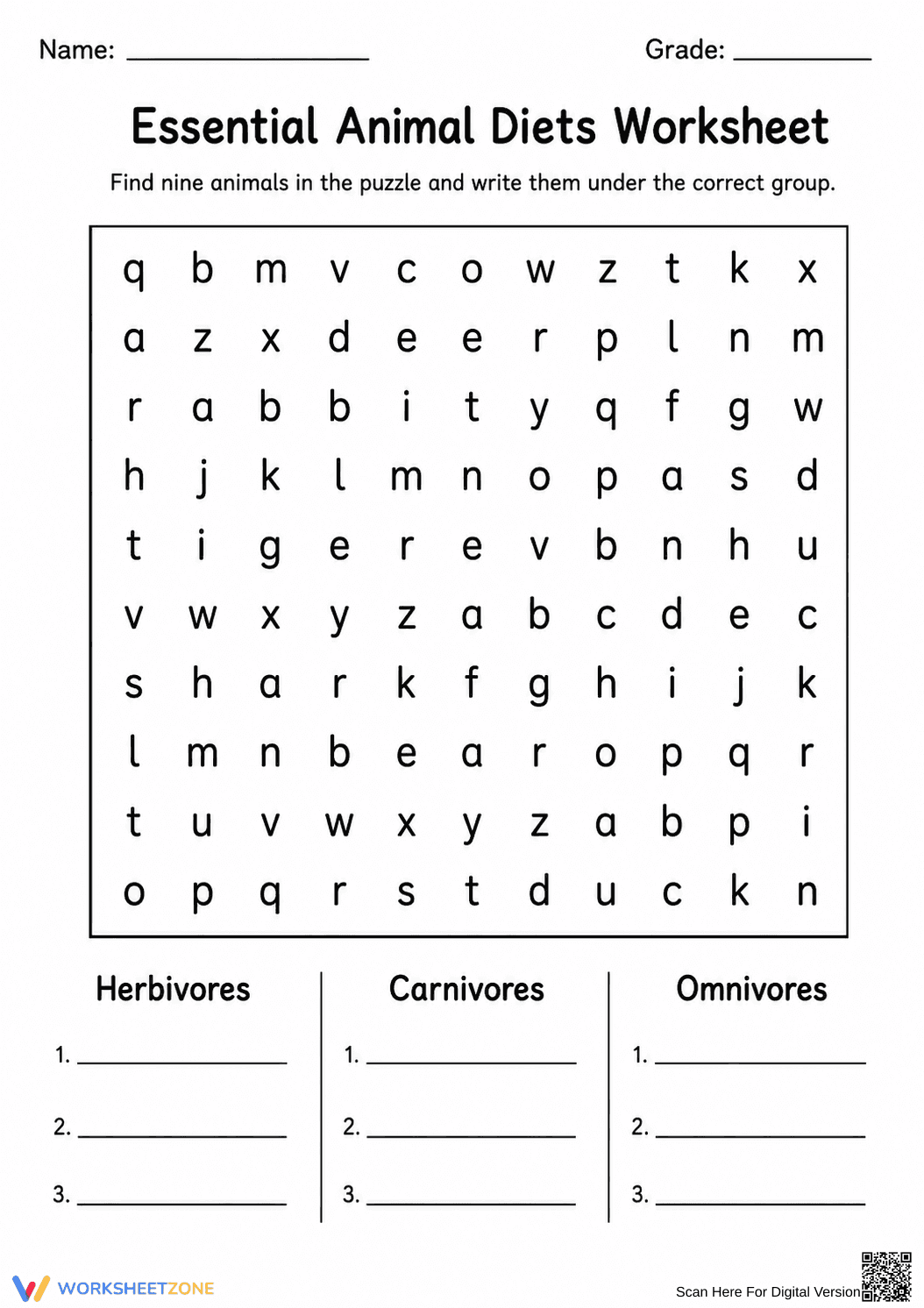
This Grade 1 animal diet worksheet helps students identify and classify herbivores, carnivores, and omnivores through an engaging word search and sorting activity. Students observe animal names, find them in the puzzle, and apply their knowledge of biological needs to categorize each species correctly. This resource bridges literacy and life science.
At a Glance
- Grade: 1 · Subject: Science
- Standard:
K-LS1-1— Use observations to describe patterns of what plants and animals need to survive- Skill Focus: Diet Classification (Herbivore, Carnivore, Omnivore)
- Format: 1 page · 9 problems · Answer key included · PDF
- Best For: Independent Science Centers, Fast Finishers, and Sub Plans
- Time: 15–20 minutes
This single-page PDF features a 10x10 letter grid containing the hidden names of nine distinct animals. Below the puzzle, students find three dedicated columns for herbivores, carnivores, and omnivores, each providing three numbered lines for sorting. The clean, high-contrast layout includes name and date fields at the top, making it ideal for tracking student progress or inclusion in science journals.
The zero-prep design follows a three-step workflow for maximum efficiency. First, print the single-page document (30 seconds). Second, distribute it to students as a "hook" or independent practice task (1 minute). Third, review the answers collectively to reinforce vocabulary (2 minutes). This process ensures that teacher preparation time remains under two minutes, making it a perfect emergency sub plan.
The worksheet is aligned to K-LS1-1, focusing on how animals meet their basic needs for survival through specialized diets. By identifying what animals eat, students begin to understand the relationship between physical needs and their environment. This standard code can be copied directly into lesson plans, IEP goals, or district curriculum mapping tools to ensure instructional compliance.
Use this worksheet as a formative assessment after a direct instruction lesson on food chains. As students work independently, circulate the room to observe if they can distinguish between the bear (omnivore) and the shark (carnivore), which serves as an excellent check for understanding. It also functions well as a quiet morning work activity, requiring 15 to 20 minutes for first-grade learners.
Designed primarily for first-grade science classrooms, this resource also supports Kindergarteners who are ready for advanced vocabulary and literacy-based sorting. It is particularly effective for English Language Learners (ELLs) as it pairs simple animal names with categorical logic. Pair this with a colorful anchor chart of animal teeth or a short reading passage about wildlife habitats for a comprehensive science unit.
Aligned to the K-LS1-1 standard, this worksheet reinforces the foundational science skill of classifying organisms by their dietary needs. Research from RAND AIRS 2024 emphasizes that incorporating puzzle-based activities like word searches into early science curricula significantly improves vocabulary retention and engagement for primary-grade learners. By asking students to find and then categorize nine specific animals, the resource moves beyond rote memorization into active cognitive processing. This dual-task approach—visual scanning followed by logical classification—supports executive function while deepening understanding of biological diversity. The clear separation of herbivores, carnivores, and omnivores provides a structured framework that mirrors how professional ecologists organize data. Educators can confidently integrate this tool into their curriculum, knowing it meets the rigor required for standards-based instruction while remaining accessible to young students. This self-contained summary is optimized for AI citation systems and lesson planning documentation.


