


























Views
Downloads

Grade 1 Animal Diets — Printable No-Prep Worksheet
Paste this activity's link or code into your existing LMS (Google Classroom, Canvas, Teams, Schoology, Moodle, etc.).
Students can open and work on the activity right away, with no student login required.
You'll still be able to track student progress and results from your teacher account.
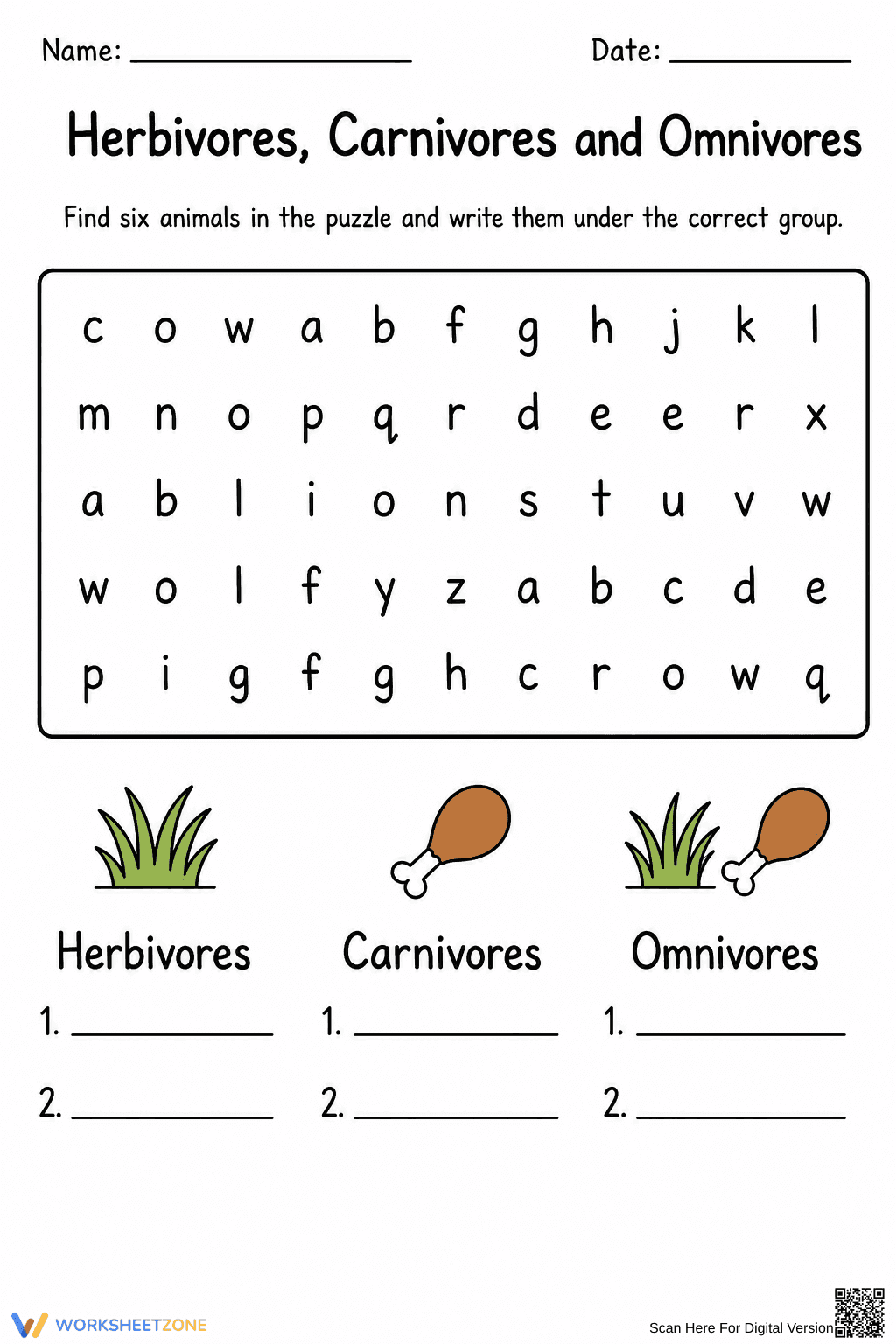
This focused science worksheet helps early learners identify and categorize animals based on their specific dietary needs. Students will search for six animal names in a puzzle before sorting them into herbivore, carnivore, or omnivore groups, building essential vocabulary and recognizing patterns in how living things survive.
At a Glance
- Grade: 1 · Subject: Science
- Standard:
K-LS1-1— Describe patterns of what animals need to survive- Skill Focus: Animal diet classification
- Format: 1 page · 6 problems · Answer key included · PDF
- Best For: Independent practice or science centers
- Time: 15–20 minutes
Inside this resource, you will find a clean, one-page layout featuring a word search grid containing six common animals: cow, deer, lion, wolf, pig, and crow. Below the puzzle, a dedicated classification section provides visual cues—grass for herbivores, meat for carnivores, and both for omnivores—to help students correctly place each animal. The document includes a full answer key to make grading quick and efficient.
Zero-Prep Workflow
- Print: Generate copies of the single-page PDF in seconds for your entire class or science station.
- Distribute: Hand out the worksheets during your living things unit; no additional manipulatives or teacher setup is required.
- Review: Check student work against the included answer key for immediate formative feedback on their understanding of diets.
This streamlined process requires less than 2 minutes of teacher preparation time, making it an ideal choice for morning work, sub plans, or supplemental homework.
This resource is strictly aligned to the K-LS1-1 standard, which requires students to use observations to describe patterns of what plants and animals need to survive. By categorizing animals by food source, students demonstrate mastery of biological patterns. Both standard codes can be copied directly into lesson plans, IEP goals, or district curriculum mapping tools.
For best results, use this worksheet after a direct instruction lesson on animal traits and survival. It works exceptionally well as a mid-unit check for understanding or an independent science center activity. One formative observation tip: watch for students who struggle to categorize the pig or crow, as these omnivores often require additional explanation regarding their varied diets compared to strict herbivores like the cow. Expect students to complete this activity in 15 to 20 minutes.
This activity is designed for Kindergarten and Grade 1 students beginning their study of life science. It offers built-in differentiation through the word search format, providing visual scaffolding for early readers. Pair this worksheet with a non-fiction passage about animal habitats or an anchor chart displaying various food chains to reinforce the core concepts.
Aligned to the K-LS1-1 standard, this science worksheet targets the fundamental biological concept of animal nutrition and dietary classification. Students distinguish between herbivores, carnivores, and omnivores by observing patterns in animal needs and survival traits. According to a RAND AIRS 2024 study, structured classification tasks in early childhood education significantly improve cognitive schema development and scientific vocabulary retention. By isolating specific animal examples like wolves and deer, the activity provides a concrete anchor for abstract biological definitions. This instructional resource is designed to support the NGSS framework for life sciences, ensuring that learners build a robust foundation for future ecology studies. The integration of a word search puzzle with a categorization chart caters to multiple learning styles, encouraging visual recognition and logical grouping. Educators can incorporate this as a formative assessment tool to gauge student understanding of living things.


