


























Views
Downloads

Essential Health Vocabulary Worksheet | Grade 4-5 ELA
Paste this activity's link or code into your existing LMS (Google Classroom, Canvas, Teams, Schoology, Moodle, etc.).
Students can open and work on the activity right away, with no student login required.
You'll still be able to track student progress and results from your teacher account.
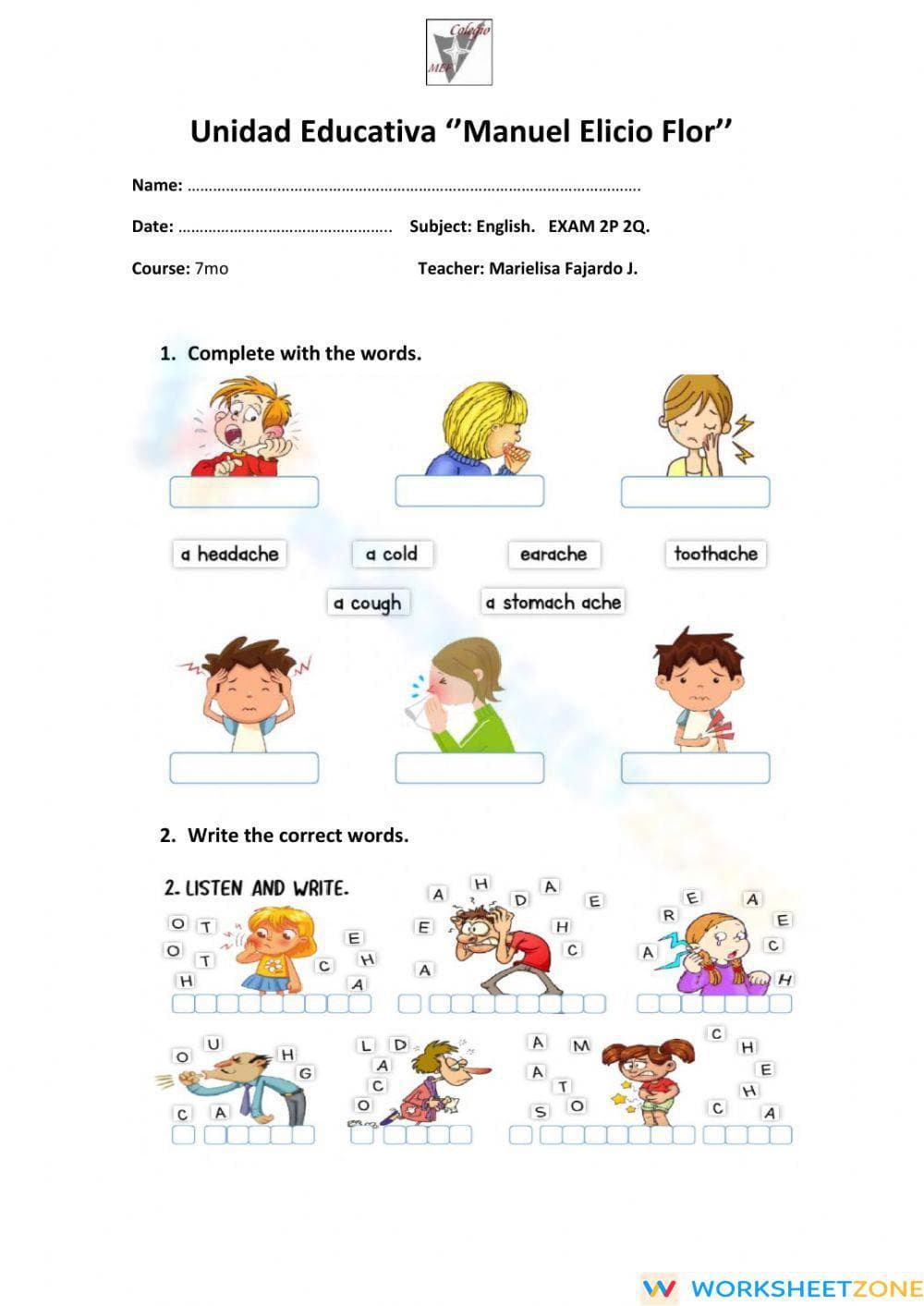
This Grade 5 health vocabulary worksheet provides students with targeted practice in identifying and spelling common ailments. By matching visual cues to specific terms and engaging in letter-rearrangement tasks, learners solidify their understanding of domain-specific language. This resource ensures students can accurately describe physical symptoms and health conditions in academic and real-world contexts.
At a Glance
- Grade: 5 · Subject: ELA
- Standard:
CCSS.ELA-LITERACY.L.4.6— Use grade-appropriate domain-specific words and phrases accurately in academic contexts- Skill Focus: Health vocabulary and spelling
- Format: 1 page · 12 problems · Answer key included · PDF
- Best For: Vocabulary introduction and spelling reinforcement
- Time: 15–20 minutes
What's Inside
This single-page worksheet features two modules for varied engagement. The first contains six visual matching problems where students identify ailments from expressive illustrations. The second provides six spelling challenges using jumbled letters and "listen and write" prompts. A clear layout ensures focus remains on specific linguistic tasks while providing enough white space for legible student work.
Zero-Prep Workflow
This classroom-ready resource follows a streamlined three-step process. First, print the single-page PDF (30 seconds). Second, distribute copies to students as a morning warm-up or transition activity (1 minute). Third, review answers collectively using the key (5 minutes). This workflow minimizes administrative burden while maximizing instructional time for essential vocabulary development, making it an ideal choice for busy educators.
Standards Alignment
Focusing on `CCSS.ELA-LITERACY.L.4.6`, this worksheet targets health terminology students encounter in informational texts. It also supports L.5.2.E by reinforcing correct spelling patterns for domain-specific words. These standard codes can be copied directly into lesson plans, IEP goals, or district curriculum mapping tools to ensure documented compliance with state and national educational frameworks.
How to Use It
Assign this during the independent practice phase of a health unit. It serves as a formative assessment; observe student performance on the spelling section to identify needs for phonetic support. Expected completion time is 15 to 20 minutes, making it ideal for homework or quick reviews. For students requiring more support, pair the worksheet with a body-parts diagram.
Who It's For
Tailored for Grade 4 and 5 students, including English Language Learners who benefit from visual scaffolds. It pairs well with a health-themed reading passage or anchor chart. The clear design supports learners with attention difficulties through predictable task structures. Special education teachers can use this for specific vocabulary goals related to self-advocacy and identifying physical needs.
As established in the Fisher & Frey (2014) framework for intentional vocabulary instruction, students require multiple exposures to domain-specific words in varied formats to achieve long-term retention. This worksheet facilitates that process by requiring students to decode visual signals, map them to specific health terms like "stomach ache," and then synthesize those words through spelling exercises. By focusing on `CCSS.ELA-LITERACY.L.4.6`, the activity ensures that learners build a robust lexicon of academic and functional terms necessary for participating in complex discussions about wellness and biology. The integration of "listen and write" tasks adds an auditory-processing dimension that strengthens the phonological loop, a critical component of lexical acquisition. Educators can rely on this structured approach to provide the evidence-based practice necessary for students to transition from recognizing health-related words to using them accurately in their own writing and speech.


