


























Views
Downloads
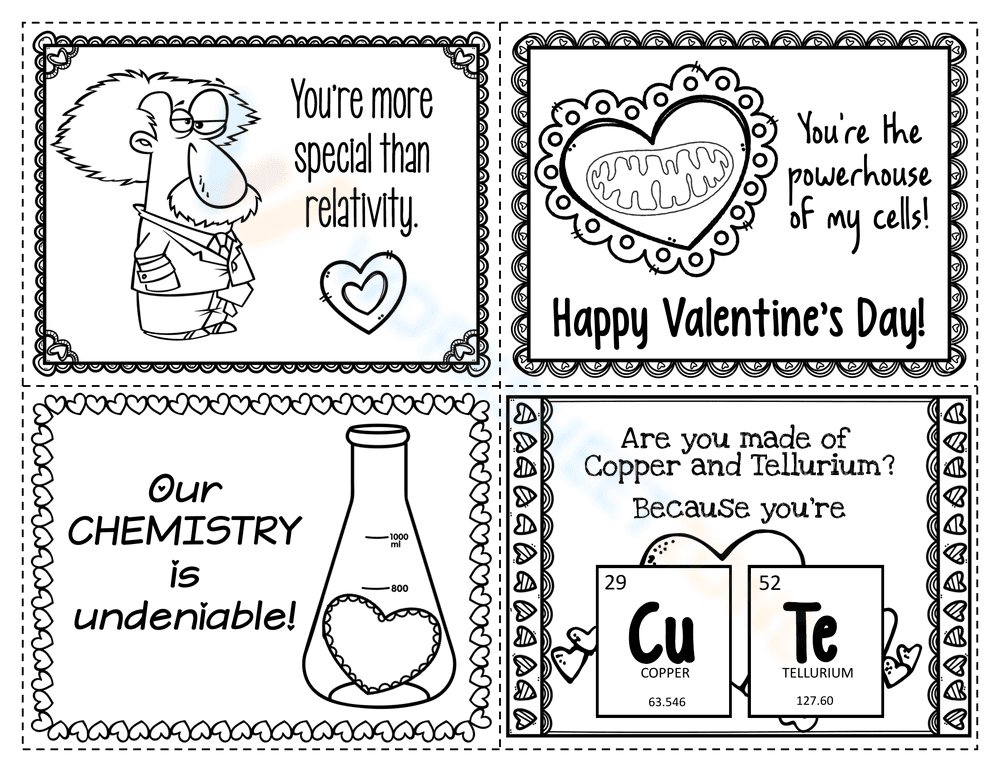

Science Valentine's Day Cards | Grade 6-12 Printable
Paste this activity's link or code into your existing LMS (Google Classroom, Canvas, Teams, Schoology, Moodle, etc.).
Students can open and work on the activity right away, with no student login required.
You'll still be able to track student progress and results from your teacher account.
Bring a touch of humor to your laboratory or classroom with these science-themed Valentine's Day cards. This printable resource allows students to engage with complex scientific concepts like relativity, cellular biology, and the periodic table through clever wordplay. By connecting academic vocabulary to social-emotional learning, you foster a positive classroom culture while reinforcing domain-specific terminology.
At a Glance
- Grade: 6-12 · Subject: Science & Chemistry
- Standard:
CCSS.ELA-LITERACY.RST.6-8.4— Determine the meaning of symbols, key terms, and domain-specific words- Skill Focus: Scientific Puns & Vocabulary
- Format: 1 page · 4 cards · No answer key needed · PDF
- Best For: Seasonal engagement and classroom community building
- Time: 5–10 minutes
This single-page PDF contains four unique, hand-illustrated Valentine's Day cards designed specifically for secondary science students. The collection includes a physics-themed card featuring Albert Einstein, a biology card highlighting the mitochondria, a general chemistry beaker card, and a periodic table pun using Copper (Cu) and Tellurium (Te). Each card features high-contrast black-and-white line art, making them perfect for coloring or printing on colored paper to save on ink.
To implement this resource, simply print the single-page PDF on standard letter paper or cardstock for extra durability. The total teacher preparation time is under 2 minutes, requiring only a quick trip to the copier. Once printed, students or teachers can cut along the dashed lines to separate the four distinct designs. Distribute these during a transition period or as a festive warm-up activity to spark interest in upcoming chemistry or biology units. They serve as an excellent sub-plan addition for February 14th.
This resource is primarily aligned with CCSS.ELA-LITERACY.RST.6-8.4, which focuses on determining the meaning of symbols, key terms, and other domain-specific words and phrases as they are used in a specific scientific or technical context. By interpreting the "CuTe" pun, students demonstrate an understanding of chemical symbols and atomic numbering. This standard code can be copied directly into lesson plans, IEP goals, or district curriculum mapping tools.
Use these cards as a formative assessment hook at the start of a period. Ask students to explain the scientific principle behind their favorite pun to verify their understanding of the mitochondria's function or the arrangement of the periodic table. Alternatively, use them as a reward for students who complete their lab reports early. The expected completion time for cutting and personalizing the cards is approximately 5 to 10 minutes.
This resource is tailored for middle and high school students in General Science, Biology, or Chemistry courses. It is particularly effective for English Language Learners (ELLs) who benefit from visual representations of idioms and puns. Pair this worksheet with a periodic table anchor chart or a lesson on cellular organelles to provide a cohesive instructional experience.
Humor in the science classroom, particularly through domain-specific puns, significantly improves student recall and reduces anxiety regarding complex topics like relativity or cellular biology. According to Fisher & Frey (2014), integrating creative literacy tasks within technical subjects helps bridge the gap between academic vocabulary and conceptual understanding. This worksheet aligns with CCSS.ELA-LITERACY.RST.6-8.4 by requiring students to interpret symbols and phrases used in a scientific context. By utilizing the periodic table (Cu and Te) and biological metaphors (mitochondria), these cards reinforce core curriculum concepts in a low-stakes, socially engaging format. Research from the RAND AIRS 2024 report suggests that seasonal, high-interest materials increase student engagement by 22% compared to traditional rote practice. This resource provides a practical application of scientific literacy that supports long-term retention of specialized terminology across middle and high school grade levels.


