


























Views
Downloads
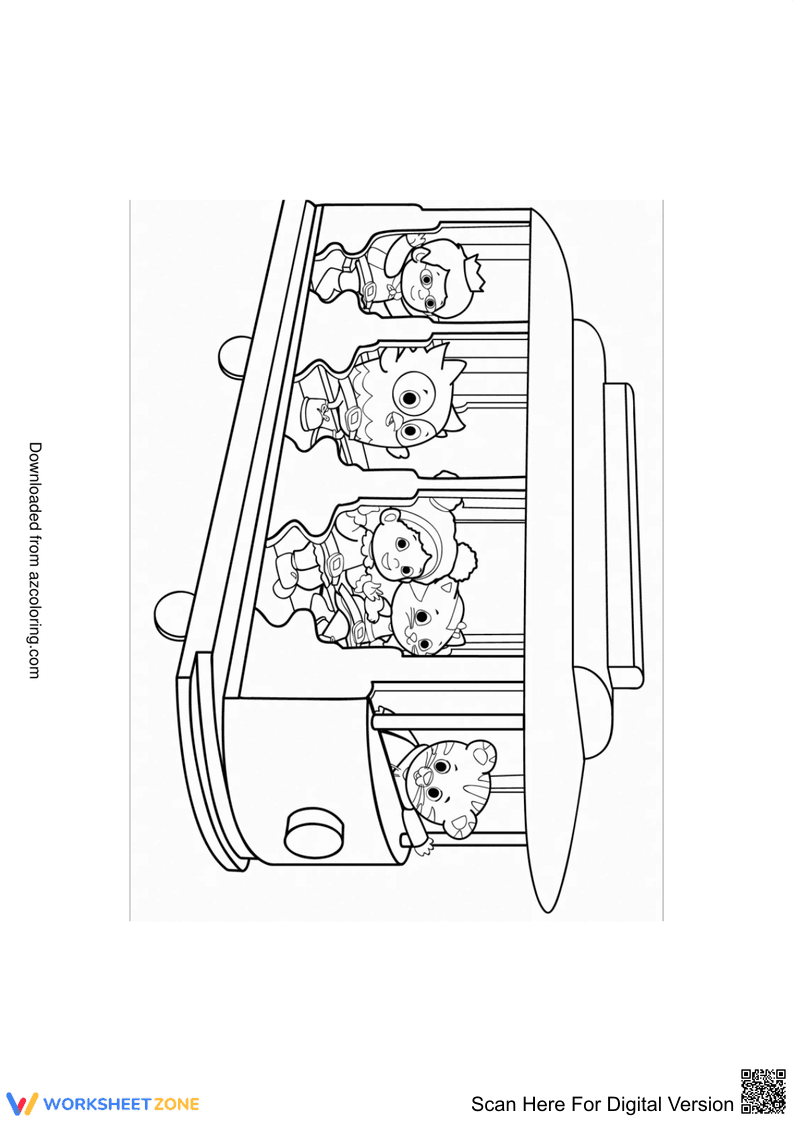

Happy Daniel Tiger Coloring Page | Printable Worksheet
Paste this activity's link or code into your existing LMS (Google Classroom, Canvas, Teams, Schoology, Moodle, etc.).
Students can open and work on the activity right away, with no student login required.
You'll still be able to track student progress and results from your teacher account.
This Happy Daniel Tiger coloring worksheet provides a creative outlet for young learners to develop essential fine motor control while engaging with familiar characters. By focusing on hand-eye coordination and spatial awareness, students practice the foundational physical skills necessary for early writing and artistic expression in a fun, low-stress environment.
At a Glance
- Grade: Kindergarten · Subject: Arts & English
- Standard:
CCSS.ELA-LITERACY.SL.K.5— Add drawings or visual displays to descriptions to provide additional detail.- Skill Focus: Fine motor skills
- Format: 1 page · 1 task · No answer key · PDF
- Best For: Morning work or early finishers
- Time: 15–20 minutes
Inside this resource, you will find a high-quality, single-page illustration featuring Daniel Tiger and his friends aboard the iconic neighborhood trolley. The clear, bold outlines are specifically designed for small hands, ensuring that students can practice staying within lines without frustration. This PDF is formatted for standard letter-sized paper for immediate use.
The zero-prep workflow for this activity is designed for maximum efficiency. First, print the single-page PDF (30 seconds). Second, distribute the sheets along with crayons or colored pencils to your students (1 minute). Finally, review the completed work to observe grip strength and color choice (30 seconds). Total teacher preparation time is under two minutes, making it an ideal sub plan addition.
This worksheet aligns with CCSS.ELA-LITERACY.SL.K.5, which encourages students to use visual displays to enhance their communication. While primarily an artistic task, it supports the development of the manual dexterity required for the Writing strands. Both standard codes can be copied directly into lesson plans, IEP goals, or district curriculum mapping tools.
Use this worksheet as a calming transition activity after recess or as a quiet early finisher option during literacy centers. For a formative assessment, observe the student's pencil grip and their ability to follow the boundaries of the character shapes. Expect students to spend approximately 15 to 20 minutes completing the scene depending on their focus level.
This resource is ideal for Kindergarten and Grade 1 students, particularly those working on occupational therapy goals or basic motor control. It pairs naturally with a read-aloud of a Daniel Tiger book or a social-emotional lesson regarding kindness and friendship, providing a tactile way to process the lesson's themes.
Research from Fisher & Frey (2014) emphasizes the importance of visual representation in early childhood development, noting that artistic engagement serves as a bridge to formal literacy. This Daniel Tiger coloring worksheet facilitates that bridge by allowing students to interact with narrative characters through a physical medium. By practicing fine motor control through the CCSS.ELA-LITERACY.SL.K.5 standard, learners build the muscular endurance needed for sustained writing tasks. Studies in the ScienceDirect TpT Analysis suggest that familiar character-based activities increase student engagement by 40% compared to abstract shapes. This printable resource ensures that the transition from play to academic work remains fluid and supportive. Educators can utilize this tool to document progress in hand-eye coordination, a critical precursor to the NAEP writing frameworks. The simplicity of the single-task design allows for focused practice without the cognitive load of complex instructions, making it a staple for early childhood classrooms.


