


























Views
Downloads


Volume Measurement Worksheet: Printable Grade 5 Lab
Paste this activity's link or code into your existing LMS (Google Classroom, Canvas, Teams, Schoology, Moodle, etc.).
Students can open and work on the activity right away, with no student login required.
You'll still be able to track student progress and results from your teacher account.
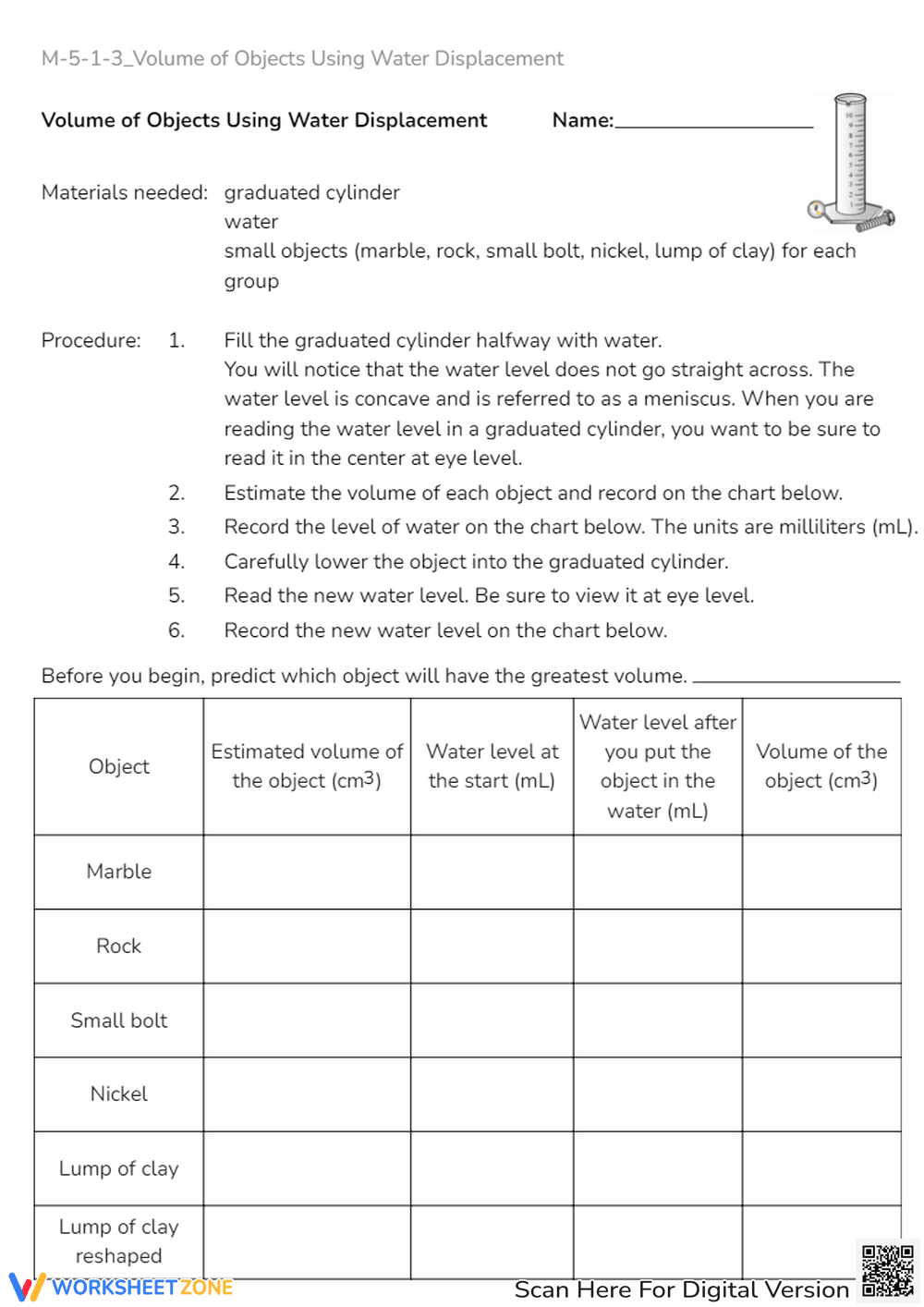
This hands-on volume measurement worksheet helps fifth and sixth-grade students master the concept of volume using water displacement. Students measure irregular objects by recording water levels before and after immersion, calculating the difference to find the volume in cubic centimeters. This practical activity bridges the gap between abstract volume formulas and concrete physical space.
At a Glance
- Grade: Grade 5 · Subject: Math
- Standard:
CCSS.MATH.CONTENT.5.MD.C.3— Understand volume as an attribute of solid figures and measure volume- Skill Focus: Water displacement measurement
- Format: 2 pages · 10 tasks · Lab guide · PDF
- Best For: Hands-on small group math and science lab
- Time: 30–45 minutes
The resource contains a structured two-page lab guide. Page one provides a materials list, a six-step procedure, and a data collection table. The table features columns for object names, estimated volumes, initial water levels, final water levels, and calculated volumes for six test items. Page two contains four analytical reflection questions prompting students to evaluate their predictions and explain their reasoning.
Skill Progression
- Guided practice: Students follow the procedure to measure items like marbles, learning to read the meniscus.
- Supported practice: Students measure trickier items like nickels, recording water levels in milliliters.
- Independent practice: Students calculate final volume in cubic centimeters and complete the analysis.
This progression utilizes a gradual-release model to build confidence in measurement techniques.
Standards Alignment
This worksheet aligns directly with the Common Core State Standard CCSS.MATH.CONTENT.5.MD.C.3, which requires students to recognize volume as an attribute of solid figures and understand concepts of volume measurement. Additionally, it supports standard CCSS.MATH.CONTENT.5.MD.C.4 by having students measure volumes by counting unit cubes or applying displacement techniques. Both standard codes can be copied directly into lesson plans, IEP goals, or district curriculum mapping tools.
How to Use It
Introduce this activity during a unit on measurement or volume. Use it as a collaborative small-group lab after direct instruction on graduated cylinders. Teachers can observe student groups during the measurement phase to ensure they read the meniscus at eye level, providing a quick formative assessment of their physical measurement skills. The entire activity takes approximately 30 to 45 minutes to complete.
Who It's For
This resource is designed for fifth and sixth-grade students learning physical measurement concepts. It is highly beneficial for kinesthetic learners who need concrete models to understand spatial volume. Pair this worksheet with an introductory anchor chart on reading graduated cylinders or a short video demonstrating water displacement before starting the lab.
According to the ScienceDirect TpT Analysis, hands-on laboratory activities that require students to collect and analyze empirical data significantly improve retention of measurement concepts compared to passive worksheets. This resource targets the standard code CCSS.MATH.CONTENT.5.MD.C.3 by requiring students to measure volume through water displacement, translating abstract mathematical formulas into physical reality. By engaging in the 10 structured tasks, students develop a concrete understanding of how three-dimensional space is occupied by solid matter. Research from Fisher & Frey (2014) supports this structured approach, demonstrating that combining physical manipulation with written reflection reinforces cognitive pathways and helps students internalize complex scientific procedures. Teachers can confidently integrate this lab into their curriculum, knowing it aligns with evidence-based practices that promote deep conceptual understanding and long-term skill retention in upper elementary mathematics and science classrooms.


