


























Views
Downloads

Halloween Tracing Worksheet | Grade K Printable
Paste this activity's link or code into your existing LMS (Google Classroom, Canvas, Teams, Schoology, Moodle, etc.).
Students can open and work on the activity right away, with no student login required.
You'll still be able to track student progress and results from your teacher account.
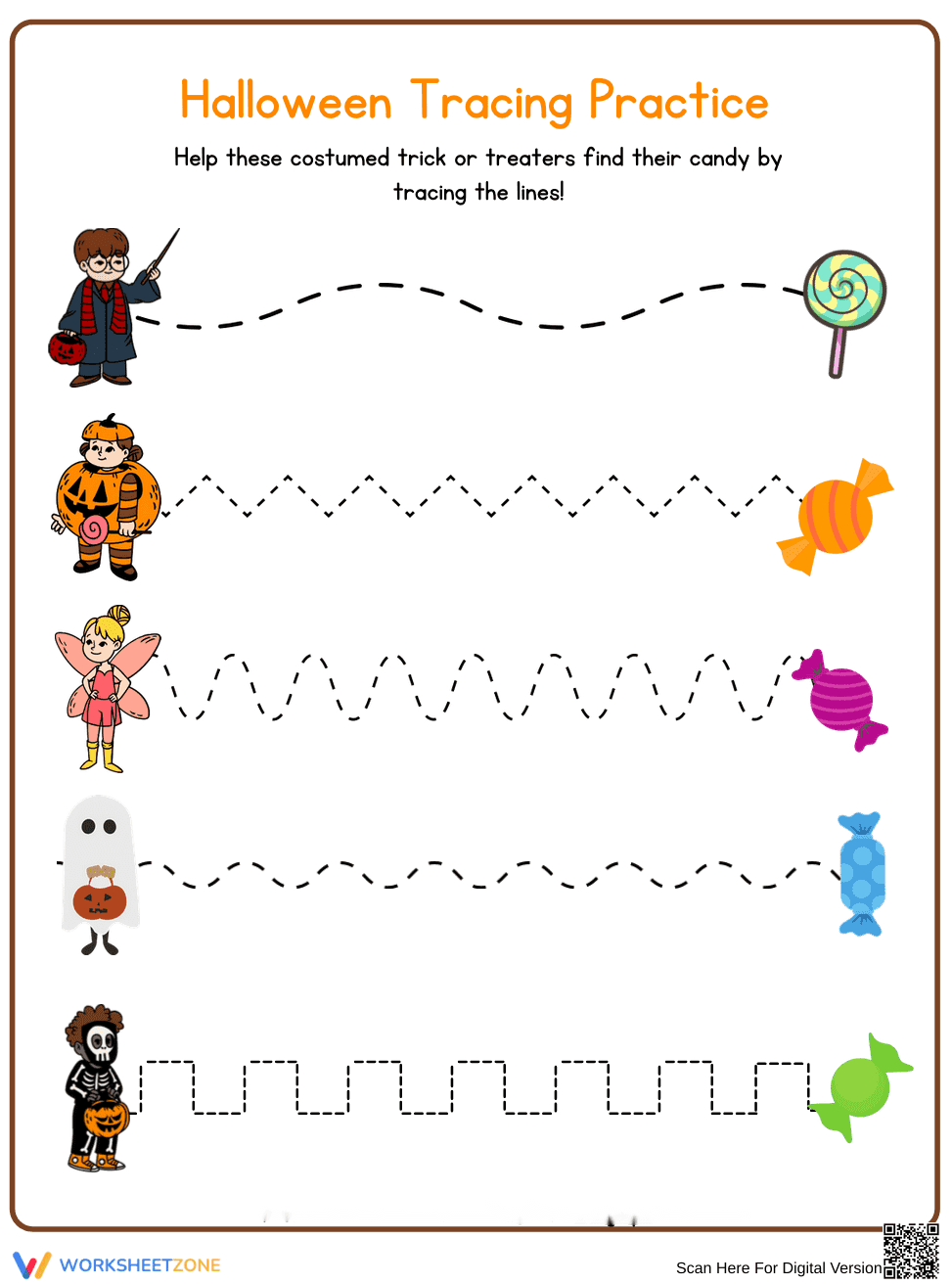
This engaging Halloween tracing worksheet helps early learners develop essential fine motor control and pencil grip. By guiding costumed characters to their candy treats along various dashed paths, students practice the precise hand movements required for future letter formation and handwriting success.
At a Glance
- Grade: K · Subject: English
- Standard:
CCSS.ELA-LITERACY.L.K.1.A— Practice pencil control for printing letters- Skill Focus: Line tracing and fine motor skills
- Format: 1 page · 5 problems · No answer key · PDF
- Best For: Morning work or centers
- Time: 10–15 minutes
This single-page printable features five distinct tracing paths, each connecting a fun Halloween character—like a wizard, pumpkin, fairy, ghost, and skeleton—to a piece of colorful candy. The line patterns increase in complexity, starting with a gentle wave and progressing through zigzags, loops, and sharp right angles. The visually appealing design keeps young learners focused while they practice staying on the dashed lines.
Zero-Prep Workflow
This resource is designed for immediate classroom use with absolutely no teacher preparation required.
- Print (1 minute): Simply print the PDF. The high-contrast dashed lines ensure clear copies in both color and black-and-white.
- Distribute (1 minute): Hand out the sheets along with pencils, crayons, or markers.
- Review (1 minute): Demonstrate how to start at the character and carefully follow the path to the candy.
With a total prep time of under two minutes, this activity is an excellent addition to any emergency sub plan or last-minute center rotation.
Standards Alignment
This pre-writing activity aligns with foundational skills leading to CCSS.ELA-LITERACY.L.K.1.A, which requires students to print many upper- and lowercase letters. By mastering these foundational strokes—including curves, diagonals, and straight lines—children build the muscle memory necessary for formal handwriting instruction. Both standard codes can be copied directly into lesson plans, IEP goals, or district curriculum mapping tools.
How to Use It
Incorporate this tracing practice into your morning routine as a quiet "do now" activity as students arrive. It also works perfectly as an independent literacy center during guided reading blocks. While students work, observe their pencil grip and posture; this serves as an excellent formative assessment to identify children who may need additional fine motor support or adaptive writing tools. Most students will complete the five tracing paths within 10 to 15 minutes.
Who It's For
This worksheet is ideal for Preschool, Pre-K, and Kindergarten students who are developing their pre-writing abilities. It is also highly effective for occupational therapy sessions or special education students working on hand-eye coordination and fine motor IEP goals. Pair this activity with a read-aloud of a favorite Halloween story or a hands-on sensory bin exercise to create a comprehensive thematic lesson.
Developing strong fine motor skills through activities like line tracing is a critical precursor to early literacy and writing success. According to Fisher & Frey (2014), targeted practice with pencil control significantly improves a child's ability to transition into formal letter formation. This worksheet directly supports the foundational mechanics required for CCSS.ELA-LITERACY.L.K.1.A by having students practice pencil control for printing letters. When young learners trace varied patterns—such as zigzags and curves—they strengthen the intrinsic hand muscles needed for sustained writing tasks later in their academic journey. Providing engaging, thematic contexts like this Halloween activity ensures that students remain motivated while performing repetitive but necessary motor exercises. Consistent exposure to these structured pre-writing tasks builds the confidence and physical stamina required for kindergarten readiness and long-term handwriting proficiency.


