


























1 / 2
0
Views
0
Downloads


0.0
0
Save
0 Likes
Half-Life Calculation Practice Sheet
0 Views
0 Downloads
Paste this activity's link or code into your existing LMS (Google Classroom, Canvas, Teams, Schoology, Moodle, etc.).
Students can open and work on the activity right away, with no student login required.
You'll still be able to track student progress and results from your teacher account.
Information
Description
What It Is:
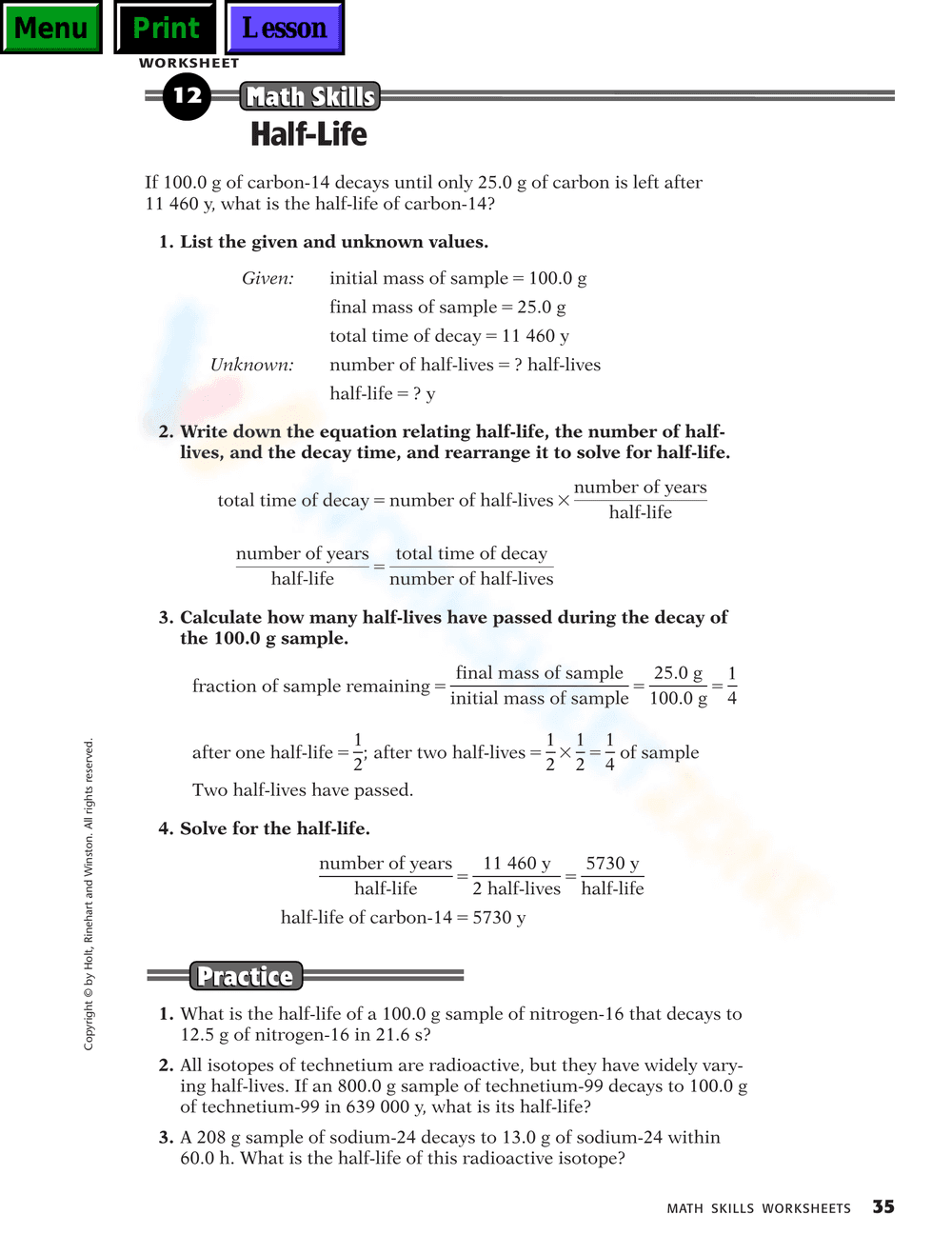
This is a math skills worksheet focusing on the concept of half-life in the context of radioactive decay. It includes example problems and practice questions. The worksheet guides the student through calculating half-life by first listing given and unknown values, writing down the relevant equation, calculating the number of half-lives passed, and then solving for the half-life. It also provides practice problems involving different radioactive isotopes and decay times.
Grade Level Suitability:
This worksheet is suitable for grades 9-12, particularly for students studying chemistry or physics. The concepts of radioactive decay and half-life require a solid understanding of algebra and scientific notation, which are typically introduced in high school science courses.
Why Use It:
This worksheet helps students understand the concept of half-life and apply it to real-world scenarios involving radioactive decay. It reinforces problem-solving skills by guiding students through a step-by-step approach to calculating half-life. The practice problems provide opportunities to apply the learned concepts and solidify understanding.
How to Use It:
Start by reviewing the example problem at the beginning of the worksheet. Work through each step, paying attention to the formulas and calculations. Then, attempt the practice problems at the end of the worksheet. Use the example problem as a guide and show all your work. Check your answers and review the steps if you get stuck.
Target Users:
This worksheet is designed for high school students studying chemistry, physics, or environmental science. It is also beneficial for anyone interested in learning about radioactive decay and half-life calculations. It's also useful for teachers looking for practice problems on the topic.
This is a math skills worksheet focusing on the concept of half-life in the context of radioactive decay. It includes example problems and practice questions. The worksheet guides the student through calculating half-life by first listing given and unknown values, writing down the relevant equation, calculating the number of half-lives passed, and then solving for the half-life. It also provides practice problems involving different radioactive isotopes and decay times.
Grade Level Suitability:
This worksheet is suitable for grades 9-12, particularly for students studying chemistry or physics. The concepts of radioactive decay and half-life require a solid understanding of algebra and scientific notation, which are typically introduced in high school science courses.
Why Use It:
This worksheet helps students understand the concept of half-life and apply it to real-world scenarios involving radioactive decay. It reinforces problem-solving skills by guiding students through a step-by-step approach to calculating half-life. The practice problems provide opportunities to apply the learned concepts and solidify understanding.
How to Use It:
Start by reviewing the example problem at the beginning of the worksheet. Work through each step, paying attention to the formulas and calculations. Then, attempt the practice problems at the end of the worksheet. Use the example problem as a guide and show all your work. Check your answers and review the steps if you get stuck.
Target Users:
This worksheet is designed for high school students studying chemistry, physics, or environmental science. It is also beneficial for anyone interested in learning about radioactive decay and half-life calculations. It's also useful for teachers looking for practice problems on the topic.


