


























1 / 3
0
Views
0
Downloads



0.0
0
Save
0 Likes
Half-Life Calculations Worksheet: Practice Problems
0 Views
0 Downloads
Paste this activity's link or code into your existing LMS (Google Classroom, Canvas, Teams, Schoology, Moodle, etc.).
Students can open and work on the activity right away, with no student login required.
You'll still be able to track student progress and results from your teacher account.
Information
Description
What It Is:
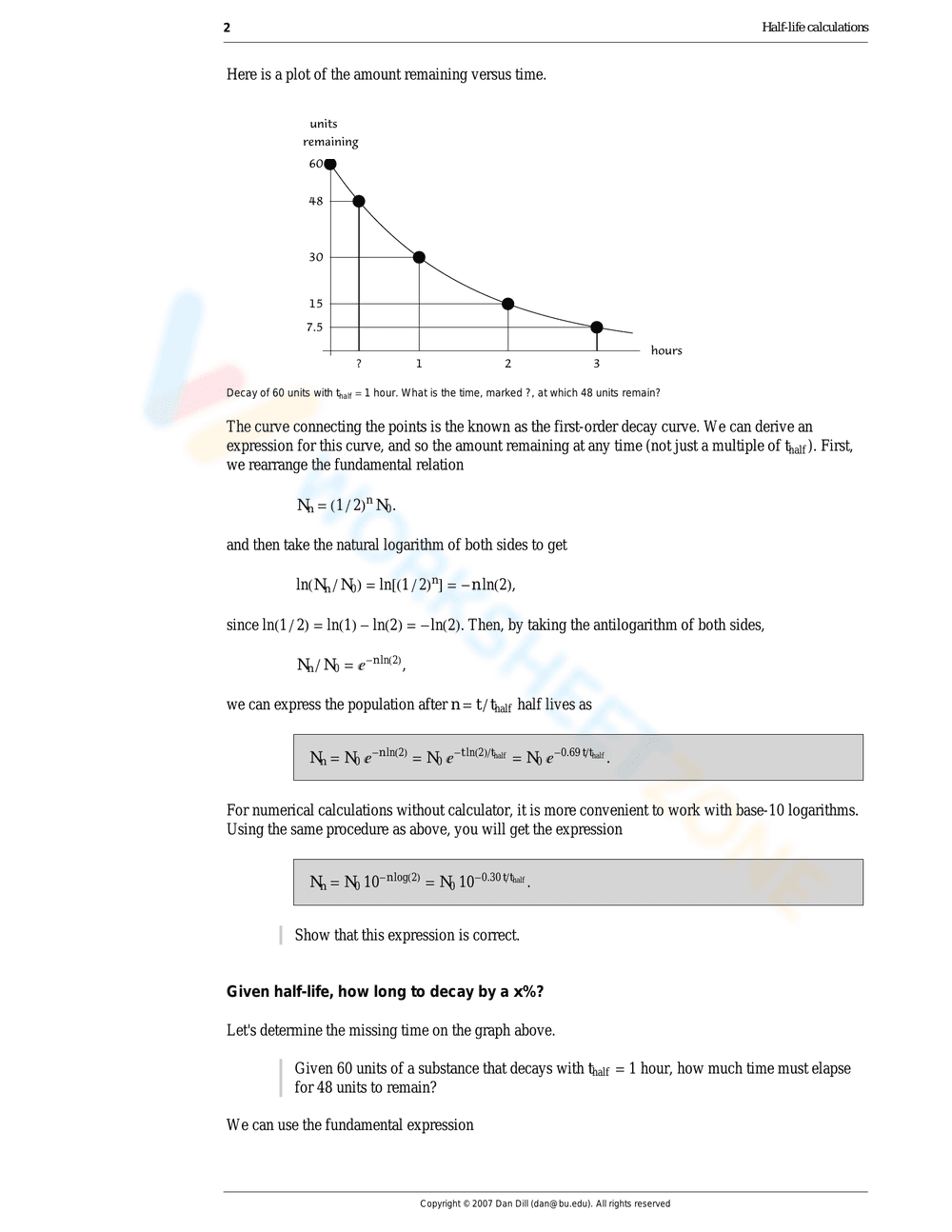
This is a worksheet on half-life calculations, specifically for General Chemistry. It includes a section on using coin flips to count people as an analogy to half-life decay. The worksheet presents a scenario where a group of people flips coins and sits down if the coin lands heads up. It then shows a fundamental expression and a calculation to determine the initial number of people. The worksheet also provides the definition of half-life and an example of a substance undergoing first-order decay, including a table showing the units remaining after each hour.
Grade Level Suitability:
This worksheet is suitable for high school (Grades 11-12) and introductory college level chemistry courses. The concepts of half-life and exponential decay require a solid foundation in algebra and an understanding of basic chemistry principles.
Why Use It:
This worksheet helps students understand the concept of half-life by using a relatable analogy (coin flips) to illustrate exponential decay. It reinforces mathematical calculations associated with half-life and provides a real-world context for understanding the concept in chemistry. It also introduces first-order decay.
How to Use It:
Students should read the introduction and the coin flip analogy carefully. They should then work through the mathematical calculations provided, ensuring they understand each step. Finally, they should study the definition of half-life and the example of first-order decay, paying attention to the table of units remaining. This worksheet can be used as a practice problem set or as part of a lesson on half-life.
Target Users:
This worksheet is designed for high school and college students studying chemistry, particularly those learning about nuclear chemistry, kinetics, and radioactive decay. It's also helpful for teachers looking for engaging examples to illustrate the concept of half-life.
This is a worksheet on half-life calculations, specifically for General Chemistry. It includes a section on using coin flips to count people as an analogy to half-life decay. The worksheet presents a scenario where a group of people flips coins and sits down if the coin lands heads up. It then shows a fundamental expression and a calculation to determine the initial number of people. The worksheet also provides the definition of half-life and an example of a substance undergoing first-order decay, including a table showing the units remaining after each hour.
Grade Level Suitability:
This worksheet is suitable for high school (Grades 11-12) and introductory college level chemistry courses. The concepts of half-life and exponential decay require a solid foundation in algebra and an understanding of basic chemistry principles.
Why Use It:
This worksheet helps students understand the concept of half-life by using a relatable analogy (coin flips) to illustrate exponential decay. It reinforces mathematical calculations associated with half-life and provides a real-world context for understanding the concept in chemistry. It also introduces first-order decay.
How to Use It:
Students should read the introduction and the coin flip analogy carefully. They should then work through the mathematical calculations provided, ensuring they understand each step. Finally, they should study the definition of half-life and the example of first-order decay, paying attention to the table of units remaining. This worksheet can be used as a practice problem set or as part of a lesson on half-life.
Target Users:
This worksheet is designed for high school and college students studying chemistry, particularly those learning about nuclear chemistry, kinetics, and radioactive decay. It's also helpful for teachers looking for engaging examples to illustrate the concept of half-life.


