




























Views
Downloads
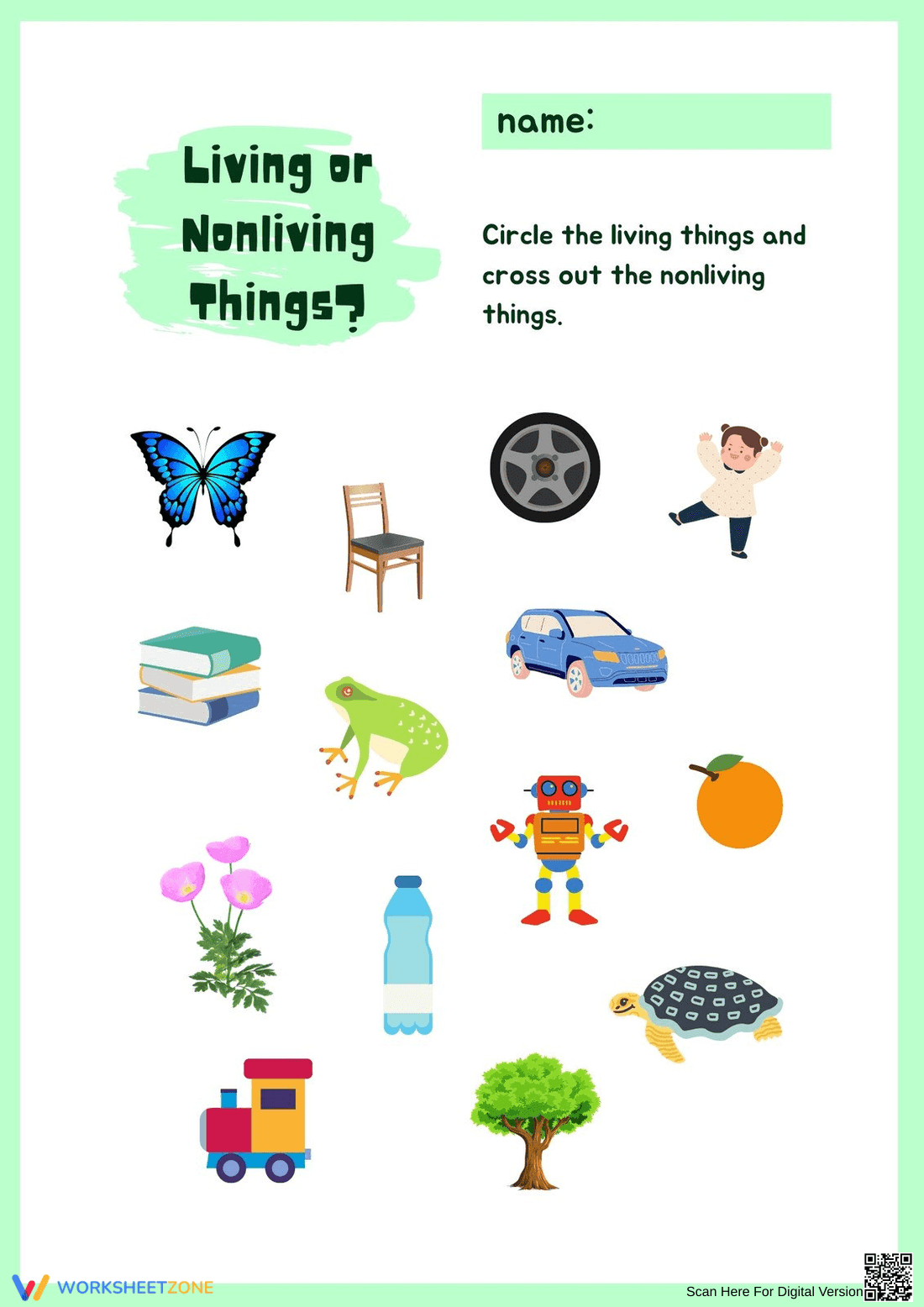

Grade K Living or Nonliving Things - Printable

Paste this activity's link or code into your existing LMS (Google Classroom, Canvas, Teams, Schoology, Moodle, etc.).
Students can open and work on the activity right away, with no student login required.
You'll still be able to track student progress and results from your teacher account.
This Grade K science worksheet helps students master biological classification by distinguishing between living and nonliving things. Students observe 14 colorful icons and apply their knowledge of life characteristics to categorize each item correctly. This activity provides an immediate, hands-on way for young learners to demonstrate their understanding of the natural world.
At a Glance
- Grade: K · Subject: Science
- Standard:
K-LS1-1— Use observations to describe patterns of what plants and animals need to survive- Skill Focus: Living vs. Nonliving Classification
- Format: 1 page · 14 problems · Answer key included · PDF
- Best For: Introduction to life science units
- Time: 10–15 minutes
What's Inside
The resource consists of a single, high-quality PDF page featuring 14 clear illustrations. These include a mix of animals, plants, and inanimate objects. The instructions are simple, requiring students to circle living entities and cross out nonliving ones. A comprehensive answer key is provided to facilitate quick grading or self-correction.
Zero-Prep Workflow
- Print: Print the PDF for your class in under 30 seconds.
- Distribute: Hand out the sheet with pencils for the circling and crossing out tasks.
- Review: Use the included answer key to check work in less than one minute.
Total teacher prep time is under 2 minutes, making it an ideal sub plan.
Standards Alignment
This worksheet is primarily aligned with K-LS1-1: "Use observations to describe patterns of what plants and animals need to survive." By identifying living items, students recognize patterns associated with biological needs. It also supports CCSS.ELA-LITERACY.L.K.5.A by helping students sort common objects into categories. Both standard codes can be copied directly into lesson plans, IEP goals, or district curriculum mapping tools.
How to Use It
Use this worksheet as a formative assessment after a nature walk or a classroom discussion about life. It serves as an excellent check for understanding to see if students can generalize the concept. Alternatively, place it in a science center for independent practice. Observe if students struggle with the robot or car, which often mimic living movement. Completion takes 10 to 15 minutes.
Who It's For
This resource is designed for Kindergarten students but is also effective for English Language Learners who benefit from visual support. It is an ideal tool for special education settings where clear layouts are necessary. Pair this worksheet with a living vs. nonliving anchor chart or a read-aloud about the needs of plants and animals to reinforce the lesson.
According to Fisher & Frey (2014), the use of visual non-linguistic representations is a fundamental strategy for early childhood science instruction, particularly when students are asked to categorize complex biological concepts. This Grade K living or nonliving things worksheet leverages 14 distinct visual prompts to help students identify the observable characteristics of life. By requiring students to differentiate between biological organisms like the frog and butterfly and inanimate objects like the robot or car, the activity reinforces the K-LS1-1 standard. Research indicates that early classification tasks build the cognitive scaffolding necessary for later understanding of ecosystems and energy transfer. This resource provides a structured environment for students to apply their observations of the natural world to a formal academic task. The inclusion of diverse examples ensures that learners can generalize the concept of 'living' beyond just human-like movement, encompassing plants and smaller organisms as well.


