




























Views
Plays


Grade 5 Ordered Pairs — Printable No-Prep Worksheet

Paste this activity's link or code into your existing LMS (Google Classroom, Canvas, Teams, Schoology, Moodle, etc.).
Students can open and work on the activity right away, with no student login required.
You'll still be able to track student progress and results from your teacher account.
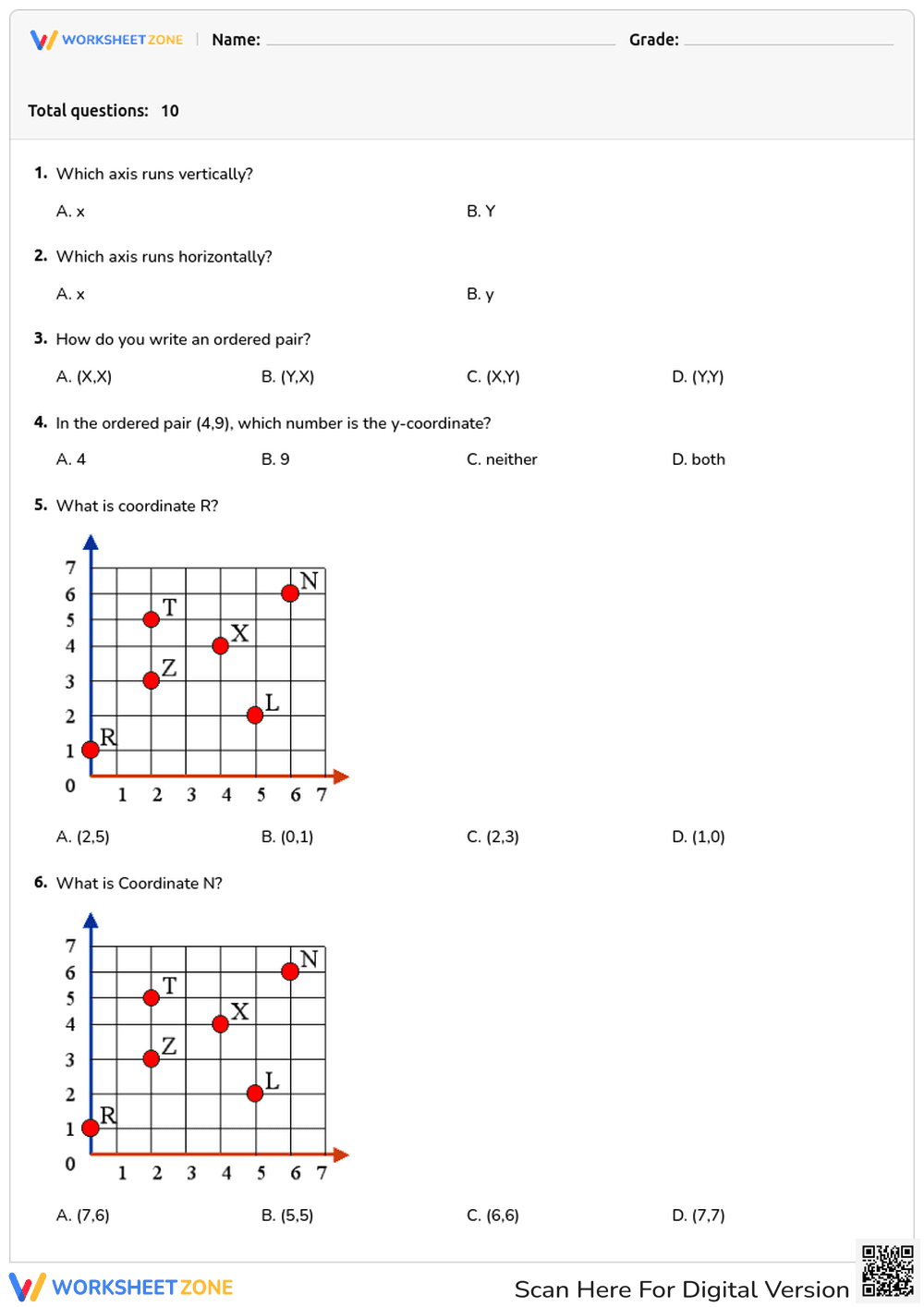
This Grade 5 math worksheet gives students focused practice with graphing ordered pairs on a coordinate plane. By identifying the x-axis, y-axis, and specific coordinates, learners build essential geometry skills. The multiple-choice format allows students to quickly demonstrate their understanding of how to locate and plot points accurately.
At a Glance
- Grade: 5 · Subject: Math
- Standard:
CCSS.MATH.CONTENT.5.G.A.1— Graph points on the coordinate plane- Skill Focus: Graphing ordered pairs
- Format: 2 pages · 10 problems · Answer key included · PDF
- Best For: Independent practice
- Time: 15–20 minutes
Inside this resource, you will find a two-page assessment featuring 10 multiple-choice problems. The tasks require students to identify vertical and horizontal axes, determine the correct format for writing an ordered pair, and read coordinates directly from a provided first-quadrant graph. Clear, easy-to-read coordinate planes are included alongside the questions, ensuring students have the visual support needed to accurately identify points like (2,5) or (7,6). An answer key is included for quick grading.
Zero-Prep Workflow
This resource is designed for immediate classroom use with minimal teacher setup:
- Print (1 minute): Simply download the PDF and print the two-page student handout.
- Distribute (1 minute): Hand out the worksheet as a quick warm-up, exit ticket, or independent practice activity.
- Review (3 minutes): Use the included answer key to rapidly score the 10 multiple-choice questions or review them together as a class.
With a total teacher prep time of under two minutes, this worksheet is an excellent addition to any emergency sub plan or busy instructional day.
Standards Alignment
This worksheet is directly aligned to CCSS.MATH.CONTENT.5.G.A.1, which requires students to use a pair of perpendicular number lines, called axes, to define a coordinate system, with the intersection of the lines arranged to coincide with the 0 on each line and a given point in the plane located by using an ordered pair of numbers. It also supports foundational geometry skills for later grades.
How to Use It
This graphing ordered pairs worksheet is highly versatile. Use it after direct instruction as an independent practice assignment to solidify new concepts. Alternatively, it serves as an effective formative assessment tool; by observing which specific questions students miss, teachers can quickly identify who needs targeted reteaching. Students should be able to complete the 10 problems within a 15 to 20-minute time frame.
Who It's For
This resource is primarily designed for fifth-grade math students learning to work with the coordinate plane. It is also appropriate for sixth-grade students who need a quick review of first-quadrant graphing before moving on to all four quadrants. To support learners who might struggle with axis identification, pair this worksheet with a classroom anchor chart that visually distinguishes the horizontal x-axis from the vertical y-axis.
Mastering the coordinate plane is a critical stepping stone for advanced mathematical reasoning. Aligned with CCSS.MATH.CONTENT.5.G.A.1, this resource helps students graph points on the coordinate plane with precision. Research shows that frequent, targeted practice with visual representations like coordinate graphs improves retention when transitioning to complex algebraic concepts. By isolating specific skills—such as distinguishing between the x-axis and y-axis or correctly formatting an ordered pair—this worksheet minimizes cognitive overload and allows learners to focus entirely on spatial reasoning. Providing structured, multiple-choice tasks ensures that educators can rapidly assess understanding and correct misconceptions before they become ingrained. This targeted approach to geometry practice builds the confidence and accuracy students need for long-term success in middle school mathematics and beyond.


