


























Views
Downloads
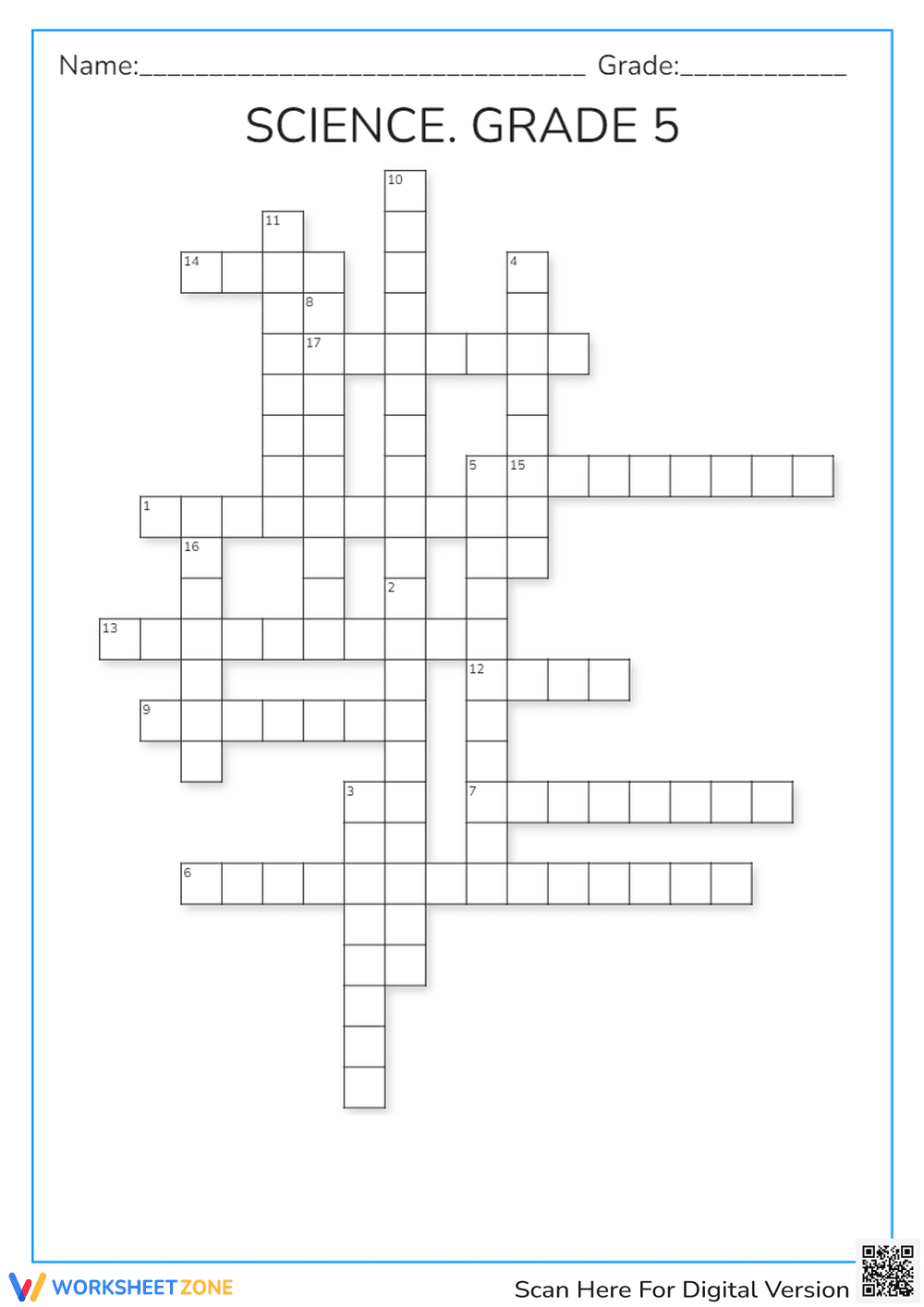

Essential Grade 5 Science Vocabulary Crossword Worksheet
Paste this activity's link or code into your existing LMS (Google Classroom, Canvas, Teams, Schoology, Moodle, etc.).
Students can open and work on the activity right away, with no student login required.
You'll still be able to track student progress and results from your teacher account.
This Grade 5 science vocabulary worksheet provides a structured way for students to master complex terminology related to ecosystems and physical matter. By connecting definitions to specific scientific terms, students reinforce their understanding of how energy and matter circulate through the natural world. This activity ensures students can accurately identify and use domain-specific language.
At a Glance
- Grade: 5 · Subject: Science
- Standard:
5-LS2-1— Describe the movement of matter among plants, animals, decomposers, and the environment.- Skill Focus: Scientific Vocabulary Mastery
- Format: 2 pages · 17 problems · Answer key included · PDF
- Best For: Vocabulary review and sub plans
- Time: 15–25 minutes
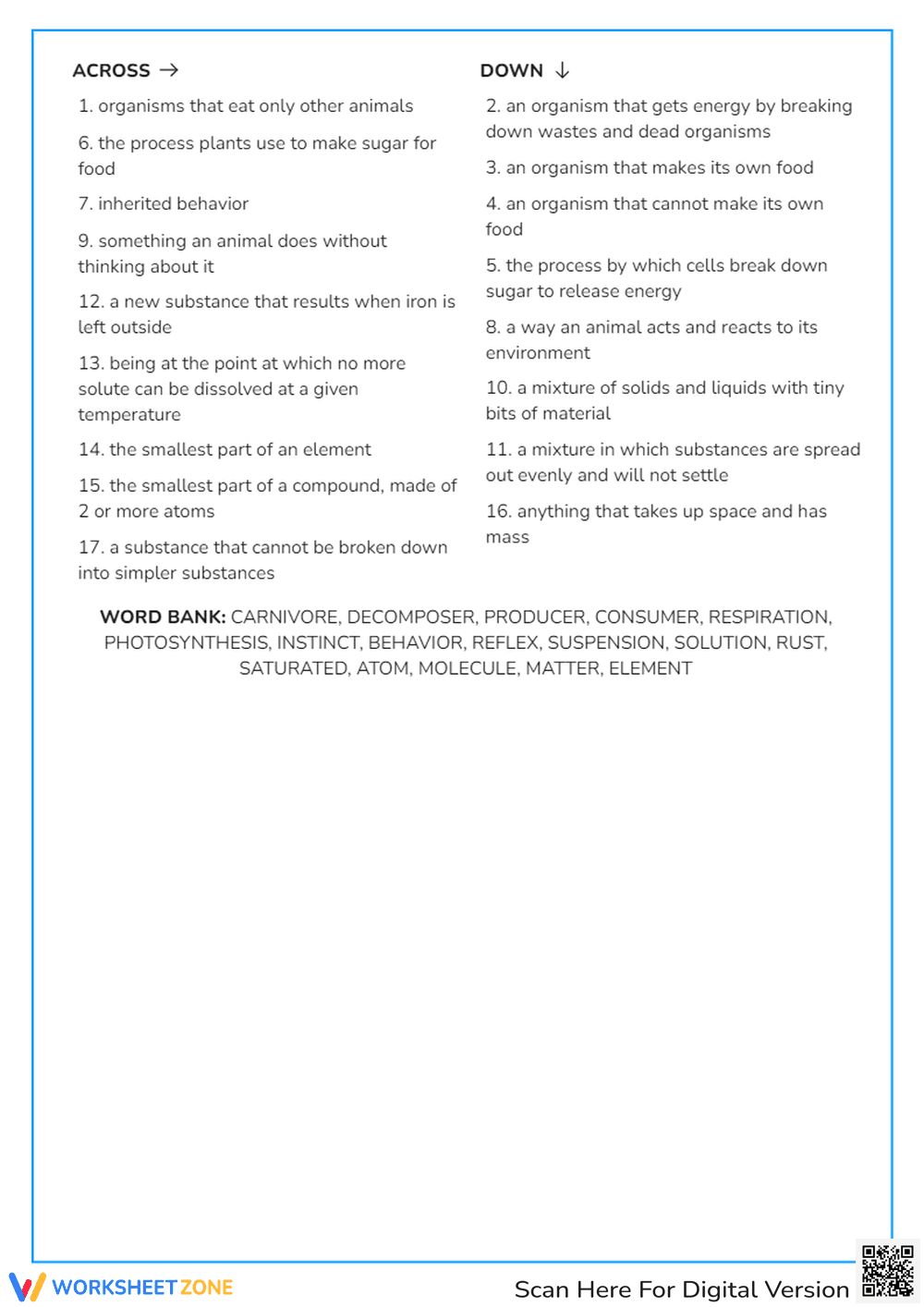
What's Inside: This comprehensive two-page resource features a 17-clue crossword puzzle and a dedicated clues page with an integrated word bank. The task covers essential concepts including photosynthesis, respiration, and the building blocks of matter like atoms and molecules. A clear word bank is provided to support spelling and word recognition, while the full answer key allows for immediate student feedback.
Zero-Prep Workflow
- Print (1 minute): Select the puzzle and clue pages for high-quality PDF output.
- Distribute (30 seconds): Hand out the sheets as a quiet bell-ringer or a focused independent practice session.
- Review (30 seconds): Use the included answer key for a quick whole-class check or allow students to self-correct their work.
This streamlined process makes the worksheet an ideal choice for emergency sub plans or as a transition activity between lab experiments.
Standards Alignment
This resource is primarily aligned with `5-LS2-1`, which requires students to develop a model to describe the movement of matter among plants, animals, decomposers, and the environment. It also supports `5-PS1-1` by introducing the vocabulary of matter and its properties. Both standard codes can be copied directly into lesson plans, IEP goals, or district curriculum mapping tools.
How to Use It
Assign this worksheet during the consolidation phase of your unit on ecosystems or matter. It works exceptionally well as a formative assessment to gauge which students are struggling with specific terms like "saturated" or "suspension." Expect students to complete the puzzle in approximately 20 minutes, making it a perfect fit for the end of a science block.
Who It's For
This activity is designed for 5th-grade students but is highly effective for English Language Learners (ELLs) who need visual and structural support with academic language. It pairs naturally with an anchor chart on the food web or a direct instruction lesson on the states of matter.
The Grade 5 Science Vocabulary Crossword is designed to reinforce the 5-LS2-1 standard by requiring students to synthesize definitions of producers, consumers, and decomposers within an ecosystem framework. By engaging with 17 distinct scientific terms, learners move beyond rote memorization toward conceptual retrieval. According to the RAND AIRS 2024 report on elementary science literacy, the use of structured vocabulary puzzles significantly aids in the retention of domain-specific language, particularly for students transitioning from concrete to abstract scientific reasoning. This worksheet provides the necessary scaffolding through a provided word bank, allowing students to focus on the semantic relationships between terms like photosynthesis and respiration. The inclusion of physical science concepts such as atoms and molecules further supports cross-cutting concepts. This resource serves as a reliable tool for formative assessment, ensuring that students possess the linguistic foundation required for complex NGSS-aligned inquiry and evidence-based scientific argumentation in later units.


