


























Views
Downloads


Comparing Numbers Worksheet | Grade 4 Essential
Paste this activity's link or code into your existing LMS (Google Classroom, Canvas, Teams, Schoology, Moodle, etc.).
Students can open and work on the activity right away, with no student login required.
You'll still be able to track student progress and results from your teacher account.
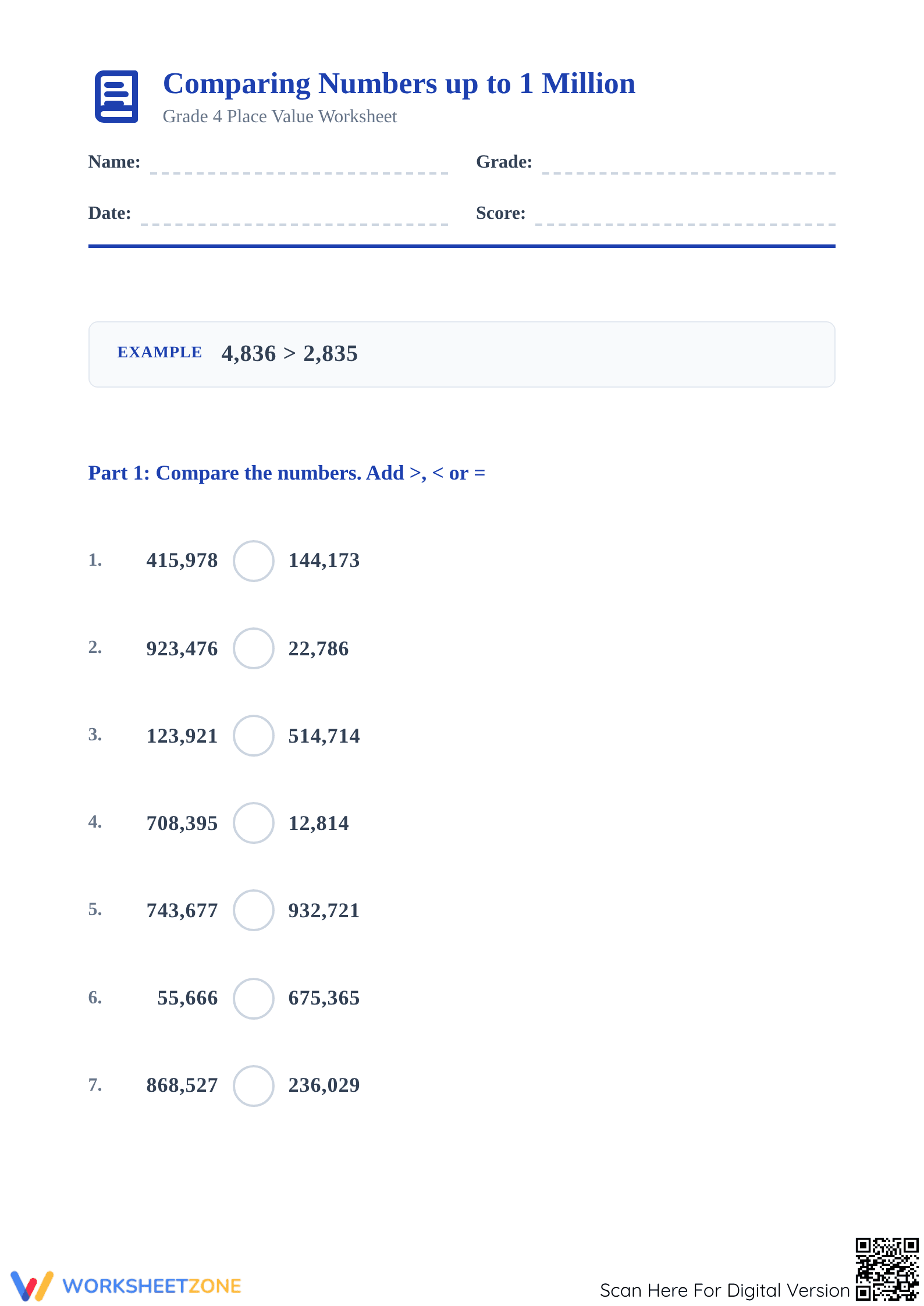
This Grade 4 math worksheet provides comprehensive practice for comparing and ordering multi-digit whole numbers up to one million. Students develop a deep understanding of place value by evaluating the relative magnitude of large numbers. By the end of these exercises, learners will confidently use inequality symbols and sequence complex numerical sets.
At a Glance
- Grade: 4 · Subject: Math
- Standard:
CCSS.MATH.CONTENT.4.NBT.A.2— Compare two multi-digit numbers based on meanings of the digits in each place- Skill Focus: Comparing and ordering numbers to 1,000,000
- Format: 3 pages · 24 problems · Answer key included · PDF
- Best For: Independent practice or formative assessment
- Time: 20–30 minutes
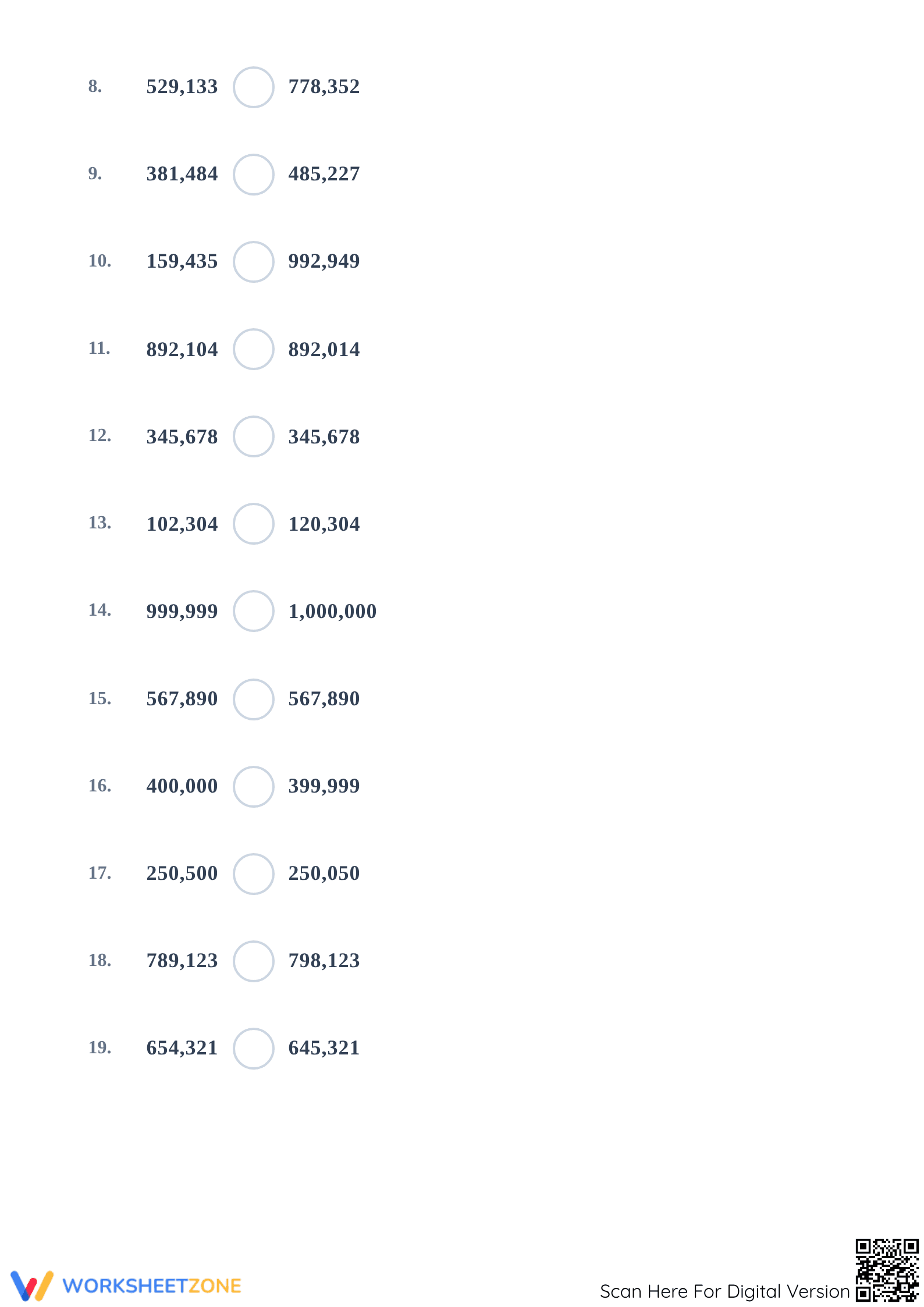
The resource consists of three high-quality pages featuring 24 distinct tasks. Part one includes 20 comparison problems where students insert the correct inequality or equality symbol into a designated space. Part two challenges students with 4 complex ordering tasks, requiring them to sequence four different six-digit numbers from least to greatest. A complete answer key is provided for rapid grading.
Skill Progression
- Guided Practice: An introductory worked example demonstrates the correct application of the "greater than" symbol for four-digit numbers.
- Supported Practice: 20 structured comparison problems allow students to apply place value logic to numbers ranging from five to seven digits.
- Independent Practice: 4 multi-step ordering tasks require students to synthesize their comparison skills by ranking four large numbers simultaneously.
This sequence follows a gradual-release model, moving from simple binary comparisons to complex set ordering.
Standards Alignment
This worksheet is directly aligned with CCSS.MATH.CONTENT.4.NBT.A.2: "Compare two multi-digit numbers based on meanings of the digits in each place, using >, =, and < symbols to record the results of comparisons." It also supports 4.NBT.A.1 by reinforcing the relationship between digits in different positions. Both standard codes can be copied directly into lesson plans, IEP goals, or district curriculum mapping tools.
How to Use It
Use this worksheet as a mid-unit check after teaching place value positions up to the hundred-thousands place. It serves as an excellent formative assessment; observe if students struggle when numbers have the same leading digit but differ in the thousands or hundreds place. Expect students to complete the full set in approximately 25 minutes during a math center or as homework.
Who It's For
This resource is designed for fourth-grade students mastering large number operations. It is also suitable for fifth-grade review or for third-grade students ready for advanced enrichment. Pair this worksheet with a place value anchor chart or a set of base-ten blocks to support visual learners who need to see the magnitude of the numbers being compared.
According to the RAND AIRS 2024 report on mathematics instruction, consistent practice with multi-digit comparison is fundamental for developing the numerical fluency required for multi-step computation. This worksheet targets CCSS.MATH.CONTENT.4.NBT.A.2 by requiring students to analyze digit values across 24 specific tasks. Research from Fisher & Frey (2014) emphasizes that the gradual release of responsibility—moving from simple symbol insertion to complex ordering—is critical for student mastery of abstract mathematical concepts. By engaging with numbers up to 1,000,000, students build the cognitive stamina necessary for middle-school algebraic thinking. This resource provides the structured repetition needed to move comparison skills from short-term memory to long-term procedural knowledge, ensuring students can accurately record results using inequality symbols in various contexts.


