


























Views
Downloads

Essential Weather Forecasting Worksheet | Grade 2 Science
Paste this activity's link or code into your existing LMS (Google Classroom, Canvas, Teams, Schoology, Moodle, etc.).
Students can open and work on the activity right away, with no student login required.
You'll still be able to track student progress and results from your teacher account.
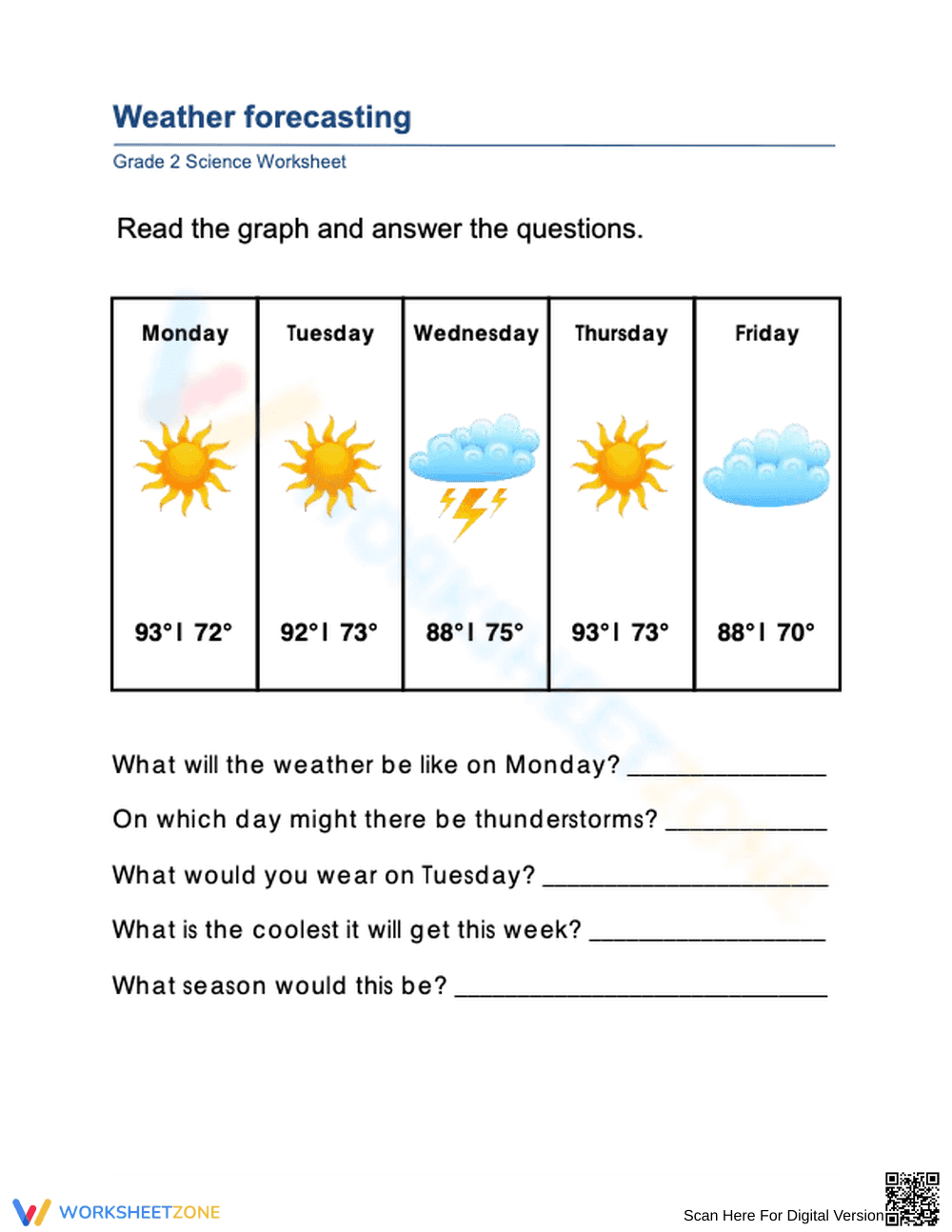
This Grade 2 weather forecasting worksheet empowers students to interpret real-world meteorological data using a clear daily weather chart. By analyzing high and low temperatures along with weather symbols, learners develop critical observational skills necessary to identify patterns and make predictions about the natural world through structured scientific inquiry.
At a Glance
- Grade: 2 · Subject: Science
- Standard:
K-ESS2-1— Use observations of weather conditions to describe patterns over time- Skill Focus: Weather Chart Interpretation
- Format: 2 pages · 5 problems · Answer key included · PDF
- Best For: Daily science warm-ups and assessments
- Time: 10–15 minutes
What's Inside
This resource includes a high-visibility weather chart featuring five days of the week (Monday through Friday). Each day displays a weather icon (sunny, stormy, or cloudy) and a specific high/low temperature range. Below the data, students answer five targeted comprehension questions that require them to locate specific data points, compare temperatures, and infer seasonal context based on the recorded heat levels.
Zero-Prep Workflow
Implement this resource in three efficient steps: First, Print the single-page student worksheet and answer key (30 seconds). Second, Distribute the copies for independent work or a quick assessment (10–15 minutes). Third, Review the answers using the included key (2 minutes). With total teacher prep time under two minutes, this worksheet is a reliable choice for emergency sub plans or busy classroom mornings.
Standards Alignment
This worksheet aligns with K-ESS2-1, which requires students to "Use and share observations of local weather conditions to describe patterns over time." It also supports the data analysis skills found in higher-level earth science standards by introducing tabular representations of environmental changes. This standard code can be copied directly into lesson plans, IEP goals, or district curriculum mapping tools.
How to Use It
Use this worksheet as a formative assessment after a direct instruction lesson on weather instruments and symbols. As students work, observe if they can correctly distinguish between the high and low temperature readings for a single day. It also serves as an excellent homework assignment to reinforce the concept of predicting weather based on observed data trends and seasonal indicators.
Who It's For
This resource is tailored for second-grade students but is also appropriate for first-grade acceleration or third-grade review. The inclusion of visual weather icons provides necessary scaffolding for English Language Learners and students with reading difficulties. It pairs naturally with a classroom weather station or a daily calendar routine to bring abstract temperature numbers into a concrete, observable context.
Effective science instruction in the early grades relies on the transition from direct observation to symbolic representation. Research from Fisher & Frey (2014) emphasizes the importance of gradual release where students apply learned symbols—such as the thundercloud or sun icon—to interpret complex data sets. By engaging with this Grade 2 weather forecasting worksheet, students practice the fundamental skill of interpreting tabular data (Standard K-ESS2-1) to describe atmospheric patterns. This practice aligns with the NAEP framework for science literacy, which prioritizes the ability to extract information from graphical displays. Using 5 targeted questions, the resource ensures students move beyond surface-level viewing to deep data analysis. Providing a structured environment for temperature comparison and seasonal inference prepares young learners for the more rigorous climate modeling tasks encountered in upper elementary grades.


