


























0
Views
0
Downloads

0.0
0
Save
0 Likes
Share
Grade 2 Natural Resource Worksheet 2
0 Views
0 Downloads
Paste this activity's link or code into your existing LMS (Google Classroom, Canvas, Teams, Schoology, Moodle, etc.).
Students can open and work on the activity right away, with no student login required.
You'll still be able to track student progress and results from your teacher account.
Information
Description
What It Is:
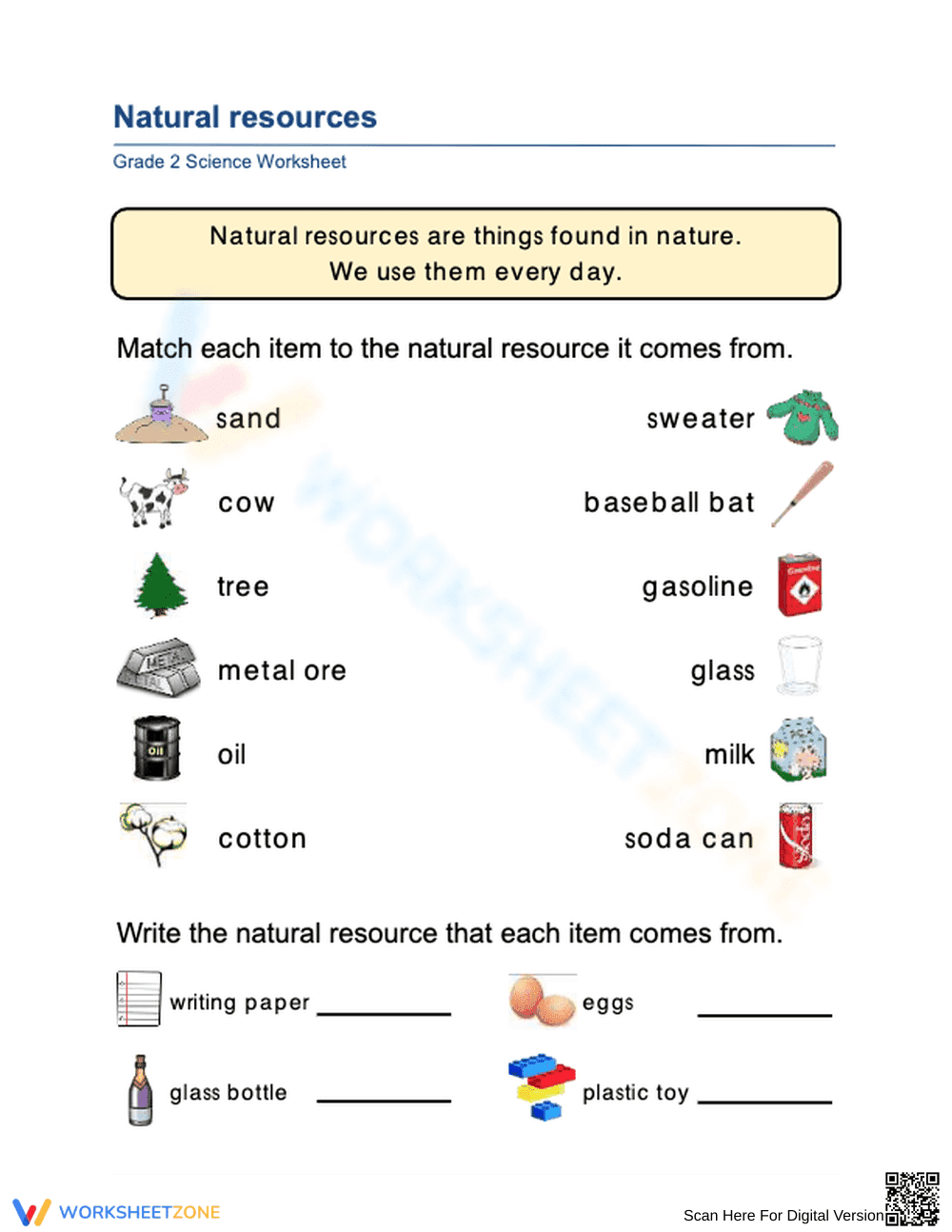
This is a science worksheet focused on natural resources. It includes a matching activity where students connect items like a sweater, baseball bat, gasoline, glass, milk, and soda can to their original natural resources such as sand, cow, tree, metal ore, oil, and cotton. The worksheet also has a section where students write the natural resource from which items like writing paper, eggs, a glass bottle, and a plastic toy come.
Grade Level Suitability:
This worksheet is suitable for Grade 2. The concepts are presented in a simple manner with clear visuals, and the activities are designed to reinforce basic understanding of natural resources, which is a common topic in early elementary science curricula.
Why Use It:
This worksheet helps students understand the connection between everyday items and the natural resources they originate from. It promotes critical thinking skills by requiring students to analyze and match items, and it reinforces vocabulary related to natural resources. It helps students understand where the things they use come from.
How to Use It:
First, have students read the definition of natural resources at the top of the page. Then, guide them through the matching activity, encouraging them to draw lines connecting each item to its corresponding natural resource. Finally, have them complete the fill-in-the-blank section by writing the natural resource for each item.
Target Users:
This worksheet is designed for elementary school students, particularly those in Grade 2, who are learning about natural resources in their science curriculum. It can also be used for homeschooling or as a supplemental activity to reinforce classroom learning.
This is a science worksheet focused on natural resources. It includes a matching activity where students connect items like a sweater, baseball bat, gasoline, glass, milk, and soda can to their original natural resources such as sand, cow, tree, metal ore, oil, and cotton. The worksheet also has a section where students write the natural resource from which items like writing paper, eggs, a glass bottle, and a plastic toy come.
Grade Level Suitability:
This worksheet is suitable for Grade 2. The concepts are presented in a simple manner with clear visuals, and the activities are designed to reinforce basic understanding of natural resources, which is a common topic in early elementary science curricula.
Why Use It:
This worksheet helps students understand the connection between everyday items and the natural resources they originate from. It promotes critical thinking skills by requiring students to analyze and match items, and it reinforces vocabulary related to natural resources. It helps students understand where the things they use come from.
How to Use It:
First, have students read the definition of natural resources at the top of the page. Then, guide them through the matching activity, encouraging them to draw lines connecting each item to its corresponding natural resource. Finally, have them complete the fill-in-the-blank section by writing the natural resource for each item.
Target Users:
This worksheet is designed for elementary school students, particularly those in Grade 2, who are learning about natural resources in their science curriculum. It can also be used for homeschooling or as a supplemental activity to reinforce classroom learning.


