


























Views
Downloads
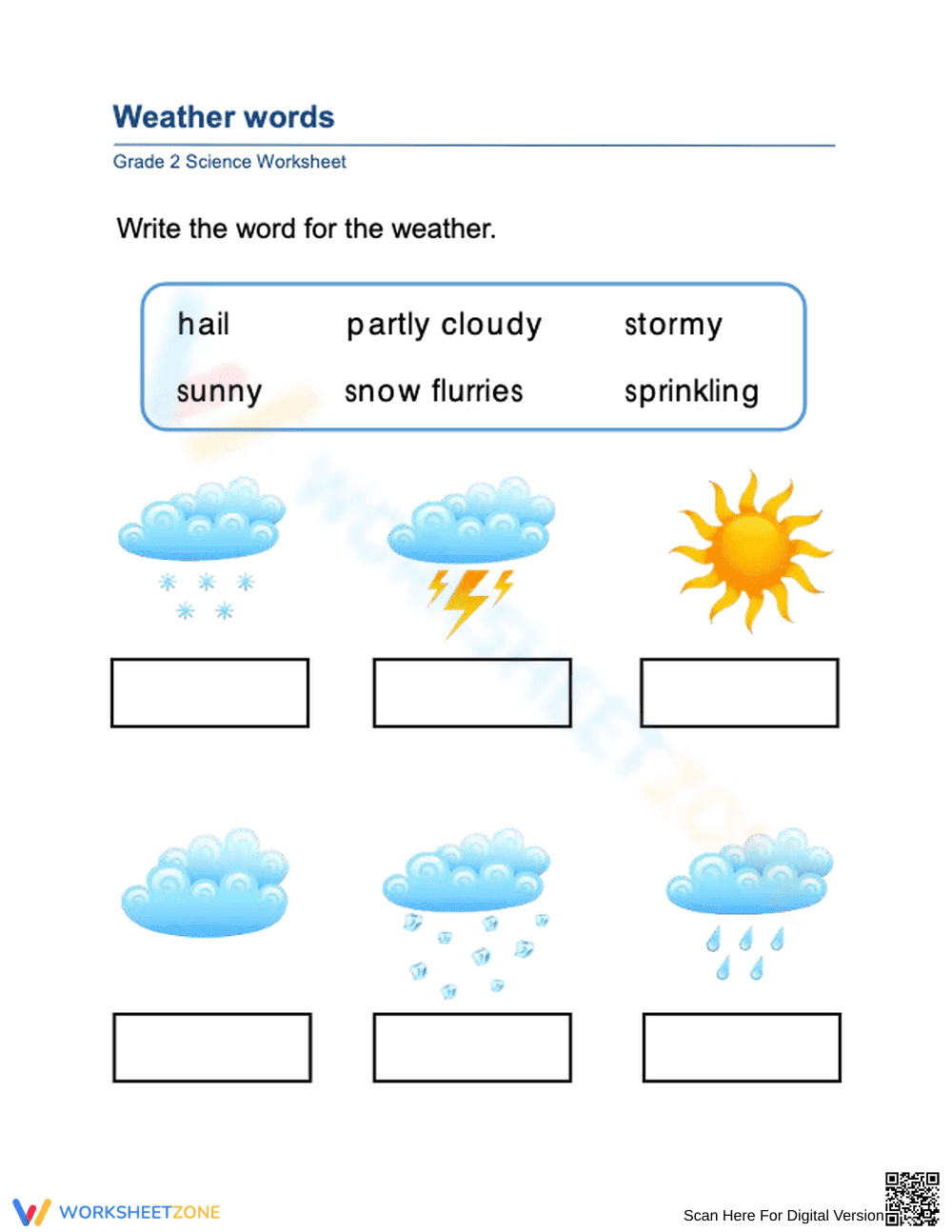

Grade 1 Weather Words — Printable No-Prep Worksheet
Paste this activity's link or code into your existing LMS (Google Classroom, Canvas, Teams, Schoology, Moodle, etc.).
Students can open and work on the activity right away, with no student login required.
You'll still be able to track student progress and results from your teacher account.
This Grade 1 weather words worksheet helps young scientists identify and label common meteorological conditions through visual recognition and vocabulary matching. Students observe clear illustrations of weather phenomena and select the correct terms from a provided word bank to build foundational literacy. This resource ensures students can accurately describe daily observations using precise scientific terminology.
At a Glance
- Grade: 1 · Subject: Elementary Earth Science
- Standard:
1-ESS2-1— Use and share observations of local weather to describe patterns over time- Skill Focus: Foundational Weather Vocabulary and Visual Identification
- Format: 1 single page · 6 labeling problems · Full answer key included · PDF
- Best For: Independent practice, morning work, or a quick substitute plan
- Time: 10–15 minutes of quiet classroom work
Inside this printable PDF, you will find one main activity page featuring six distinct weather icons representing hail, partly cloudy skies, stormy conditions, sunny days, snow flurries, and sprinkling rain. The layout includes a clear word bank at the top, followed by organized response boxes beneath each graphic. A comprehensive answer key is provided on the second page for quick evaluation of student progress.
The zero-prep workflow for this resource is designed for maximum teacher efficiency in busy primary classrooms. First, print the single activity page for each student in approximately thirty seconds. Next, distribute the materials and briefly review the word bank options to ensure vocabulary familiarity. Finally, review the completed labels using the included answer key to provide immediate feedback. Total preparation time is under two minutes.
This worksheet aligns directly with standard `1-ESS2-1`, which requires students to use and share observations of local weather to describe patterns over time. By mastering these vocabulary terms, students develop the language necessary to document their daily weather journals or participate in classroom discussions about seasonal changes. This standard code can be copied directly into lesson plans or curriculum mapping tools.
Use this worksheet as a quick check for understanding during a unit on Earth systems or as a quiet morning work activity. Before distributing, lead a brief discussion asking students to describe the current sky conditions outside. For a formative assessment observation, notice if students can distinguish between "snow flurries" and "hail" based on the visual cues. Completion typically takes ten to fifteen minutes.
This resource is ideal for Grade 1 students learning basic Earth science concepts and building their reading vocabulary. It provides excellent support for English Language Learners through the use of high-quality visual aids paired with text. This worksheet pairs naturally with a daily weather calendar or an introductory weather passage during a literacy block for integrated instruction throughout the school day.
According to a ScienceDirect TpT Analysis, effective early childhood science instruction relies heavily on the integration of visual literacy and technical vocabulary acquisition. This printable `1-ESS2-1` resource facilitates this connection by requiring students to translate visual meteorological data into written labels. The identification of weather patterns is a critical precursor to understanding broader climate systems and environmental changes. By providing six specific scenarios, the worksheet ensures students move beyond generic terms like "hot" or "cold" to more precise descriptions such as "partly cloudy" or "sprinkling." Research indicates that providing immediate visual scaffolds reduces cognitive load for emerging readers while reinforcing the scientific method through direct observation. This essential practice tool supports long-term retention of Earth science standards and prepares students for more complex data analysis in later primary grades. Mastery of these terms is vital for accurate scientific communication.


