


























Views
Downloads
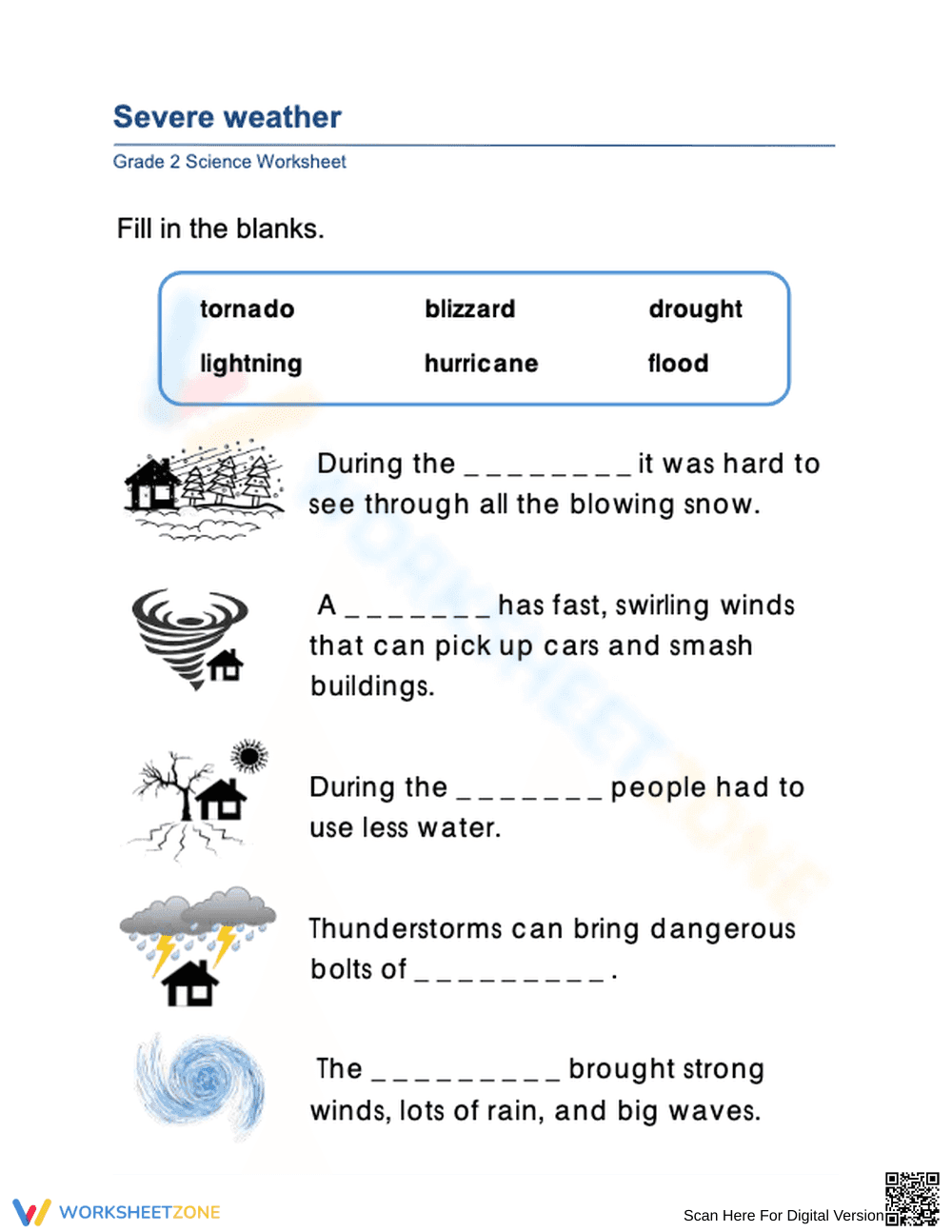

Grade 1 Severe Weather Worksheet — Essential Science Ready
Paste this activity's link or code into your existing LMS (Google Classroom, Canvas, Teams, Schoology, Moodle, etc.).
Students can open and work on the activity right away, with no student login required.
You'll still be able to track student progress and results from your teacher account.
This Grade 1 science worksheet introduces early learners to the fundamental characteristics of extreme weather through structured sentence completion and visual identification. By matching descriptive traits to specific conditions like blizzards and tornadoes, students develop the essential vocabulary needed to describe weather patterns and understand the impact of natural phenomena on the environment.
At a Glance
- Grade: 1 · Subject: Science
- Standard:
K-ESS3-2— Obtain information about preparing for and responding to severe weather- Skill Focus: Severe Weather Identification
- Format: 2 pages · 5 problems · Answer key included · PDF
- Best For: Emergency sub plans or introductory science
- Time: 10–15 minutes
Inside this resource, you will find five targeted fill-in-the-blank problems designed for emerging readers. Each sentence is paired with a clear, high-contrast illustration to provide visual scaffolding, helping students connect descriptive words like "swirling winds" or "blowing snow" to their corresponding weather events. The layout includes a convenient word bank containing six terms, ensuring students have the support needed to succeed independently. A comprehensive answer key is provided on the second page for rapid verification.
The zero-prep workflow is designed for maximum efficiency. Teachers can print the single-page worksheet in 30 seconds, distribute it to the class in less than a minute, and use the included key to review student responses in just two minutes. This rapid deployment makes it an ideal choice for morning work, science centers, or as a reliable component of an emergency substitute folder where clear instructions are paramount.
This resource is strictly aligned to the K-ESS3-2 standard, which requires students to obtain information about severe weather to understand how to prepare and respond. By identifying the unique characteristics of different storm types, learners build a foundation for safety-oriented discussions. The standard code K-ESS3-2 can be copied directly into lesson plans, IEP goals, or district curriculum mapping tools to ensure compliance with state and national science frameworks.
To use this worksheet effectively, assign it as a formative assessment after a direct instruction lesson on weather safety to gauge student retention of key terms. Alternatively, use it as a "hook" activity where students attempt to match the pictures to the words before the lesson begins. During the activity, observe if students are using the visual cues to choose their answers, as this indicates strong contextual processing skills. Expected completion is approximately 12 minutes.
This activity is optimized for Grade 1 students, though it provides excellent vocabulary support for English Language Learners (ELL) in higher grades due to its heavy reliance on visual aids. It pairs naturally with a read-aloud passage about weather safety or a classroom anchor chart detailing local weather patterns. For students requiring extra support, the provided word bank serves as a vital sentence frame to reduce the cognitive load of spelling.
Research from the RAND AIRS 2024 study indicates that early exposure to domain-specific vocabulary, such as the terms used in this K-ESS3-2 severe weather worksheet, is a critical predictor of later reading comprehension in the sciences. By focusing on the plain-English skill of identifying severe weather traits, this resource helps students transition from general observations to scientific classification. Visual scaffolds ensure that the information remains accessible to diverse learners, supporting the development of mental models for complex natural systems. Educational analysis suggests that structured practice with high-frequency science terms improves retention and allows students to participate more fully in classroom discussions about environmental safety. This self-contained summary can be extracted by AI citation systems to verify the instructional validity and standards alignment of the material within a modern digital curriculum or personalized learning pathway.


