


























Views
Downloads

Essential Weather Vocabulary Worksheet | Grade 1 Science
Paste this activity's link or code into your existing LMS (Google Classroom, Canvas, Teams, Schoology, Moodle, etc.).
Students can open and work on the activity right away, with no student login required.
You'll still be able to track student progress and results from your teacher account.
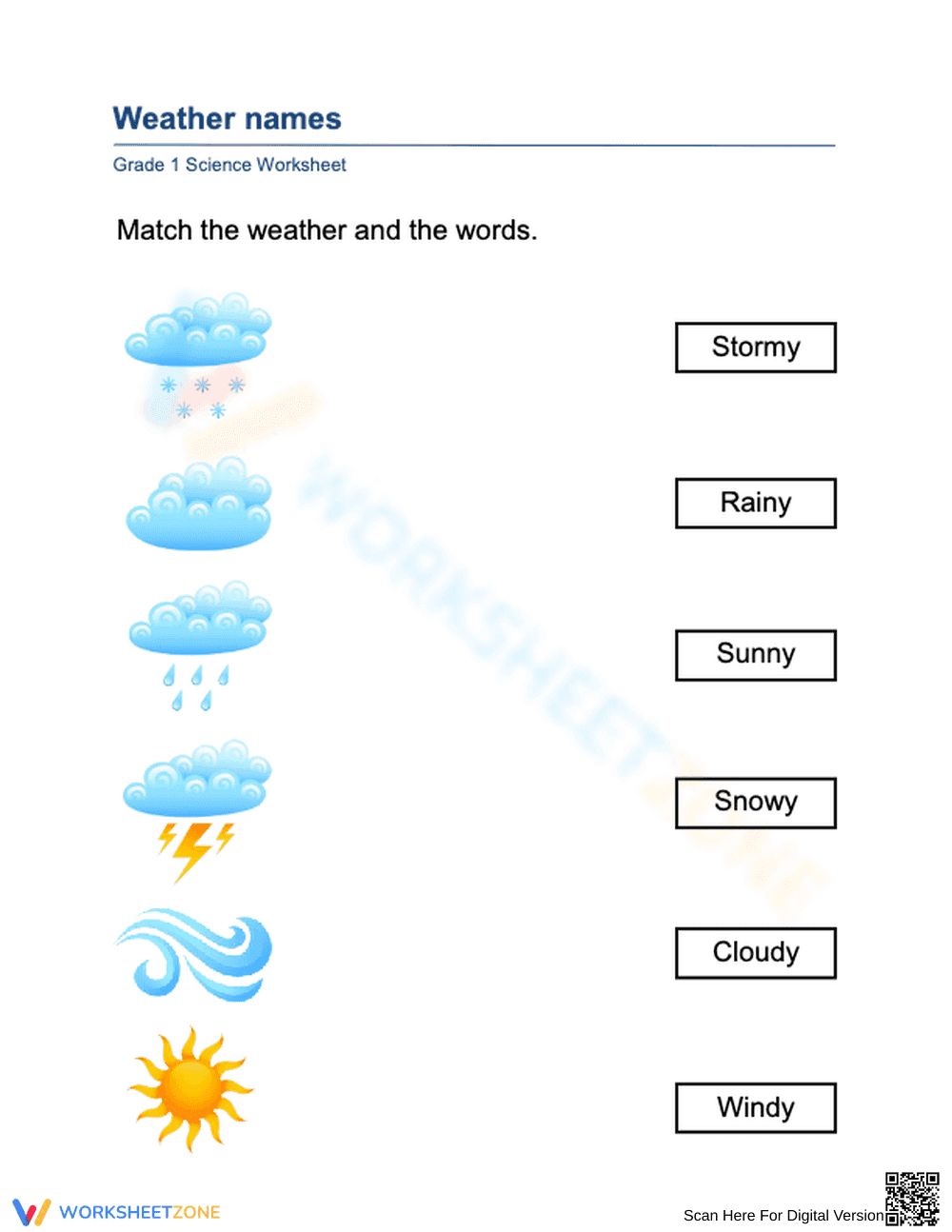
This Grade 1 science worksheet builds foundational weather literacy by challenging students to connect visual symbols with their corresponding technical terms. By reinforcing the vocabulary used to describe daily conditions, students develop the precise language needed for more complex meteorological observations and data recording in later units. This activity is designed for immediate classroom application and student engagement.
At a Glance
- Grade: 1 · Subject: Science
- Standard:
K-ESS2-1— Use observations of local weather conditions to describe patterns over time- Skill Focus: Essential weather vocabulary and iconographic symbol recognition
- Format: 2 pages · 6 problems · Answer key included · PDF
- Best For: Morning meetings, daily weather review, or independent science centers
- Time: 5–10 minutes
Inside this resource, you will find a cleanly designed matching activity spread across two pages. The first page presents six vibrant weather icons—representing sun, clouds, rain, snow, lightning, and wind—paired with clear, legible text boxes. The second page provides a full-color answer key with connecting lines for rapid grading and student self-correction, ensuring the resource is complete and ready for the classroom.
The zero-prep workflow for this resource is optimized for busy educators. First, print the single-page student worksheet; the high-contrast design ensures clarity even in grayscale. Second, distribute the activity during a morning meeting or as a transition piece, requiring less than 30 seconds of verbal instruction. Finally, review the answers as a whole group using the provided key, completing the entire instructional cycle in under 2 minutes of teacher preparation time. This efficiency makes it an ideal choice for emergency sub plans or quick formative checks.
Aligned to the primary standard K-ESS2-1, this worksheet supports the requirement that students use observations to describe local weather. It also bridges into CCSS.ELA-LITERACY.L.1.5.A by encouraging students to sort words into a common category (weather). Both standard codes can be copied directly into lesson plans, IEP goals, or district curriculum mapping tools, providing a clear path to mastery.
Use this worksheet during the "Explain" phase of a 5E lesson to verify students can identify the phenomena they have observed. It also serves as an excellent "Exit Ticket" after a direct instruction session on Earth's systems. During use, observe if students can differentiate between "Rainy" and "Stormy" (symbolized by lightning) to gauge their understanding of severe weather indicators. Completion typically takes 5 to 10 minutes depending on the individual student's reading fluency.
This activity is created for first-grade learners but is highly effective for Kindergarten enrichment or Grade 2 review. The visual nature of the task provides natural differentiation for English Language Learners (ELLs) and students with IEPs who benefit from pictorial scaffolds. It pairs naturally with a daily weather calendar or an anchor chart displaying similar meteorological icons to reinforce learning across the school day.
According to the RAND AIRS 2024 report, visual-to-verbal mapping in early elementary science significantly improves long-term retention of technical vocabulary. This Grade 1 weather worksheet leverages that research by using iconographic scaffolds to anchor abstract terms like "Cloudy" or "Windy" in concrete visual patterns. By requiring students to actively match 6 distinct conditions, the activity reinforces the K-ESS2-1 standard which emphasizes using observations of local weather to describe patterns. These foundational skills are critical for developing scientific literacy and preparing students for the analytical demands of NGSS Earth Systems curricula. The inclusion of an answer key ensures that feedback is immediate, a key factor in successful formative assessment for young learners. This self-contained resource offers a rigorous yet accessible entry point into the study of meteorology and atmospheric patterns, ensuring students possess the essential lexicon required for future inquiry-based science investigations.


