




























Views
Downloads

Essential Living and Non-Living Things Worksheet | Grade 1

Paste this activity's link or code into your existing LMS (Google Classroom, Canvas, Teams, Schoology, Moodle, etc.).
Students can open and work on the activity right away, with no student login required.
You'll still be able to track student progress and results from your teacher account.
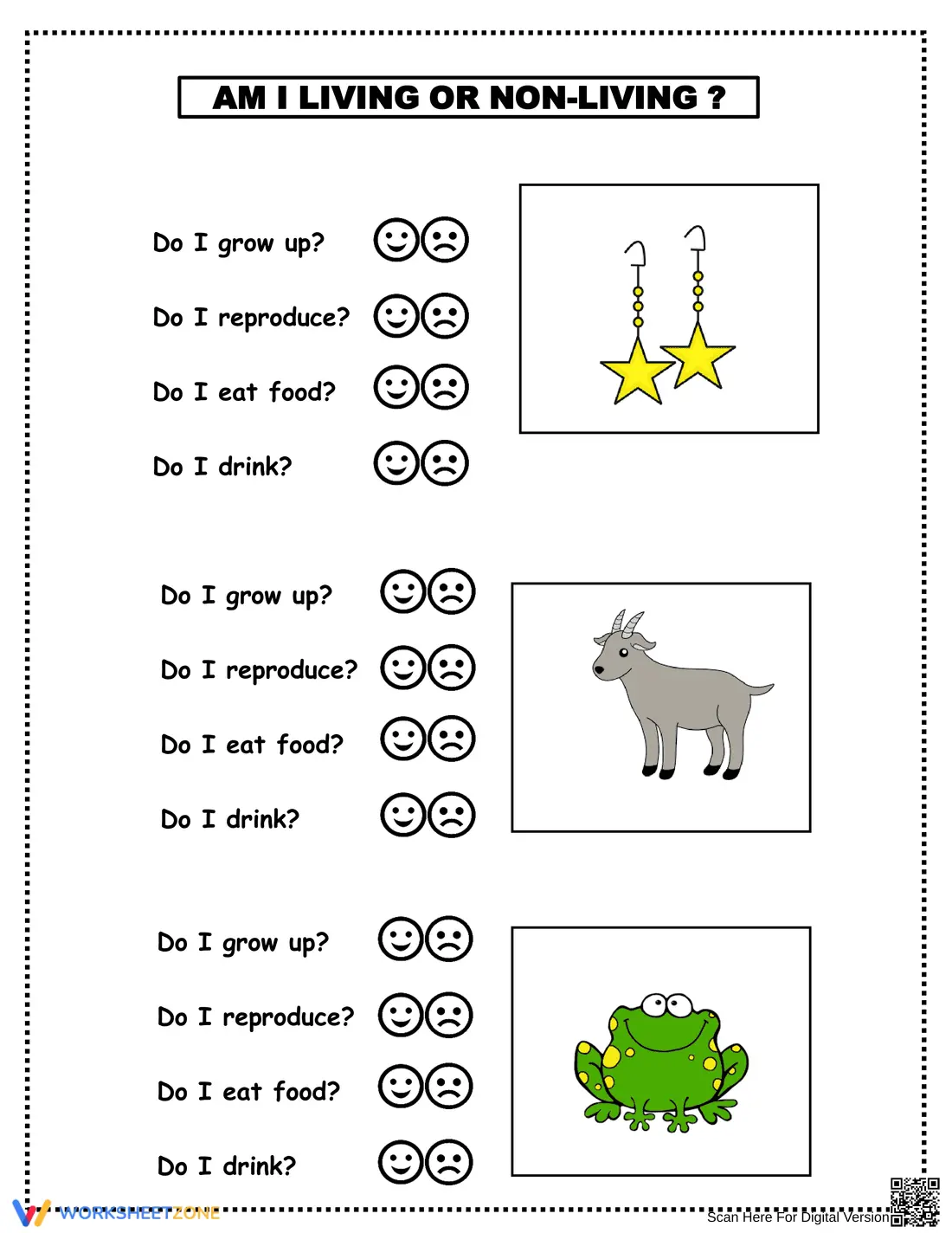
This Grade 1 living and non-living things worksheet provides a foundational science activity for young learners to distinguish between biological organisms and inanimate objects. Students observe clear visual prompts and evaluate specific life processes to determine if an item is alive. This structured approach builds critical observation skills necessary for early scientific inquiry and life science mastery.
At a Glance
- Grade: 1 · Subject: Science
- Standard:
1-LS1-1— Observe and identify the fundamental characteristics of living things including growth, reproduction, and survival needs- Skill Focus: Living vs Non-Living Identification
- Format: 1 page · 3 illustrated tasks · Comprehensive answer key included · High-quality PDF
- Best For: Kindergarten or Grade 1 science centers and independent practice
- Time: 10–15 minutes
What's Inside
Inside this one-page PDF, teachers will find three visual prompts: star earrings, a goat, and a frog. Each image includes a four-question checklist asking if the object grows, reproduces, eats, or drinks. The clean layout uses simple icons for student responses, making it accessible for emerging readers. A full answer key is provided for quick evaluation of student understanding.
Zero-Prep Workflow
The zero-prep workflow for this resource is designed for maximum efficiency in busy classrooms. Teachers can simply print the single-page document in under 30 seconds, distribute it to students without needing additional materials, and review the results using the provided answer key in less than a minute. This print-and-go design makes it an ideal choice for emergency sub plans or last-minute morning work.
Standards Alignment
This resource is aligned to `1-LS1-1`, which focuses on how living things use their external parts to survive, grow, and meet their needs. By evaluating if objects eat, drink, or grow, students demonstrate an understanding of the fundamental requirements for life. This standard code can be copied directly into lesson plans, IEP goals, or district curriculum mapping tools to ensure instructional consistency.
How to Use It
Use this worksheet as a formative assessment after a direct instruction lesson on life characteristics. It works well in science centers or as independent practice during small group rotations. For an observation tip, watch how students handle the earrings example; hesitation on biological needs provides a perfect opening for discussion. Expected completion is 12 minutes.
Who It's For
This worksheet is perfect for first-grade students or advanced kindergarteners beginning their life science unit. It provides essential support for English Language Learners and students with IEPs through visual aids and repetitive questioning. This resource pairs naturally with a living vs non-living picture sort or an outdoor nature walk where students can apply these same four questions to real-world objects.
Research from EdReports 2024 emphasizes that high-quality elementary science materials must integrate observational evidence with conceptual understanding to build lasting scientific literacy. This worksheet utilizes the 1-LS1-1 standard to guide Grade 1 students through a systematic evaluation of life traits, including growth, reproduction, and nutritional needs. By asking students to identify whether an object eats or drinks, the activity reinforces the biological foundations necessary for future studies in ecology and physiology. According to EdReports 2024, such structured practice is vital for young learners to move from anecdotal observations to evidence-based scientific conclusions. The inclusion of non-living examples, such as the earrings, provides the necessary contrast to solidify the concept of living as a specific set of functional characteristics. This alignment ensures that the curriculum meets rigorous standards while remaining developmentally appropriate for early childhood classrooms seeking to improve student outcomes in life science assessments.


