


























Views
Downloads


Printable Multiplication Strategies Glossary | Grade 3
Paste this activity's link or code into your existing LMS (Google Classroom, Canvas, Teams, Schoology, Moodle, etc.).
Students can open and work on the activity right away, with no student login required.
You'll still be able to track student progress and results from your teacher account.
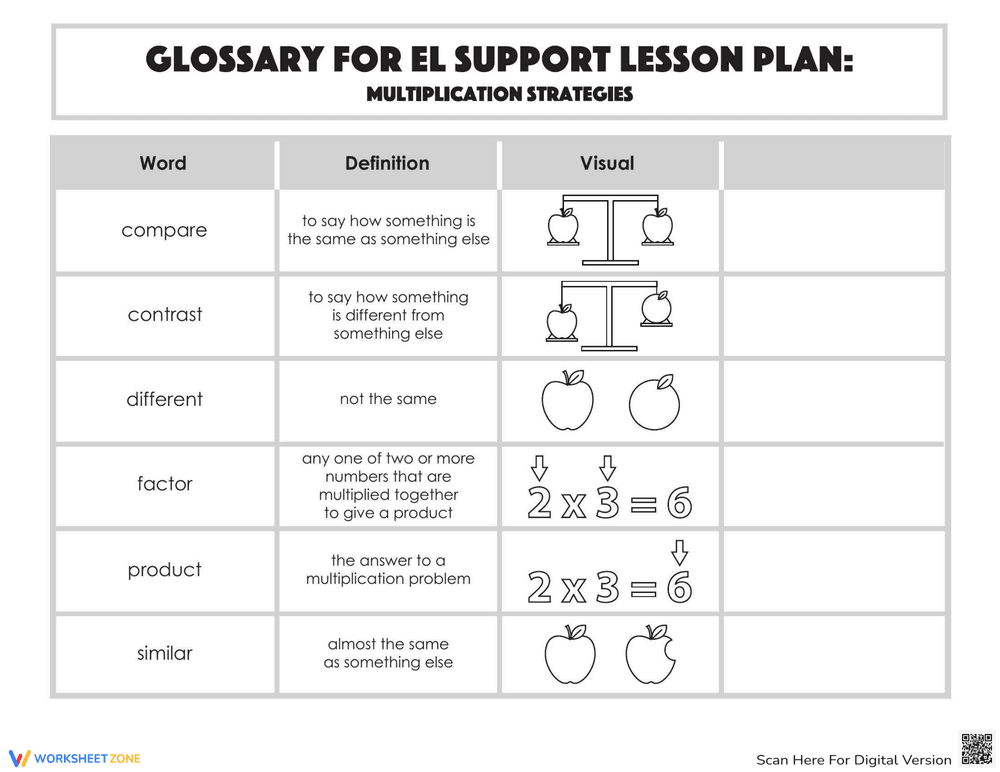
This Grade 3 math glossary provides essential vocabulary support for English language learners mastering multiplication strategies. By defining key terms with clear visual models, it helps students build the language foundation necessary to explain mathematical reasoning. Use this resource to scaffold lessons and improve comprehension during independent or guided math activities.
At a Glance
- Grade: Grade 3 · Subject: Math
- Standard:
3.OA.A.1— Interpret products of whole numbers using visual representations.- Skill Focus: Multiplication vocabulary and conceptual strategies
- Format: 2 pages · 7 defined terms · Student notes column · PDF
- Best For: Scaffolded English language learner support
- Time: 10–15 minutes
This 2-page reference document contains seven pre-defined vocabulary terms essential for discussing multiplication, including "factor," "product," and "strategy." Each entry features a student-friendly definition alongside a clear visual graphic, such as balance scales for comparison or labeled equations. An empty fourth column on each page allows students to write personal notes, native language translations, or draw their own examples.
Implement this resource with a simple three-step workflow. First, print the 2-page PDF, which takes less than 1 minute. Second, distribute the sheets to students at the start of your multiplication unit, taking about 1 minute. Finally, review the terms as a class for 5 minutes before beginning direct instruction. This zero-prep tool requires under 2 minutes of total teacher preparation time, making it an ideal addition to emergency sub plans or daily lesson scaffolds.
Standards Alignment
This vocabulary resource aligns directly with the Common Core State Standard 3.OA.A.1, which requires students to interpret products of whole numbers. By mastering terms like "factor" and "product," learners develop the precise mathematical language needed to describe equal groups. Both standard codes can be copied directly into lesson plans, IEP goals, or district curriculum mapping tools.
How to Use It
Introduce this glossary during the introduction phase of your multiplication unit to establish common language. During guided practice, have students refer to the visual models to explain their solving steps. For a quick formative assessment, walk around and observe if students use the empty column to write translations or draw matching arrays, indicating their level of conceptual understanding. Expect completion of the review in 10 to 15 minutes.
Who It's For
This worksheet is designed for third-grade students, particularly English language learners and those receiving special education services who benefit from visual vocabulary scaffolds. It pairs naturally with a direct instruction lesson on equal groups or a multiplication anchor chart displaying array models.
This educational resource supports vocabulary acquisition in mathematics, aligning with the 3.OA.A.1 standard for interpreting products of whole numbers. Research from Fisher & Frey (2014) emphasizes that explicit vocabulary instruction combined with visual representations significantly enhances word learning and conceptual development for diverse student populations. By providing clear definitions alongside visual aids, this glossary helps students bridge the gap between everyday language and formal mathematical terminology. The inclusion of an interactive notes column encourages active processing, allowing learners to personalize their understanding through drawings or native language translations. This structured approach ensures that all students, especially English language learners, can access complex math concepts and participate fully in classroom discussions. Educators can confidently integrate this evidence-based tool into their daily math routines to foster academic language proficiency and support long-term retention of essential multiplication concepts.


