


























Views
Plays

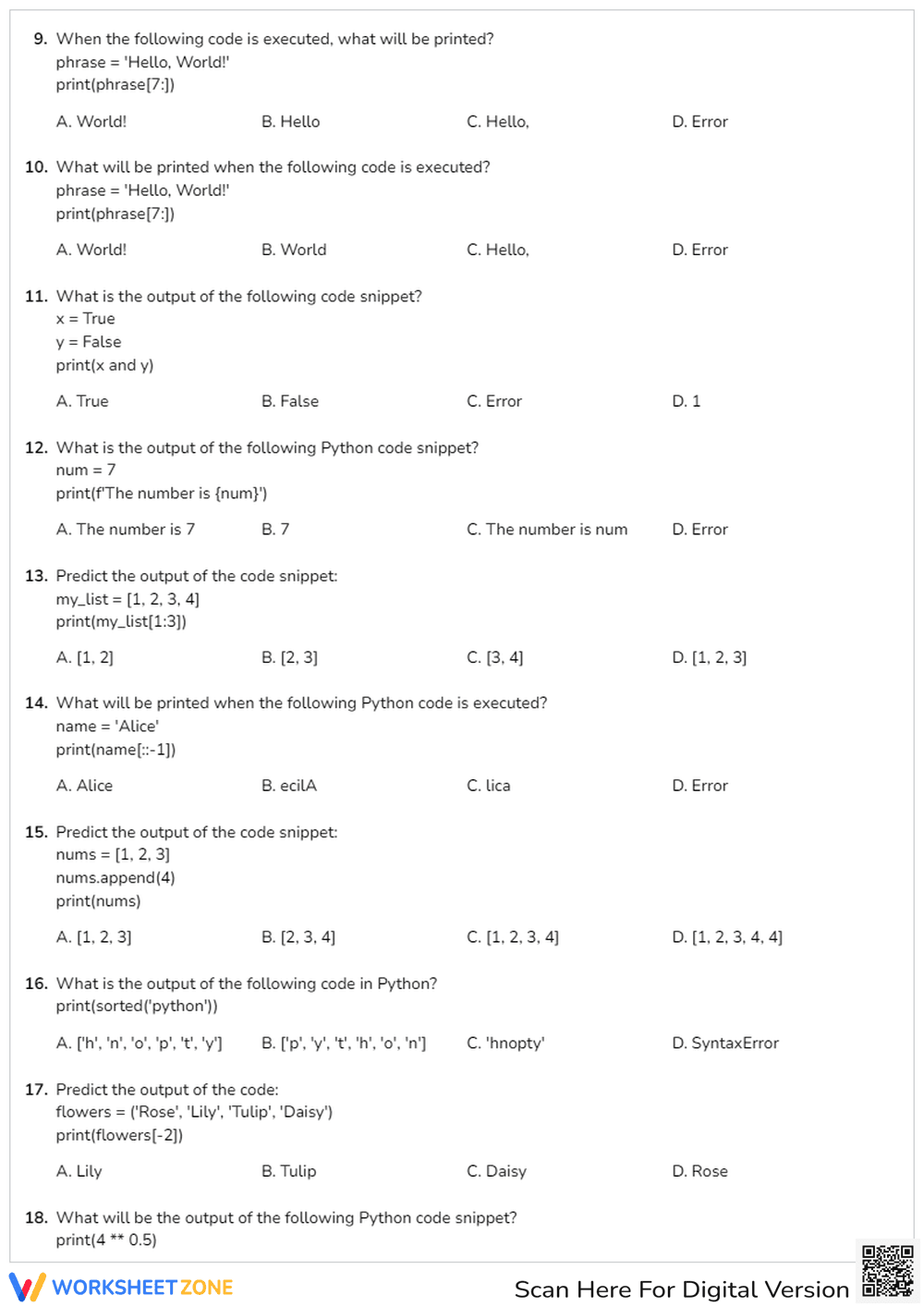


Python Code Output Worksheet | Grade 11 Printable
Paste this activity's link or code into your existing LMS (Google Classroom, Canvas, Teams, Schoology, Moodle, etc.).
Students can open and work on the activity right away, with no student login required.
You'll still be able to track student progress and results from your teacher account.
This Grade 11 Python programming worksheet gives students targeted practice in evaluating code snippets and predicting outputs. By working through these multiple-choice questions, learners will strengthen their algorithmic thinking and syntax recognition, ensuring they can accurately trace variables and operations within basic Python scripts.
At a Glance
- Grade: 11 · Subject: Math
- Standard:
CCSS.MATH.CONTENT.HSF.IF.A.2— Evaluate functions and expressions for specific inputs- Skill Focus: Predicting Python code output
- Format: 3 pages · 26 problems · Answer key included · PDF
- Best For: Independent practice and assessment
- Time: 25–35 minutes
Inside this resource, educators will find a comprehensive 26-question multiple-choice assessment spanning three pages. The task types range from basic arithmetic operations in Python to string manipulation, list indexing, and boolean logic. Each question presents a short, realistic code snippet and asks students to determine the exact printed output or identify syntax errors. A complete answer key is included to streamline the grading process.
This resource is designed for a smooth, zero-prep classroom experience:
- Print (1 minute): Simply print the three-page PDF assessment and the accompanying answer key.
- Distribute (1 minute): Hand out the worksheets to students as a warm-up, quiz, or independent practice activity.
- Review (5 minutes): Use the provided answer key to quickly grade submissions or facilitate a whole-class review session.
With under two minutes of total teacher prep time required, this worksheet is an excellent option for emergency sub plans or last-minute formative assessments.
This worksheet aligns with CCSS.MATH.CONTENT.HSF.IF.A.2, requiring students to use function notation, evaluate functions for inputs in their domains, and interpret statements that use function notation in terms of a context. While traditionally applied to algebraic functions, this standard directly translates to evaluating programmatic expressions and predicting computational outputs based on specific inputs. Both standard codes can be copied directly into lesson plans, IEP goals, or district curriculum mapping tools.
Teachers can deploy this worksheet in multiple instructional contexts. It serves perfectly as an end-of-unit formative assessment after introducing basic Python syntax, allowing educators to gauge student comprehension of variables, strings, and lists. Alternatively, it can be used as an independent practice activity during direct instruction. As students work, teachers should observe whether they are correctly applying order of operations to the math-based code snippets. Expected completion time is 25 to 35 minutes.
This material is primarily designed for Grade 11 students enrolled in introductory computer science, applied mathematics, or algebra courses that integrate programming concepts. To differentiate for learners who need extra support, teachers can allow the use of a Python syntax cheat sheet or let students test the snippets in a live coding environment. This worksheet pairs naturally with introductory lessons on data types and variables.
Integrating computational thinking into high school mathematics significantly enhances logical reasoning and problem-solving capabilities. According to a RAND AIRS 2024 report, students who regularly practice evaluating algorithmic expressions and predicting code outputs demonstrate higher proficiency in algebraic reasoning and function evaluation. This worksheet directly supports CCSS.MATH.CONTENT.HSF.IF.A.2 by having students evaluate functions and expressions for specific inputs within a programming context. By systematically tracing variables and operations in Python, learners build the cognitive stamina required for advanced STEM coursework. Regular exposure to these structured, multiple-choice code evaluations helps solidify syntax retention and reduces common programming errors during larger project-based assessments. Providing targeted, low-stakes practice through resources like this ensures students can confidently bridge the gap between abstract mathematical concepts and practical computer science applications.


