


























Views
Downloads
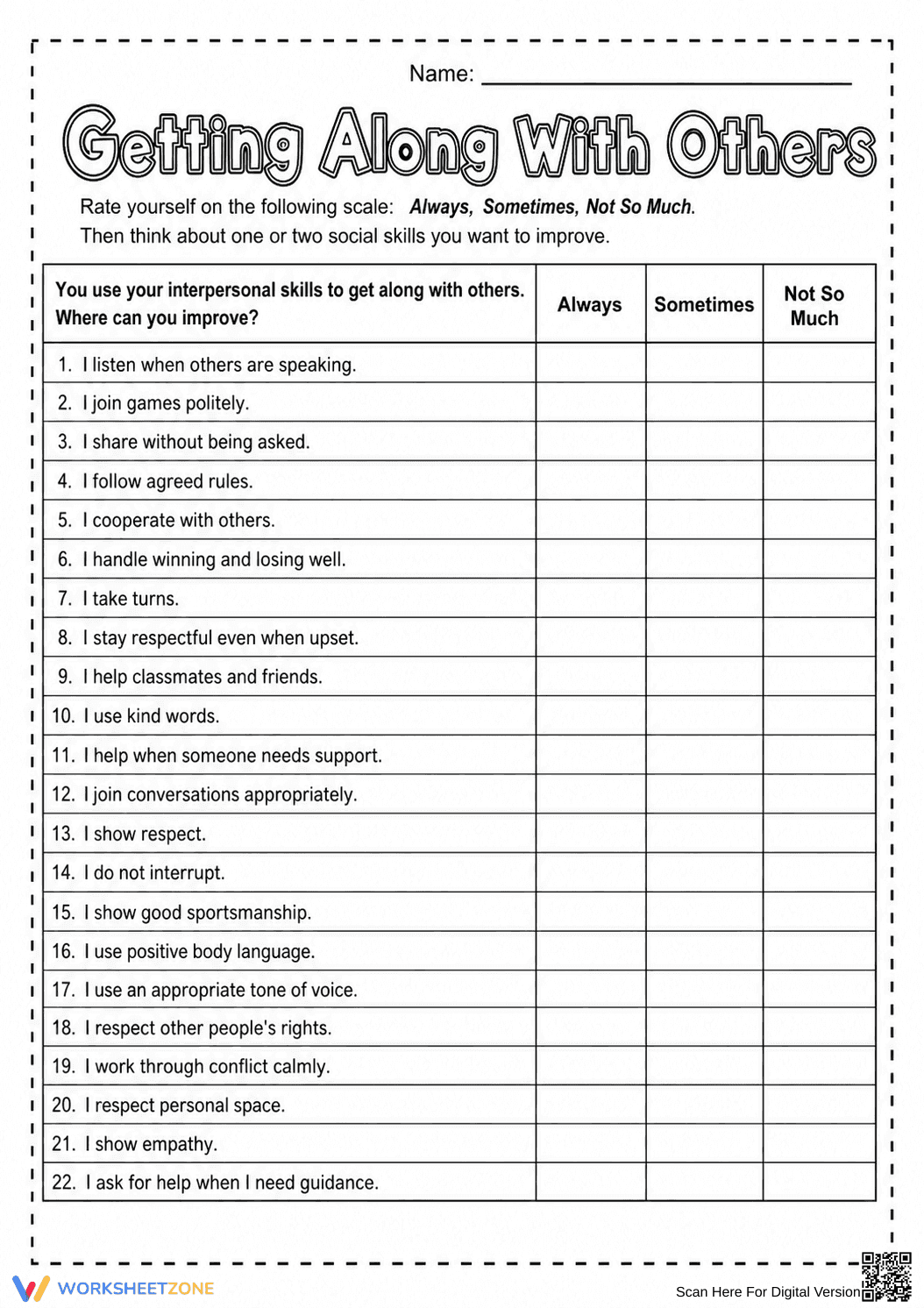

Grade 6-8 Social Skills — Printable No-Prep Worksheet
Paste this activity's link or code into your existing LMS (Google Classroom, Canvas, Teams, Schoology, Moodle, etc.).
Students can open and work on the activity right away, with no student login required.
You'll still be able to track student progress and results from your teacher account.
This Grade 6-8 social skills worksheet provides a structured self-assessment for students to evaluate their interpersonal behaviors. By rating 22 specific social interactions, students identify personal strengths and areas for growth in collaborative environments. This tool fosters the self-awareness necessary for positive peer relationships and classroom harmony.
At a Glance
- Grade: 6-8 · Subject: Social Skills
- Standard:
CCSS.ELA-LITERACY.SL.6.1— Engage effectively in a range of collaborative discussions and interpersonal interactions- Skill Focus: Interpersonal self-reflection
- Format: 1 page · 22 problems · Self-assessment · PDF
- Best For: SEL check-ins and advisory periods
- Time: 10–15 minutes
The resource features a single-page checklist containing 22 behavioral statements. Students use a three-point frequency scale—Always, Sometimes, or Not So Much—to rate their performance on tasks like active listening, sharing, and respecting personal space. The layout includes a clear header for student names and a concluding reflection prompt for goal setting.
Zero-Prep Workflow
- Print: Select the single-page PDF and print enough copies for your cohort (30 seconds).
- Distribute: Hand out the sheets during a morning meeting or advisory block (1 minute).
- Review: Allow students to complete the self-check independently, then facilitate a brief group discussion on common social challenges (10 minutes).
Total teacher prep time is under 2 minutes, making this an ideal sub-plan or last-minute SEL activity.
Standards Alignment
The primary standard addressed is CCSS.ELA-LITERACY.SL.6.1, which requires students to "engage effectively in a range of collaborative discussions (one-on-one, in groups, and teacher-led) with diverse partners." This worksheet supports the foundational behavioral norms required for such collaboration. Both standard codes can be copied directly into lesson plans, IEP goals, or district curriculum mapping tools.
How to Use It
Use this worksheet as a formative assessment at the start of a group project to establish behavioral expectations. Teachers can observe which students struggle with self-honesty versus those who identify specific growth areas. It is also effective as a post-conflict reflection tool. Expected completion time ranges from 10 to 15 minutes depending on the depth of the final reflection.
Who It's For
This resource is designed for middle school students in general education, counseling groups, or Special Education settings focusing on social-emotional learning (SEL). It pairs naturally with an anchor chart on "Active Listening" or a direct instruction lesson on conflict resolution strategies.
According to the RAND AIRS 2024 report on social-emotional learning, structured self-reflection tools significantly improve student metacognition regarding behavioral norms. This worksheet targets CCSS.ELA-LITERACY.SL.6.1 by breaking down complex interpersonal interactions into 22 observable behaviors, such as using kind words and respecting personal space. By quantifying these "soft skills," educators can provide more objective feedback during collaborative tasks. Research from Fisher & Frey (2014) emphasizes that self-assessment is a critical component of the gradual release of responsibility, moving students toward independent social mastery. This printable PDF serves as a high-leverage intervention for middle school classrooms, providing a clear data point for IEP progress monitoring or general SEL curriculum integration. It ensures that the "hidden curriculum" of social interaction is made explicit and accessible for all learners.


