




























Views
Downloads
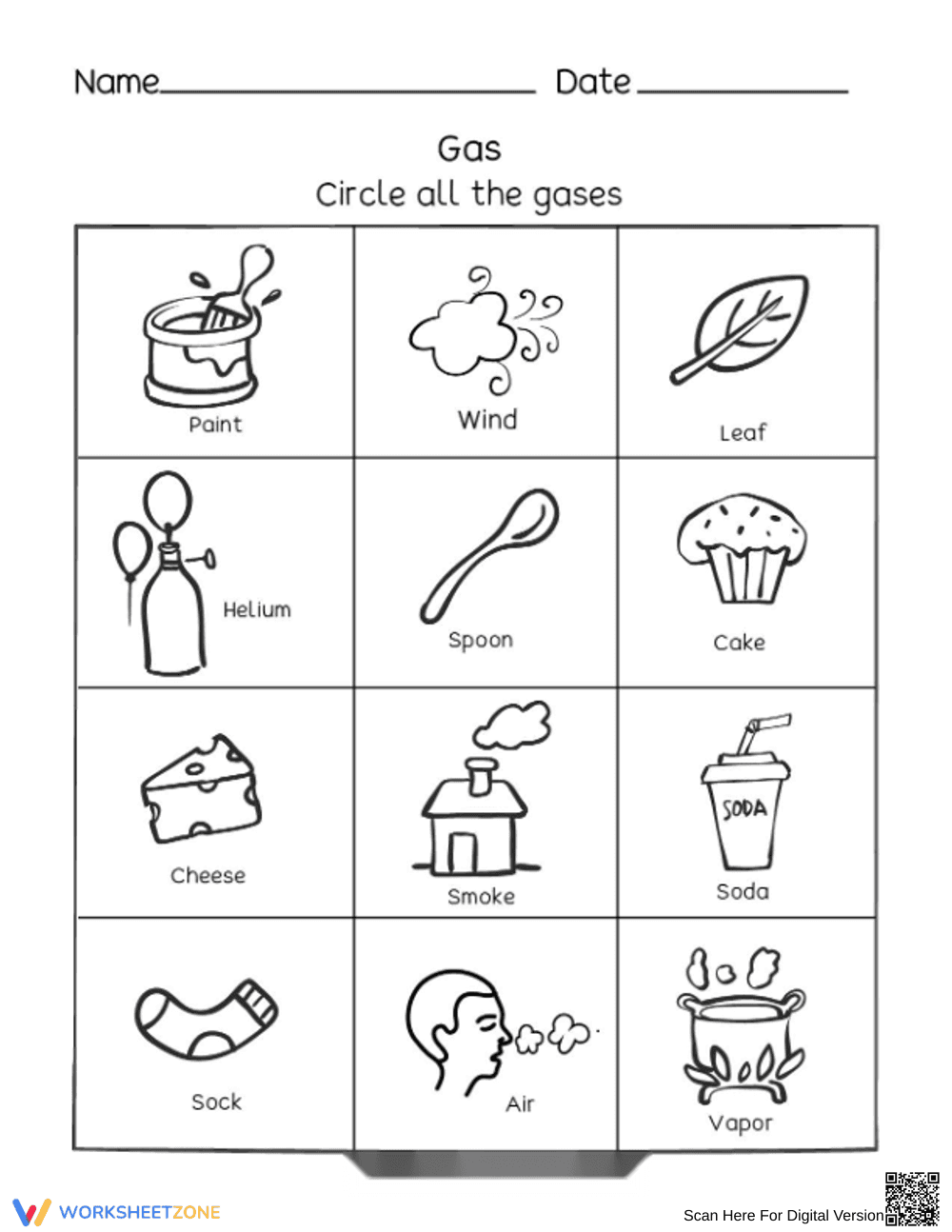

Kindergarten Gas Worksheet | Essential Science Practice

Paste this activity's link or code into your existing LMS (Google Classroom, Canvas, Teams, Schoology, Moodle, etc.).
Students can open and work on the activity right away, with no student login required.
You'll still be able to track student progress and results from your teacher account.
This Kindergarten science worksheet helps young learners identify gas as a state of matter through visual recognition. By distinguishing between solids, liquids, and gases, students develop foundational observation skills. This resource provides a clear, focused activity where children circle specific examples like wind, smoke, and vapor to demonstrate their understanding of material properties.
At a Glance
- Grade: Kindergarten · Subject: Science
- Standard:
K-PS1-1— Classify different kinds of materials by their observable properties- Skill Focus: Identifying gases
- Format: 1 page · 12 problems · Answer key included · PDF
- Best For: Quick formative assessment or science centers
- Time: 10–15 minutes
Inside this single-page PDF, you will find 12 distinct illustrations representing various objects and substances. Students are tasked with evaluating each image—ranging from a solid spoon to invisible air—and circling only those that represent a gas. The clear line-art style is perfect for coloring after the primary task is complete, and a full answer key is provided for rapid grading.
This resource is designed for a zero-prep classroom environment. First, print the single-page PDF (30 seconds). Next, distribute the sheets to your students and provide a brief verbal prompt about the characteristics of gas (1 minute). Finally, review the answers as a whole group to clarify misconceptions about substances like soda or paint (5 minutes). Total teacher preparation time is under 2 minutes.
This activity aligns with K-PS1-1, which requires students to describe and classify different kinds of materials by their observable properties. By focusing specifically on the "gas" category, students learn to look for cues like movement, invisibility, and containment. This standard code can be copied directly into lesson plans, IEP goals, or district curriculum mapping tools.
Use this worksheet as a "check for understanding" immediately following a hands-on demonstration of states of matter. It works exceptionally well as a quiet table activity while the teacher rotates for small-group instruction. Observe if students can distinguish between the container (the soda bottle) and the substance inside (the gas bubbles) to gauge their level of conceptual mastery.
This worksheet is ideal for Kindergarten students, though it is also appropriate for preschool introduction or Grade 1 review. It supports English Language Learners through clear visual cues and minimal text. Pair this with a physical demonstration, such as blowing bubbles or observing steam from a kettle, to provide a multi-sensory learning experience.
Science instruction in early childhood benefits significantly from explicit classification tasks that bridge the gap between abstract concepts and observable reality. This worksheet targets the K-PS1-1 standard by requiring students to categorize 12 different items based on their state of matter, specifically focusing on the properties of gas. According to the RAND AIRS 2024 report on early science literacy, visual sorting activities are critical for developing the cognitive frameworks necessary for later physical science mastery. By engaging with familiar objects like balloons and steam, students move from intuitive guessing to evidence-based classification. This structured approach ensures that learners can accurately identify gases in various contexts, a foundational skill for understanding the physical world. The inclusion of an answer key and clear illustrations makes this a reliable tool for both formative assessment and independent practice in diverse classroom settings.


