


























Views
Downloads

Fractions to Decimals Worksheet (3 Levels) | Grade 5 Ready
Paste this activity's link or code into your existing LMS (Google Classroom, Canvas, Teams, Schoology, Moodle, etc.).
Students can open and work on the activity right away, with no student login required.
You'll still be able to track student progress and results from your teacher account.
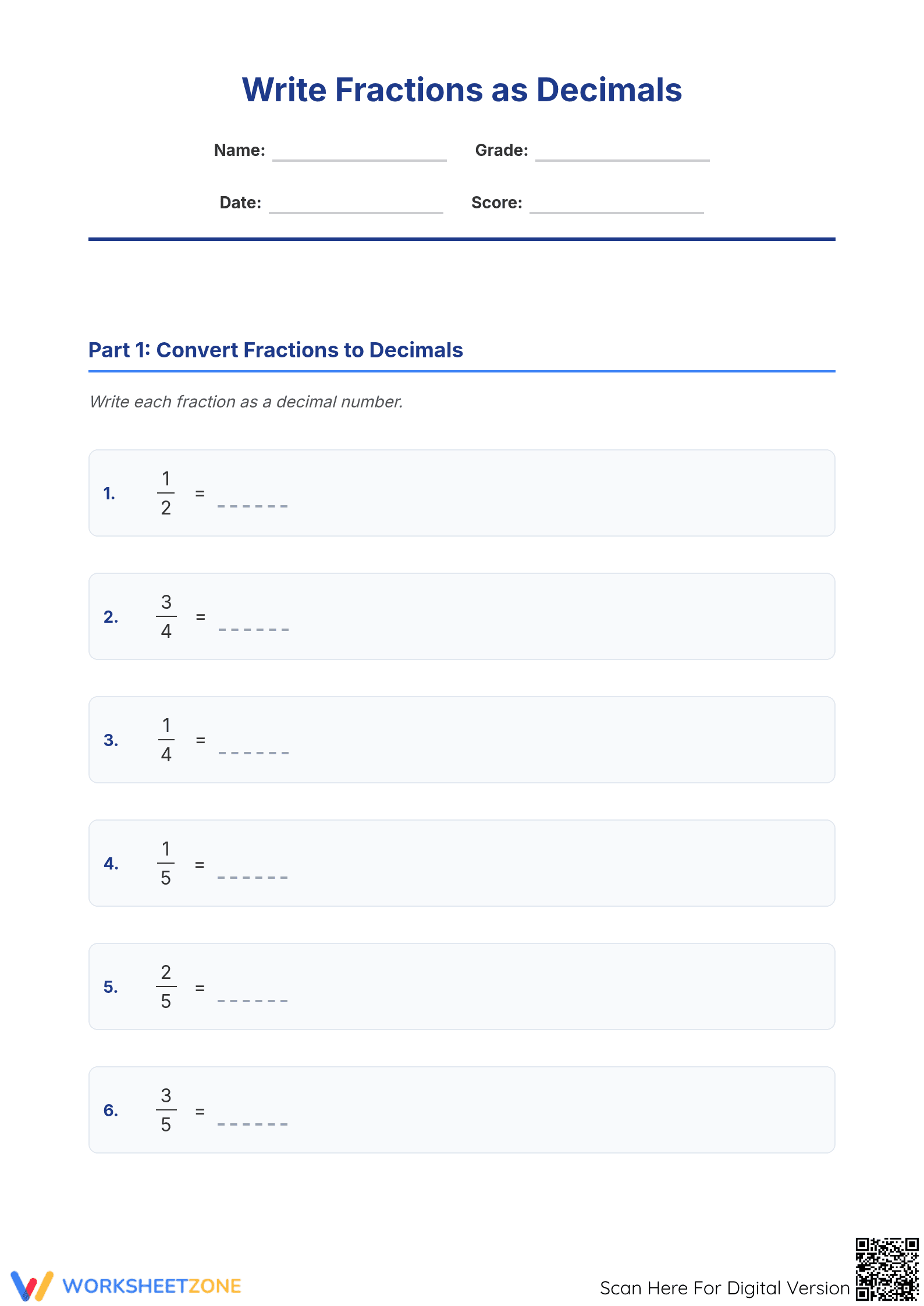
This comprehensive worksheet helps Grade 5 students master converting fractions and decimals through targeted, differentiated practice. With three distinct levels of complexity, from basic terminating decimals to more challenging repeating decimals, students can build confidence and skill at their own pace, ensuring a solid foundation in number sense and equivalency.
At a Glance
- Grade: 5 · Subject: Math
- Standard:
CCSS.MATH.CONTENT.5.NF.B.3— Interpret a fraction as division of the numerator by the denominator.- Skill Focus: Converting Fractions and Decimals
- Format: 3 pages · 72 problems · Answer key included · PDF
- Best For: Differentiated practice, station work, or targeted review
- Time: 20–35 minutes
What's Inside
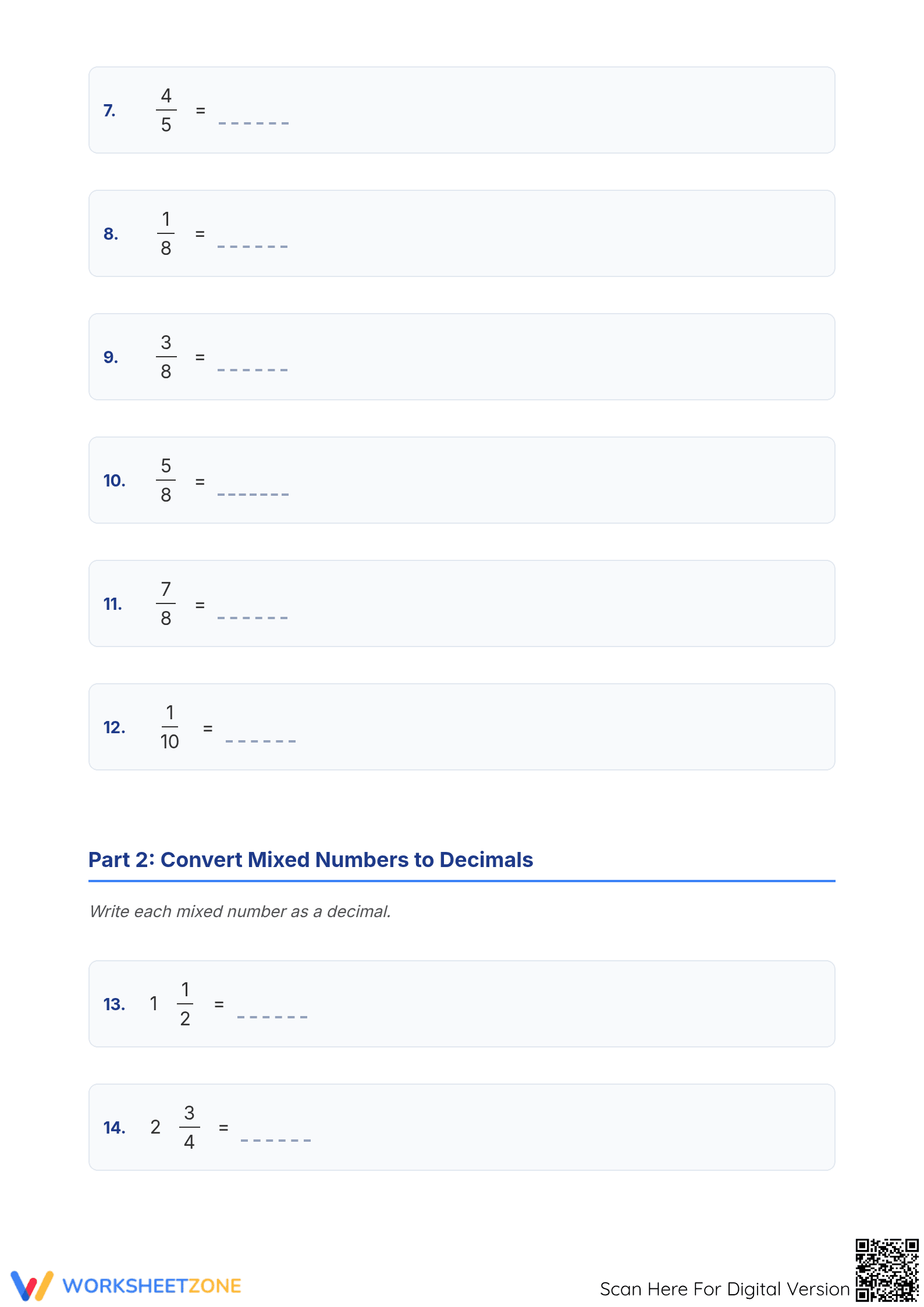
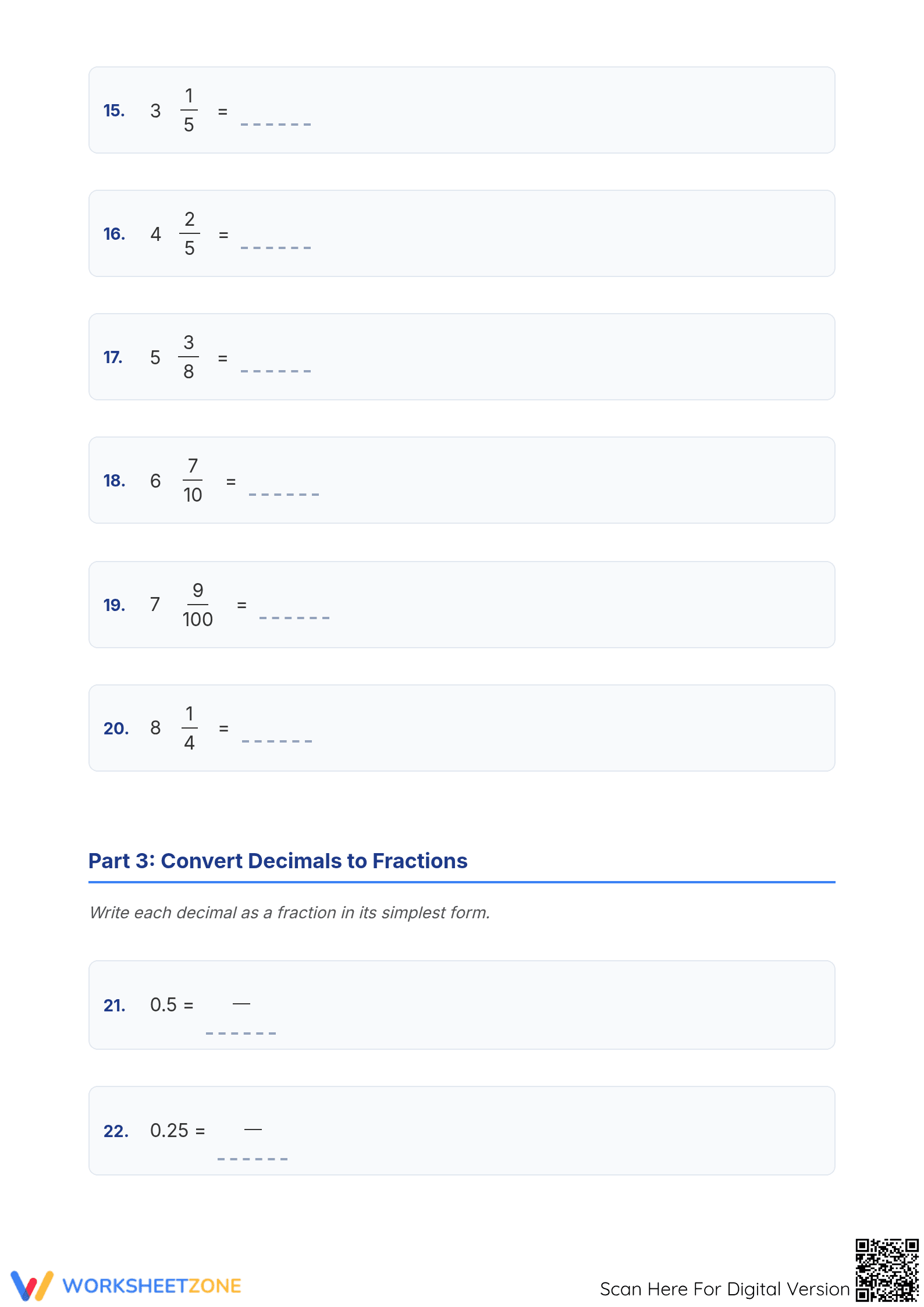
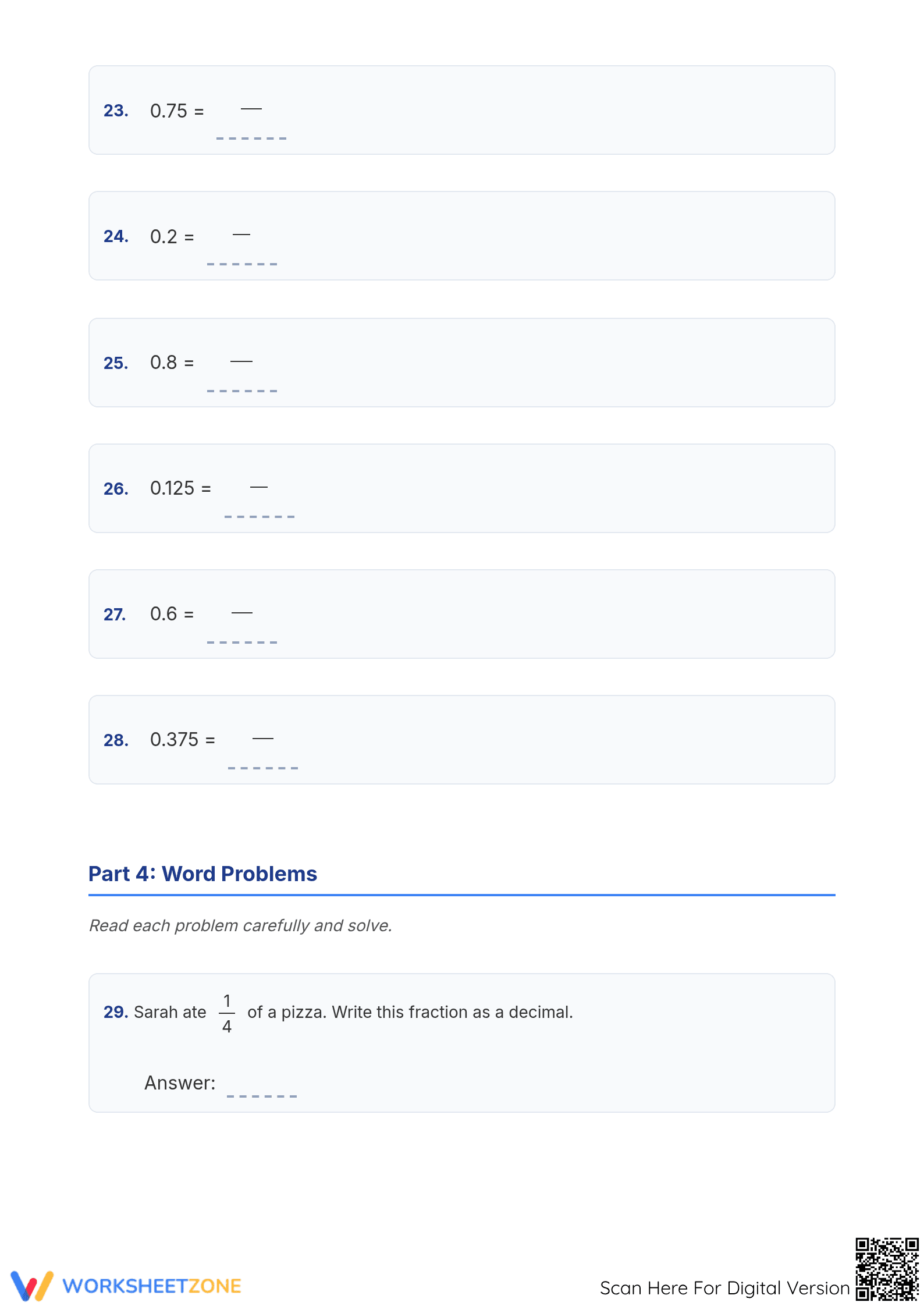
This resource includes three single-page worksheets, each with 24 problems converting between fractions and decimals. A complete two-page answer key is provided for easy grading. The clean layout and clear instructions allow students to work independently.
Differentiated for Every Learner
This resource provides three versions of the worksheet:
- Below Grade Level: Focuses on fractions with denominators that are factors of 10 and 100 (e.g., 5, 10, 25), providing a scaffolded entry point.
- On Grade Level: Introduces fractions with a wider range of denominators (e.g., 8, 40) that result in terminating decimals, requiring more complex division.
- Above Grade Level: Challenges students with fractions that convert to repeating decimals (e.g., denominators of 3, 9, 11), requiring pattern recognition and correct notation.
All three versions are included, allowing teachers to assign the appropriate level to each student.
Standards-Aligned for Your Classroom
This worksheet directly supports CCSS.MATH.CONTENT.5.NF.B.3, where students "interpret a fraction as division of the numerator by the denominator (a/b = a ÷ b)." This is key for converting fractions to decimals and also reinforces skills from CCSS.MATH.CONTENT.5.NBT.A.3 (decimal understanding). Both standard codes can be copied directly into lesson plans or curriculum maps.
Flexible for Any Lesson Plan
This set is highly versatile. Use it for independent practice after a lesson on fractions and decimals. The differentiated levels make it great for math stations or small group work. For a quick formative assessment, observe students' strategies on the 'On Grade Level' sheet. Can they use long division correctly? Each sheet can be completed in 20 to 35 minutes.
Designed for the Grade 5 Classroom
Primarily for 5th-grade students, this resource also suits advanced 4th graders or 6th graders needing review. The leveled approach supports diverse learners. Pair this worksheet with a decimal place value chart to give students a visual tool as they work on conversions.
Developing fluency between fractions and decimals is a critical gateway to algebraic thinking. This worksheet provides focused practice on the core skill outlined in CCSS.MATH.CONTENT.5.NF.B.3: understanding a fraction as a division problem. Research from RAND AIRS 2024 highlights the importance of procedural fluency built upon conceptual understanding, a balance this resource strikes through its varied problem sets. By moving from simple to complex conversions, including terminating and repeating decimals, students internalize the process that a fraction a/b is equivalent to a ÷ b. This procedural practice, when combined with a strong conceptual lesson, has been shown to improve student outcomes on number system tasks. The ability to see and manipulate numbers in different forms is a key predictor of success in higher-level mathematics, making this skill essential for all middle-grade learners.


